Find the amount in 9 g of water. Use molar mass 18 g/mol.
- Use n = m/M.
- n = 9/18 = 0.5.
- There are 0.5 mol of water.
Common mistakes to check
- Changing subscripts to balance an equation
- Using millilitres in a concentration formula that requires litres
Your Australian school pathway · Noble Educators
Chemistry tutoring for TCE students pairs a subject specialist with the way TASC actually assesses: criterion-based course assessments during the year and external assessment in Level 3 and 4 courses at the end. One-on-one lessons work on the student's current Chemistry topic, their next TCE assessment and the specific parts of the course that have stopped feeling secure. Tasks arrive as evidence against named criteria rather than as percentage-weighted tests, so nothing is ever simply worth ten per cent. That is why the opening fortnight of TCE Chemistry lessons maps the whole term's calendar before any drilling begins.

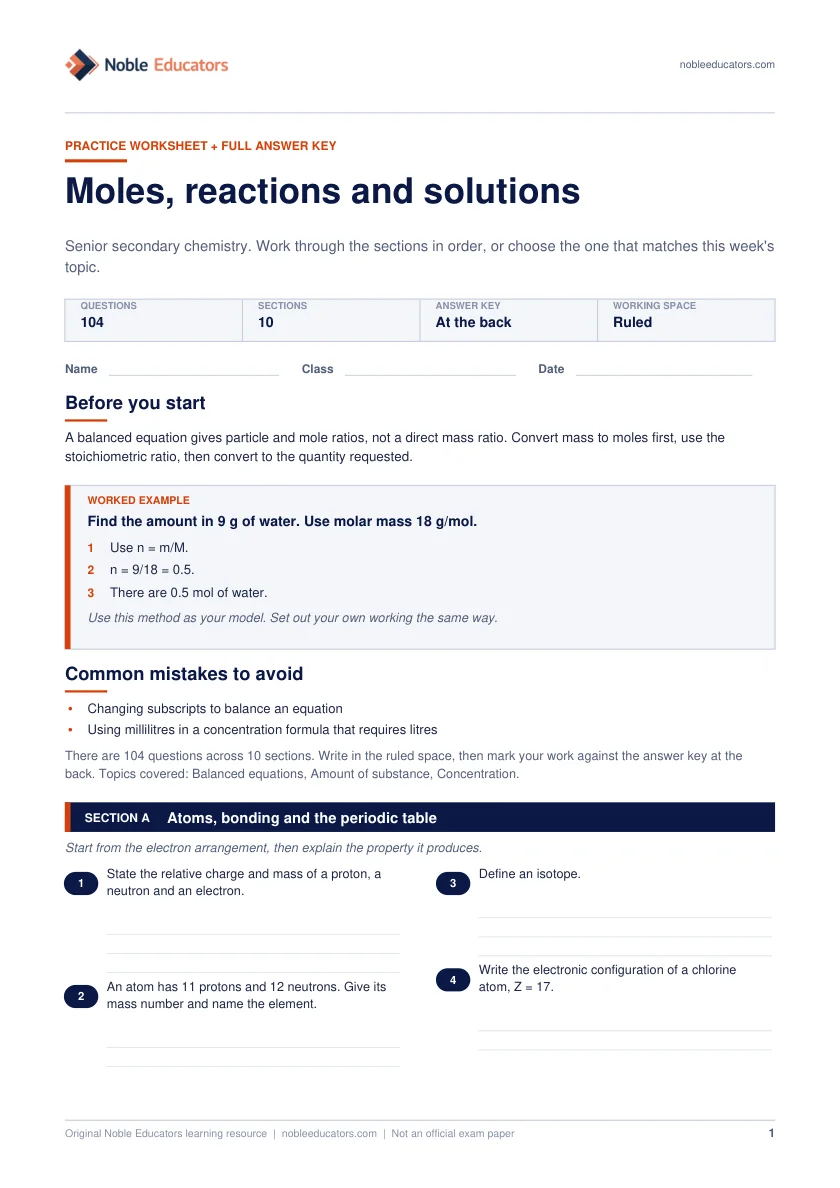 Preview the worksheet
 Senior secondary chemistry. A focused topic sample with space to work and an answer key for checking your reasoning.
Original Noble Educators practice. Not an official exam paper or a complete course syllabus.
1
The first session finds what is actually breaking down — missing content, a weak method, or lost confidence — because practising the wrong thing wastes a term.
2
Lessons aim at the student's next school task — a SAC, assessment, trial, NAPLAN window or exam block — not a generic syllabus order.
3
Timed where the task is timed, written where it is written, with the calculator and formula rules the real assessment uses.
4
After lessons, parents get plain-language notes: what was covered, what improved, and the next piece of work — no jargon, no guesswork.
TCE Chemistry fails students in a specific way: they follow classwork comfortably, then multi-step questions — moles into limiting reagents into concentration — collapse under exam conditions. Tutoring rebuilds that TCE calculation chain one link at a time, with the unit-tracking habits that stop small slips cascading.
The explanation marks in TCE Chemistry live at the particle level. Lessons train the discipline of answering what happens, then why, in terms of particles, bonds and energy — the structure TCE marking schemes reward — instead of circular restatements of the question.
Stoichiometry is the spine of TCE Chemistry, and almost every calculation question routes through it somewhere. A student who moves confidently between mass, moles, concentration and volume answers TCE questions that look entirely unrelated using the same three lines of working.
Equilibrium is where TCE Chemistry students most often write a plausible sentence that earns nothing at all. Le Châtelier explanations need a stated change, a stated shift and a stated consequence in that order, and TCE marking schemes reward the sequence rather than the conclusion on its own.
Organic chemistry rewards structure over memory in the TCE: functional groups behave predictably, and reaction pathways become navigable once a student groups reactions by what they do rather than by chapter order. Lessons build one pathway map that the TCE student keeps and extends across the whole year.
Practical work feeds a real share of TCE Chemistry assessment, volumetric analysis most of all. Titration calculations, sources of error and the reasoning behind each procedural step all appear in TCE tasks, so tutoring rehearses the arithmetic until it survives both time pressure and a messy data set.

Bonding and structure open the TCE Chemistry course and quietly explain almost everything after them. Intermolecular forces, lattice types and molecular shape determine solubility, boiling point and reactivity, so a TCE student who understands them predicts properties instead of memorising tables of them.
Quantitative chemistry is the load-bearing middle of the TCE Chemistry course. Moles, limiting reagents, concentration, gas calculations and titration analysis appear in TCE assessment again and again, and the gap between a strong and an average result is usually arithmetic discipline rather than conceptual insight.
Equilibrium, acids and bases, redox and organic chemistry complete the TCE Chemistry course and carry the hardest explanation marks. Each of those TCE topics asks a student to describe a particle-level cause and a measurable effect in one answer, which is a writing skill as much as a chemistry one.
These are the recurring pressure points tutors see in TCE Chemistry work, and they are diagnostic rather than universal — most students carry two or three of them, not the whole list. The first Chemistry session identifies which ones apply before any drilling starts, because practising the wrong TCE weakness is how a family loses a term.
Several of these TCE Chemistry weaknesses are structural rather than topical. A student who leaks marks through presentation, timing or misread instructions will keep leaking them in every TCE task until the habit itself changes, which is why lessons treat those as a skill to be taught rather than as carelessness to be scolded.
The list is worth revisiting at each TCE reporting point, because weaknesses migrate. A Chemistry gap closed in Term 1 is often replaced by a new one as the TCE course reaches material that assumes the first is now automatic and unremarkable.
Every TCE Chemistry result is assembled from more than one kind of evidence, and each kind rewards a different habit. Through the year the school runs criterion-based course assessments, alongside external assessment in Level 3 and 4 courses; in TCE Chemistry, internal criterion ratings and external assessment combine into one award rather than a percentage split.
Because tasks arrive as evidence against named criteria rather than as percentage-weighted tests, so nothing is ever simply worth ten per cent, no fortnight of the TCE year is genuinely free. Tutoring reads the published task schedule against the Chemistry topics each task draws on, so preparation for a TCE assessment begins three weeks out instead of three nights out.
Achievement is reported as criterion ratings that combine into an award running from Satisfactory Achievement to Exceptional Achievement, and TASC verifies internal criterion ratings, and external assessment confirms the result in Level 3 and 4 courses. That mechanism explains more about a TCE Chemistry report than the number printed beside it, because it is the reason a comfortable class mark can still move once the whole cohort is compared.
Lessons therefore run in two modes. One builds Chemistry understanding; the other rehearses the response formats a TCE assessor is instructed to reward, which is the half students rarely practise alone and where the recoverable Chemistry marks usually sit.
Because evidence accumulates against each course criterion across the whole year, weekly Chemistry lessons alternate between the topic being taught in class and maintenance of the earlier material that TCE assessment still draws on. As each criterion-based course assessments approaches, sessions shift to timed Chemistry practice and targeted review of the student's error log; once results come back, the tutor rebuilds whatever that task exposed. Approaching November for externally assessed courses, preparation moves to full-length Chemistry papers under TCE conditions.
The maintenance half of that cycle is the part most TCE students skip. Earlier Chemistry topics decay quietly while attention sits on the current chapter, so each lesson spends a short block revisiting older material — enough to keep it retrievable under TCE conditions, not enough to crowd out the work immediately in front of the student.
Holidays are used differently again. A break is the only stretch long enough for a TCE Chemistry student to rebuild an entire topic from its foundations, so it is spent on the single area the term could only patch rather than on a general review of everything at once.
Term 1 is where a TCE Chemistry year is quietly decided, because criterion evidence starts accumulating in Term 1, and a criterion left untouched early is awkward to rescue late. Lessons in this phase are deliberately diagnostic: they find which prerequisite Chemistry skills are missing while the TCE course is still close enough to its starting point for repairs to be cheap.
By the middle of the year the TCE Chemistry course has reached its harder centre section, and students who were coping start to feel the load. The year's rehearsal then arrives in the form of the practice examinations Tasmanian colleges run through Term 3, and a sensible TCE Chemistry program reshapes around that date — preparation first, then an honest reading of what it exposed.
The weeks after the college practice examinations are the repair window for TCE Chemistry. Whatever the rehearsal exposed gets rebuilt while rebuilding is still realistic, and any TCE topic that was memorised rather than understood is re-taught until it survives an unfamiliar Chemistry question.
From November for externally assessed courses, TCE Chemistry work becomes almost entirely about execution — timing, transcription accuracy, and the discipline of leaving a hard question early rather than feeding it ten minutes it will never repay.
A lesson opens with the student's own material rather than a generic worksheet — the current TCE Chemistry chapter, the last returned task, and the question set the class was given this week. That keeps the hour anchored to what the school is actually assessing for the TCE, instead of to a parallel Chemistry course of the tutor's own design.
The tutor then works one Chemistry problem or paragraph aloud, hands the next one straight back, and watches the working rather than the answer. Most TCE marks are lost inside the method, so the method is precisely what the lesson is built to observe.
Because TASC specifies the calculator and materials permitted in each externally assessed course, lessons rehearse the tool conditions a TCE Chemistry task will impose rather than letting a student practise only in whichever mode feels comfortable. Moving between those modes on the same Chemistry question is a skill the TCE assessments quietly test.
The closing minutes set the week: two or three specific Chemistry tasks chosen because they target the gap this lesson found, not because they finish a chapter. Parents receive a short written note covering what was done and what the TCE student is working towards before the next session.
The first signal is not a mark. It is that a TCE Chemistry student starts describing what a question is asking before attempting it, which is the habit separating an average response from a strong one under TCE marking.
The second signal is a shrinking TCE Chemistry error log. Tutors keep a running list of the specific Chemistry mistakes a student makes, and in a program that is working the same entry stops reappearing across three or four consecutive TCE tasks.
The third signal is the reported TCE Chemistry result, delivered as criterion ratings that combine into an award running from Satisfactory Achievement to Exceptional Achievement. It lags the other two by a full assessment cycle, because TCE Chemistry evidence accumulates slowly, and families watching only this number tend to change tutors about a month before the change would have shown.
No honest TCE Chemistry tutor will promise a number in advance. What can be committed to is the process — weekly Chemistry contact, work marked with specific written feedback, and an accurate reading of where the student currently sits against TCE standards.
Very few parents can help with senior Chemistry content, and attempting it usually costs more goodwill than it earns. What genuinely helps under the TCE is logistics: knowing the assessment dates, protecting the study block, and noticing early when a subject has quietly stopped making sense.
Ask for the TCE assessment schedule and put it somewhere visible. Because tasks arrive as evidence against named criteria rather than as percentage-weighted tests, so nothing is ever simply worth ten per cent, a family that knows what lands in week six behaves very differently in week three from a family that discovers it the weekend before.
The more useful question after a returned TCE Chemistry task is not how it went but what the feedback said. A marked task carries specific comments, and a TCE student who can paraphrase them has understood something the mark by itself never communicates.
It also helps to know how the subject travels into tertiary selection, since Level 3 and 4 course results are scaled into the ATAR, so the pre-tertiary course choice made in Year 11 matters early. That context stops one disappointing TCE Chemistry task from being read at home as the end of a pathway.
Subject selection shapes a TCE outcome more than most families expect, and Chemistry is one of the choices worth thinking through properly. Under the TCE, most Tasmanian students move to a senior secondary college for Years 11 and 12, changing campus, teachers and routine at once, which limits what can still be changed once the year is underway.
The honest test is not interest alone but current fluency in the prerequisites, because the TCE Chemistry course moves at a pace that assumes those are already automatic. One diagnostic Chemistry session usually settles the question faster than another TCE term of hoping it resolves itself.
Dropping a TCE subject is sometimes correct and sometimes an expensive overcorrection. Because Level 3 and 4 course results are scaled into the ATAR, so the pre-tertiary course choice made in Year 11 matters early, the arithmetic of dropping TCE Chemistry deserves to be worked through on paper rather than settled in the week after a single poor result.
Prerequisites matter too: some degrees name Chemistry or a companion course as assumed knowledge, so the UTAS prerequisite guide is worth reading a year before it feels urgent to a TCE family.
Senior certificate subjects are booked at the Year 11 or Year 12 rate, depending on where the student currently sits.
Booking a block reduces the per-session rate: 5% from 8 sessions, 8% from 12 sessions, 12% from 15 sessions, 15% from 20 sessions. At 12 sessions, Year 11 works out to $20.24 per session. The first lesson is free and there is no lock-in contract.
Students preparing for UCAT ANZ alongside senior subjects are booked at the Special Prep rate for that component, because the reasoning and timing work sits outside the school syllabus.
See the full rate cardOnline 1-on-1, a private in-person tutor and a tutoring centre are genuinely different products, and the cheapest is not automatically the right one. These are the typical advertised rates for each in Australia.
| Option | Typical cost per session | Format |
|---|---|---|
| Noble Educators | $12–$34 | 1-on-1, live |
| Private in-person tutor | $40–$100 | 1-on-1, in person |
| Tutoring centre | $45–$90 | Small group, sometimes 1-on-1 |
| Online marketplace tutor | $30–$70 | 1-on-1, live |
Ranges describe typical advertised rates for each type of tutoring in Australia and are provided as general guidance only. They are not quotes from specific providers, and actual prices vary by tutor, year level, subject, location and session length. Compare current published pricing directly before deciding.
See the full cost comparisonThe tutor match works from evidence, not a job title. Anything from the list below gives the first session a concrete starting point instead of a cold diagnostic.
Progress a parent cannot see is progress they cannot support. Reporting is part of the service, not an add-on you have to chase.
Assessment rules, dates and syllabus documents change. Whenever a decision depends on them, confirm the detail with the body that sets it — these are the official sites for this page.
Noble Educators is an independent tutoring provider and is not affiliated with, endorsed by or accredited by any of these organisations. Their sites are always the source of truth for official requirements.
Start with a free demo
Tell us the student's state, year level, subject and goal. We will recommend a tutor and a practical first lesson plan.