Exam preparation
HSC tutoring
Explore support for senior subjects in New South Wales.
Explore supportONLINE TUTORING FOR AUSTRALIAN STUDENTS
One-to-one online tutoring for Australian school subjects and senior certificates. Find a learning plan that fits your year level, state curriculum and school week.
Meet your tutor. Share your goals. Build your plan.

FIND YOUR STARTING POINT
Your year level and state help us understand what you are studying. For senior school, choose your certificate and subject so your lessons match the course you take.
9 learning pathways · showing 6
Explore support for senior subjects in New South Wales.
Explore supportBuild understanding and practise for your Victorian senior courses.
Explore supportWork through maths concepts with examples and guided practice.
Explore supportExplore learning areas and support across Foundation to Year 10.
Explore supportDevelop reading, writing and communication skills for school.
Explore supportBuild the literacy and numeracy skills used in NAPLAN questions.
Explore support










Noble Educators is an independent tutoring provider. Logos and name marks are shown to indicate the curricula and assessments we support. We are not affiliated with, endorsed by, or accredited by any of these organisations.
Pick your state or territory to see the senior certificate, curriculum authority, admissions centre and the Foundation-year name your school uses.
New South Wales
Foundation year is called Kindergarten. Lessons are planned around AEST/AEDT; this state observes daylight saving.
What changes in New South Wales: School assessment marks are moderated against external exams. Admissions run through UAC, and the syllabus is set by NESA.
Students need the right kind of practice at the right time: foundations before NAPLAN, assessment evidence during the year, and timed response habits before major exams.
March test-window preparation across reading, writing, conventions of language and numeracy. Tutors use the four proficiency standards - Exceeding, Strong, Developing and Needs additional support - to explain progress without creating panic.
NAPLAN tutoringSupport for VCE scaled study scores, HSC moderated assessment plus external exams, QCE subject assessments and state senior certificates. We practise exam language, timing and correction habits without promising guaranteed ranks.
How the ATAR worksPreparation for NSW Selective High School Placement Test, NSW OC Test, VIC Selective Entry High School Exam, ACER Cooperative Scholarship Testing Program, Edutest and AAS.
Selective and scholarship testingStructured reasoning and timing support for UCAT ANZ, ISAT, CASPer and LANTITE, with study routines that sit alongside Year 11 or Year 12 workloads.
Explore admissions and professional testsFind the relevant test, subject guidance, practice resources and next steps.
The national curriculum covers English, Mathematics, Science, HASS, The Arts, Technologies, Health and Physical Education, and Languages. We connect the national skill to the student's current school task.

Reading, writing, speaking, listening and text analysis from Foundation to Year 12.
View support
Number, algebra, measurement, geometry, statistics, probability, calculus and modelling.
View support
Biology, chemistry, physics and scientific inquiry with stronger evidence-based responses.
View support
History, geography, civics, citizenship, economics and business thinking.
View support
Creative practice, analysis, folios and performance reflection across arts disciplines.
View support
Digital technologies, design thinking, coding, systems and project documentation.
View support
Health literacy, movement analysis, wellbeing concepts and assessment writing.
View support
Vocabulary, grammar, speaking confidence and intercultural communication practice.
View supportA Year 3 NAPLAN plan should not look like Year 10 subject recovery, and Year 12 tutoring needs to respect the assessment calendar.
Foundation to Year 12 is one continuous run, but families usually meet it one deadline at a time. This is the map.
Australian schooling has a shape, and most of the pressure families feel comes from meeting a stage without knowing it was coming. Here is the whole run, and what actually changes at each point.
Step 1 · Foundation to Year 2
Every state teaches to the Australian Curriculum, even where the certificate at the end differs. The first years are about decoding, number sense and the habit of explaining an answer out loud. Nothing is examined, which makes it the cheapest time to fix a gap.
Step 2 · Years 3 and 5
NAPLAN arrives in Term 1 — your school will confirm the exact sitting. It reports reading, writing, language conventions and numeracy against four proficiency standards, and it is a snapshot rather than a verdict. What matters is whether Year 3 and Year 5 show the same gap twice.
Step 3 · Years 4 to 6
Families considering selective, OC and scholarship testing usually decide in this window, because the tests sit a year ahead of entry. These exams reward reasoning under time pressure, which is a different skill from doing well in class. Plenty of strong students choose not to sit them, and that is a legitimate answer.
Step 4 · Years 7 and 9
By Year 7 a student has separate teachers with separate expectations, and by Year 9 the maths that senior subjects assume — algebraic fluency, proportional reasoning — is either in place or it is not. This is the last stretch where a gap can be closed without it costing subject choice.
Step 5 · Year 10
Subject selection happens here, and it is the decision families most often make with the least information. A senior maths or science sequence usually assumes particular Year 10 work, so dropping a subject now can close a university prerequisite two years out. Year 10 tutoring is as much about keeping options open as about marks.
Step 6 · Years 11 and 12
Senior study runs on two clocks: the school assessment calendar and the external exam. How they combine is the one thing that genuinely differs by state, which is why Year 11 and Year 12 plans start from the certificate rather than the subject. The ATAR is a rank, not a mark — it describes a position in a cohort, so it depends on how everyone else went as well as on the student. That is precisely why no tutor can promise one.
No stage on this list is a cliff. The students who find senior school manageable are usually the ones whose gaps were closed two or three years earlier, when the work was smaller and nobody was panicking.
Live whiteboard sessions, recordings you can revisit, and progress reporting that shows a parent what changed and what is next.
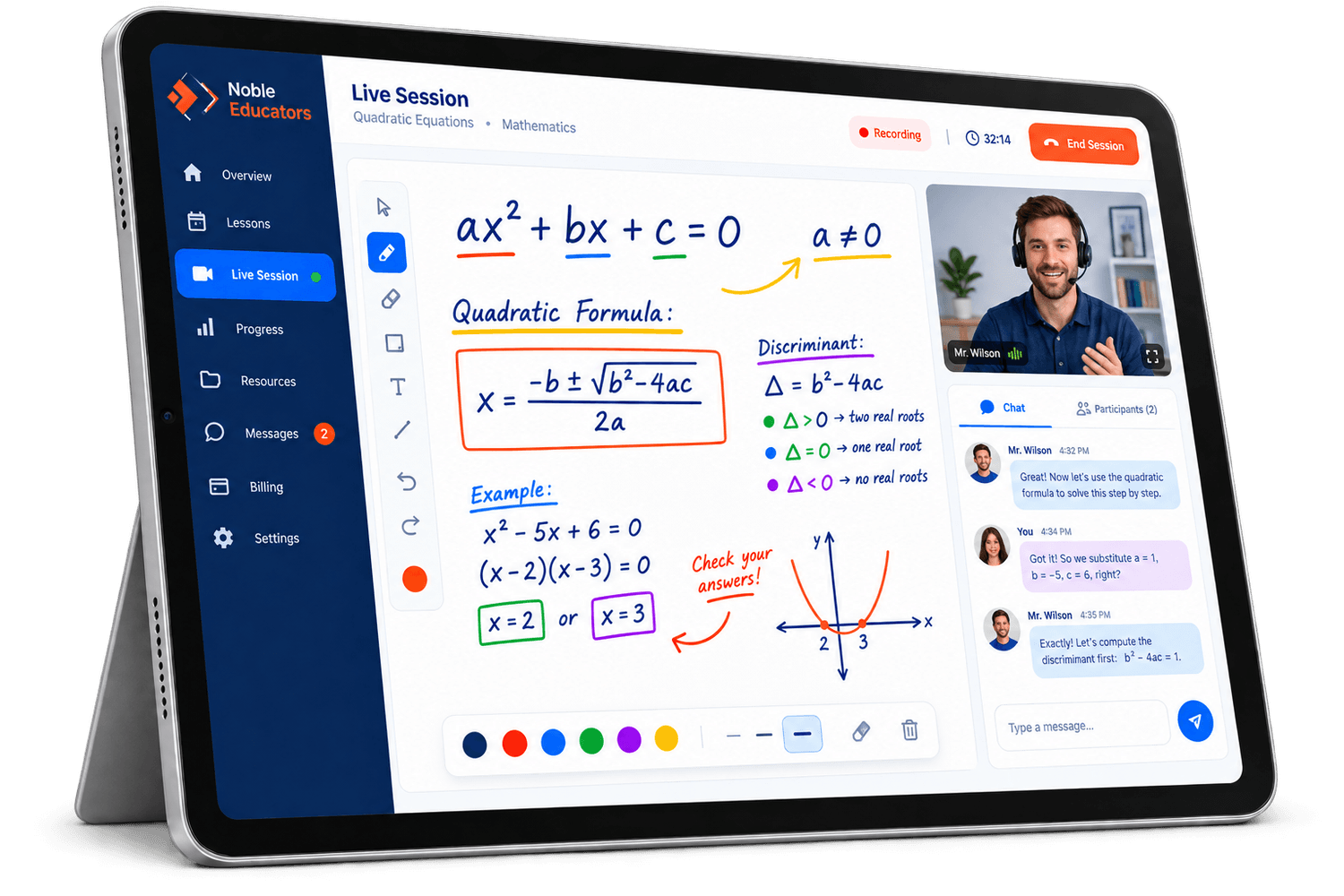
Lessons run on an interactive whiteboard where the tutor works through problems in real time and the student writes alongside them. Sessions can be recorded, so the working stays available afterwards rather than disappearing when the call ends.
Every year level has a published per-session rate. Start with the first lesson free, then book single sessions or a discounted block.
| Year level | Stage | Per session (AUD) |
|---|---|---|
| Year 1 | Primary | $12 |
| Year 2 | Primary | $13 |
| Year 3 | Primary | $14 |
| Year 4 | Primary | $15 |
| Year 5 | Primary | $16 |
| Year 6 | Primary | $17 |
| Year 7 | Middle years | $18 |
| Year 8 | Middle years | $19 |
| Year 9 | Middle years | $20 |
| Year 10 | Middle years | $21 |
| Year 11 | Senior secondary | $22–$24 |
| Year 12 | Senior secondary | $26 |
| Special Prep | Exam preparation | $28–$34 |
Rates are per 1-on-1 live session in Australian dollars. Year 11 varies with subject complexity, and exam preparation covers selective, scholarship and admissions testing including UCAT ANZ.
Per-session rates are easy to compare and hard to budget against. These are two ordinary bookings priced from end to end, using the same rate card and the same automatic discounts.
One session a week across a term, which is the usual pattern for keeping up rather than catching up.
The first lesson is free, so the first block is effectively one session cheaper than this.
A shorter block aimed at one assessment run or an exam period, rather than the whole year.
The first lesson is free, so the first block is effectively one session cheaper than this.
$12–$17
per session, AUD
Foundational literacy and numeracy, homework support and confidence.
$18–$21
per session, AUD
Subject depth, assessment habits, NAPLAN and pre-senior readiness.
$22–$26
per session, AUD
Certificate subjects, assessment tasks, exam technique and ATAR planning.
$28–$34
per session, AUD
Selective, scholarship and admissions test preparation, including UCAT ANZ.
Ready to compare options?
Share the student's year, state and subject. We will confirm the AUD rate, available tutor options and how the free demo would be structured.
Every Australian year level is covered, from $12 per session in Year 1 to exam preparation at $28–$34. Ask us for a written quote before booking so the rate, session length and any block discount are confirmed in writing.
Get to know our approach, explore tutor profiles and hear from families who choose to share their experience.
Discuss your child's goals, meet a tutor in a free demo and see how their teaching approach fits. You can also explore feedback shared on our reviews page.
Tell us your subject, year level and senior certificate. We’ll help you find a tutor whose teaching experience fits your course and learning goals.
Mathematics, English Language Arts
Bharti Ahuja is a results-driven Maths & English (ELA) tutor holding an M.Com with B.Ed, Certified Reading Instructor (Indiana Department of Education), known for making Mathematics, English Language Arts, Business Studies and SAT Prep clear and enjoyable. Bharti teaches Maths and ELA for Grades 3–10 across IB, US Common Core, Cambridge, Australian and New Zealand curricula, along with SAT (English & Math), NAPLAN and IGCSE Business Studies. With individual attention in every live one-on-one class, students gain concept clarity, smart exam strategies and consistent practice aligned to IB, US Common Core, IGCSE, Australian and other boards. Reserve a free demo session with Bharti to see the difference.
Sessions are online, so the tutor is chosen for the subject rather than the postcode. What changes by city is the senior certificate, the assessment calendar and the clock a lesson is booked against.
Every family starts with a conversation. The plan then becomes specific to the student's state, subject, school calendar and confidence level.

Tell us the student's state, year level, subject, assessment dates and what currently feels hard.
We match for curriculum knowledge, subject level, teaching style and Australian time zone.
The tutor builds a plan around class topics, school rubrics, NAPLAN skills, SACs, trials or exam goals.

Parents receive useful updates: what improved, what needs practice and what happens next.
The point is not to sound bigger than the student's problem. It is to make the next piece of learning clear, practised and visible.
Tutors start with the student's state, certificate and current school topic, then explain how skills connect to the assessment language used in class.
Students get direct next steps they can practise. Parents get concise progress notes that explain what is improving and what still needs support.
Recurring lessons account for AEST/AEDT, ACST/ACDT and AWST, including states that do not observe daylight saving.
Students can request VCE, HSC and QCE specialists for subjects such as Mathematical Methods, Extension maths, English, Biology, Chemistry, Physics, Economics and Legal Studies.
We align tutor screening with relevant Australian child-safety checks, including WWCC, Blue Card and WA Working with Children Card requirements.
We focus on teaching quality, practice and reporting. We do not promise guaranteed ATAR increases or guaranteed exam results.
Online 1-on-1, a private in-person tutor and a tutoring centre are genuinely different products. Here is how they compare on cost and on what you give up.
| Option | Typical cost per session | Travel | Format | What to weigh up |
|---|---|---|---|---|
| Noble Educators | $12–$34 | None — lessons are online | 1-on-1, live | Requires a reliable connection and a quiet space at home. Best suited to students who can work with a tutor on screen rather than side by side. |
| Private in-person tutor | $40–$100 | Travel by tutor or family | 1-on-1, in person | Face-to-face contact suits some younger students and hands-on subjects. Rates usually rise with year level, and travel time is billed or built into the hourly rate. |
| Tutoring centre | $45–$90 | Family travels to the centre | Small group, sometimes 1-on-1 | Structured programs and peer environment, but attention is shared and session times are fixed. Enrolment periods and term commitments are common. |
| Online marketplace tutor | $30–$70 | None — lessons are online | 1-on-1, live | Wide choice and competitive rates, but screening, curriculum knowledge and reporting vary by individual tutor rather than being provided by the platform. |
If a student will not work unless they are physically somewhere else, with other students doing the same thing, a centre buys that structure. It is the one thing an online session genuinely cannot replicate, and no amount of scheduling discipline substitutes for it.
Hands-on subjects, students who need someone physically beside them to stay on task, and families who want a face-to-face relationship. You are paying for travel time in the rate, but for some students that is the difference between a session working and not working.
No one is in the room. A student who needs supervision to start work will need a parent nearby for the first few sessions. In exchange you get a tutor matched on the subject and certificate rather than on who lives within driving distance — which matters most for senior subjects, where the local pool is thin.
Ranges describe typical advertised rates for each type of tutoring in Australia and are provided as general guidance only. They are not quotes from specific providers, and actual prices vary by tutor, year level, subject, location and session length. Compare current published pricing directly before deciding.
Families should never need to guess how tutors are checked, how student data is handled or what happens if a lesson needs to move.

We recognise state systems including VIC, NSW, SA, TAS, ACT and NT WWCC processes, Queensland Blue Card and WA Working with Children Card.
ABN details should be displayed in launch content and invoices so families know who they are engaging.
Student notes, parent contact details and under-18 learning data are handled with Privacy Act 1988 and Australian Privacy Principles awareness.
Families should see clear rescheduling, cancellation and refund terms before committing to ongoing tutoring.
Recording is opt-in and clearly disclosed. Tutors should never record a minor without appropriate consent and purpose.
Printable, black-and-white PDFs designed to be used away from a screen — work through one with a pencil, then bring it to a tutoring session.
These are independent Noble Educators resources, not official NAPLAN, ACARA or certificate-authority material. Confirm current dates and requirements with the relevant official body.
Assessment rules, dates and syllabus documents change. Whenever a decision depends on them, confirm the detail with the body that sets it — these are the official sites for this page.
Noble Educators is an independent tutoring provider and is not affiliated with, endorsed by or accredited by any of these organisations. Their sites are always the source of truth for official requirements.
These tools are designed to support better conversations about effort, timing and pathways, not to promise guaranteed results.
Plan target ranks, prerequisites and subject effort without overclaiming outcomes.
Open toolModel scaled study score scenarios for VCE revision planning.
Open toolEstimate how school assessment and external exam performance can interact.
Open toolOrganise Year 3, 5, 7 or 9 practice around the four proficiency standards.
Open toolMap lessons, holidays, SACs, trials and exam blocks across Term 1-4.
Open toolOne short form. We reply with a suggested tutor and a first-lesson plan, and the first lesson is free.
The more specific you are, the better the tutor match. The first lesson is free, and nothing here commits you to booking.
Start with a free demo
Tell us the student's state, year level, subject and goal. We will recommend a tutor and a practical first lesson plan.
Jump straight to a certificate, learning area, year level, city or planning tool.