
Your Australian school pathway · Noble Educators

    Humanities and Social Sciences tutoring for Australian students

    Humanities and Social Sciences covers history, geography, civics and citizenship, and economics and business — a group united by evidence-based argument. In senior years these become some of the most popular ATAR subjects, and they reward students who can deploy specific evidence rather than general knowledge.

    Book a free demo
    Student working through a lesson in a notebook beside a laptop
    Live, one-to-one learningNoble Educators
    Understand it. Try it. Review it.

    Put your humanities and social sciences learning into practice.

    Worked example · Scientific enquiry and explanations

    A student tests how water temperature affects dissolving time. What should stay the same?

    1. Change temperature as the independent variable.
    2. Measure the time for a fixed amount of solute to dissolve.
    3. Keep the solute mass, water volume and stirring method the same.
    Common mistakes to check
    • Calling every variable an independent variable
    • Drawing a conclusion without referring to results
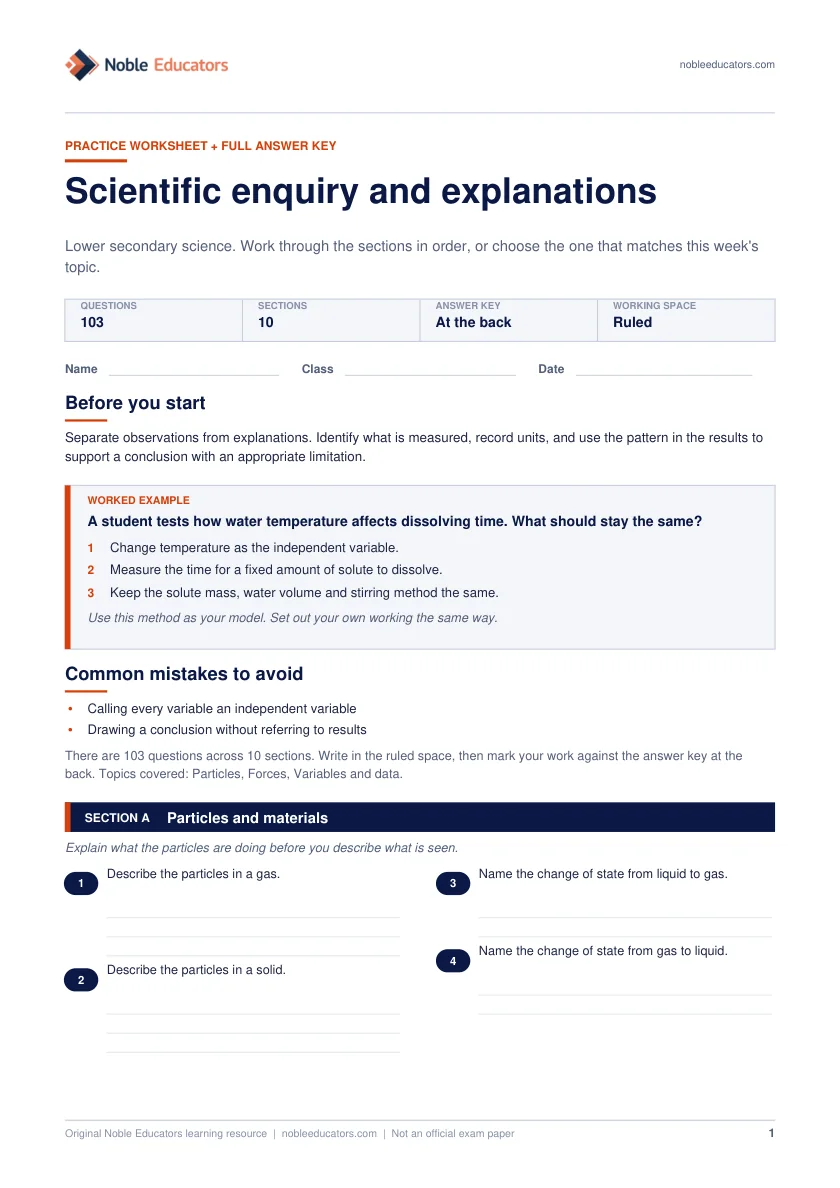
    First page of the Scientific enquiry and explanations worksheetPreview the worksheet
    Free PDF · 6 activities · Answers included

    Scientific enquiry and explanations

    Lower secondary science. A focused topic sample with space to work and an answer key for checking your reasoning.

    Download worksheet Preview questions and answers

    Original Noble Educators practice. Not an official exam paper or a complete course syllabus.

    1

    Diagnose before drilling

    The first session finds what is actually breaking down — missing content, a weak method, or lost confidence — because practising the wrong thing wastes a term.

    2

    Plan to the real calendar

    Lessons aim at the student's next school task — a SAC, assessment, trial, NAPLAN window or exam block — not a generic syllabus order.

    3

    Practise under matching conditions

    Timed where the task is timed, written where it is written, with the calculator and formula rules the real assessment uses.

    4

    Report so parents can see it

    After lessons, parents get plain-language notes: what was covered, what improved, and the next piece of work — no jargon, no guesswork.

    What HASS subjects actually assess

    Source analysis: what a source says, what it reveals about its origin, and how reliable it is for a given purpose. Extended response: a sustained argument organised around a contention, supported by specific evidence — dates, figures, case studies, named examples — rather than generalisation.

    Senior economics and business subjects add quantitative demands: reading financial statements, interpreting economic data, and using ratios and percentages inside argument. Students who assume these are essay-only subjects are surprised by the data-response marks.

    Humanities and Social Sciences learning-area illustration for Australian Curriculum tutoring

    Where students lose marks in HASS

    Vague evidence is the dominant failure: 'the government introduced policies' where the response needed a named policy, a year and a measured effect. Source questions attract a second pattern, where students describe the source instead of using it.

    • General claims where specific evidence was required
    • Sources described rather than analysed or evaluated
    • Case studies half-remembered and therefore unusable
    • Data-response questions answered without the data
    • Essays that narrate chronology instead of arguing

    How HASS tutoring works here

    Tutors help students build a compact, genuinely memorised evidence bank — a handful of case studies and statistics they can deploy accurately — then practise deploying it in timed responses. Source analysis is drilled as a repeatable protocol, and data questions get their own practice stream.

    The four sub-strands of Foundation to Year 10 HASS

    Humanities and Social Sciences is a single learning area holding four sub-strands: History, Geography, Civics and Citizenship, and Economics and Business. History and Geography run from Foundation, while Civics and Citizenship begins in Year 3 and Economics and Business in Year 5, which is why the last two feel like late arrivals to most families.

    In primary school they are usually taught as integrated units, so a term on the local area might carry geography, history and civics content simultaneously. From Year 7 they separate into distinct subjects with distinct teachers, and students who had absorbed them as one subject suddenly need four sets of conventions at once.

    Secondary schools are not required to cover all four in every year, so provision varies considerably. It is worth knowing which of the four your child has genuinely studied before senior selection, because a student choosing legal studies or economics on the strength of one enthusiastic term can be surprised by what the senior course involves.

    • History: continuity, change, cause, effect, perspectives
    • Geography: place, space, environment, interconnection, sustainability
    • Civics and Citizenship: government, law, identity, participation
    • Economics and Business: resources, enterprise, consumers, work

    What history actually asks students to do

    History is not a memory subject, although it can be studied as one badly. The discipline is built on concepts — cause and effect, continuity and change, significance, perspectives, empathy and contestability — and assessment tasks are written to target them. A response that recounts events accurately without touching the concept in the question sits in the middle band.

    Contestability is the concept students meet last and find strangest. It asks them to recognise that historians disagree, and that the disagreement concerns evidence and interpretation rather than facts nobody has discovered yet. Senior history courses examine this directly through historiography, and students who never encountered it before Year 11 find the shift abrupt.

    Depth studies mean a student may cover the ancient world, medieval societies, the Industrial Revolution, the world wars and Australian social and political change across their secondary years. The content varies by school while the skills do not, which is why support in this subject concentrates on transferable analysis rather than on any particular period.

    • Causes traced through to consequences, not just listed
    • Change measured against what stayed the same
    • Significance argued rather than assumed
    • Perspectives attributed to the people who held them
    • Interpretations treated as genuinely contestable

    Geography: fieldwork, data and spatial reasoning

    Geography surprises families who remember it as capital cities and colouring in maps. The current subject is analytical and quantitative: students interpret choropleth maps and climate graphs, calculate densities and rates of change, read topographic maps using grid references and gradients, and increasingly work with spatial technologies. The mapping skills alone carry a defined set of techniques that appear in examinations every year.

    Fieldwork is required in most senior courses and it is assessed. Students collect primary data, present it in an appropriate form, and evaluate the method they used. That write-up rewards exactly the reasoning senior sciences reward, which is why the subject suits data-minded students far better than its reputation suggests.

    The concepts holding it together are place, space, environment, interconnection, sustainability, scale and change. Strong responses use them explicitly. A student writing about a flood who frames it through interconnection and scale is doing geography, while a student describing what happened is writing news.

    • Topographic maps: grid references, gradient, cross-sections
    • Climate graphs and population pyramids interpreted, not described
    • Fieldwork data collected, presented and then evaluated
    • Spatial technologies used to display and analyse patterns

    Civics, citizenship and the content nobody revises

    Civics and Citizenship covers how Australian government and law work, how they came to work that way, and what participation in them involves. It sits across Years 3 to 10 and rarely gets its own line on a timetable, which means it is frequently the least revised content a student holds.

    The material is concrete and learnable: the three levels of government and what each is responsible for, the separation of powers, how a bill becomes law, the role of the Constitution and the referendum process, the difference between statute and common law, and how the court hierarchy operates.

    It matters beyond the report because it feeds straight into senior legal studies and politics courses, which are among the more popular humanities options. It also happens to be the part of the curriculum an adult is most likely to use, which is a reasonable thing to say to a student who finds it dry.

    • Three levels of government and their responsibilities
    • Separation of powers and the role of the Constitution
    • How legislation is made and later amended
    • Court hierarchy, precedent and the jury system
    • Referendums and how the Constitution can change

    Economics and business before the senior years

    This sub-strand starts in Year 5 with resource allocation and consumer decisions, and by Year 10 covers economic performance indicators, the role of government, the changing nature of work, and how businesses respond to shifting conditions. It is the shortest-running sub-strand and the one most often taught by a non-specialist.

    Senior economics is a genuinely different animal. It requires students to reason with models, interpret real data on inflation, unemployment, growth and trade, and construct arguments about policy trade-offs. Business studies is more applied, built around case studies of actual firms and the operations, marketing, finance and human resources decisions they take.

    Students choosing between them often assume economics is the harder and more prestigious option. In practice the two reward different strengths: economics suits abstract reasoning and comfort with graphs, while business studies suits students who can hold detailed case studies in mind and deploy them with precision.

    Neither is usually a prerequisite for a commerce degree, which surprises families. The mathematics requirement is what actually gates entry, so a student intending to study economics at university should protect their mathematics level before worrying about which humanities subject to take.

    • Economics: models, indicators, policy trade-offs, graphs
    • Business: operations, marketing, finance, human resources
    • Both assess data response alongside extended writing
    • Case study depth decides business studies marks

    The inquiry sequence behind every HASS task

    All four sub-strands share one skills sequence: questioning, researching, interpreting and analysing, evaluating, concluding and communicating, and reflecting. Assessment tasks are built from it, and a rubric that looks subject-specific usually turns out to be this sequence wearing different vocabulary. The consistency is useful, because a student who genuinely learns it in geography does not have to learn it again in history.

    The step students skip is the first one. A task that begins with a vague topic instead of a sharp question produces research that collects everything and argues nothing. Teaching a student to convert a topic into a question answerable with evidence is often the single highest-return intervention available in this learning area.

    Evaluating is the step they do least well. It requires judging the usefulness and reliability of what they found, and students trained to trust their sources have had no practice at weighing them. Working through two sources that disagree, then deciding which is more useful for a stated purpose, teaches it faster than any checklist.

    • Question narrowed until evidence can answer it
    • Sources selected for purpose, not for convenience
    • Findings interpreted against the original question
    • Conclusions that answer rather than summarise

    Building an evidence bank that survives an exam

    Top-band humanities responses run on specific evidence deployed at speed, and that requires material genuinely held in memory rather than located during revision week. The practical unit is a compact bank: for each topic, a small set of dates, figures, named policies, cases or examples the student can produce without hesitating.

    Compactness is the operative principle. A half-remembered statistic is worse than none, because it produces a hedged sentence that signals uncertainty to a marker, while a small number of thoroughly held examples can be turned to face several different questions. Depth of knowledge is precisely what makes evidence flexible.

    Building the bank is a writing activity rather than a reading one. Evidence enters long-term memory through retrieval, so the method is to close the notes, write a paragraph using the example, then check what went missing. Doing that across a term costs less time than a week of revision and produces material that is actually available under pressure.

    • One page per topic, and no more than one
    • Dates, figures and names written out from memory
    • Each example rehearsed against two different questions
    • Anything still shaky late in the term gets cut

    Extended writing: structure decides the band

    A humanities essay is judged first on whether it advances a contention and second on whether the evidence selected actually supports it. Elegant prose does not rescue a response that narrates, while plain prose organised around an argument scores well. That is genuinely good news for students who do not consider themselves writers.

    The reliable structure is unglamorous. State a position that answers the question asked, take one substantial idea per paragraph, open each paragraph with the claim rather than the story, bring in the specific evidence, explain how that evidence proves the claim, then link back to the contention before moving on.

    Planning time feels wasted and is not. Five minutes deciding the contention and the three paragraph claims prevents the mid-essay collapse that costs more marks than any other single habit, and it is the difference between a response that arrives somewhere and one that simply stops when time runs out.

    • Contention stated in the opening paragraph
    • One claim per paragraph, stated first
    • Evidence named specifically, then explained
    • Counter-argument acknowledged in top-band responses
    • Conclusion that resolves rather than repeats

    Choosing senior humanities subjects in Year 10

    The senior humanities menu is wide. Modern and ancient history, geography, legal studies, politics, economics, business, society and culture, philosophy and religion studies all appear in some form across the certificates, although no single school offers every course.

    Two considerations should drive the choice. The first is whether the student is willing to read and write at volume, because all of these subjects demand it and none of them can be crammed. The second is whether they can hold detail, since the students who do well are usually those who find the content interesting enough to remember it involuntarily.

    Scaling questions come up constantly and deserve a straight answer. Humanities subjects scale according to the strength of the cohort taking them, exactly like every other subject, and the differences between them are smaller than the difference between doing a subject well and doing it moderately.

    At report time, the comment to read closely is the one about use of evidence. A student described as knowledgeable but general is the classic mid-band profile, and it is also the most fixable one, because the knowledge is already present and only the specificity is missing.

    • Reading and writing volume is unavoidable
    • Course lists vary by school, not only by state
    • Scaling differences are smaller than execution differences
    • Report comments about evidence use are the diagnostic ones
    Common questions

    What families ask about this

    They are more accessible to start and just as demanding to excel in. The content feels familiar, which lulls students into general answers, while top bands require precise evidence, disciplined structure and syllabus terminology. Scaling in most systems reflects that they are not a soft option.

    A focused amount — percentages, ratios, reading financial statements and interpreting economic indicators. It is very learnable, but it decides the data-response marks, so it deserves deliberate practice rather than being treated as incidental to the essay content.

    By keeping the bank small and using it constantly. Five case studies genuinely known beat twenty half-remembered, and the way to know them is to write with them repeatedly across the year, so retrieval happens in the context where it will be needed.

    Specificity and argument. Mid-band essays narrate accurately; top-band essays advance a contention, select evidence because it proves a point, engage with complexity or counter-argument, and sustain that across the whole response. That difference is coachable, which is why HASS tutoring moves marks reliably.

    It helps and it is not required. No Australian law degree lists it as a prerequisite, and law faculties admit students from every subject background. What senior legal studies does offer is early familiarity with statute, precedent and legal reasoning, plus an honest preview of whether the student enjoys reading dense material closely.

    By running the same protocol every time until it becomes automatic: what type of source is this, who made it and when, for whom, what does it claim, what does its origin suggest about reliability, and how useful is it for this specific question. Students lose marks by describing content and stopping there, so the origin and usefulness steps deserve the most drilling.

    Dates matter as scaffolding and almost never as the answer. The assessed skills are explaining causes and consequences, judging significance, comparing perspectives and weighing interpretations against evidence. A student who feels the subject is pure memorisation has usually been assessed on recall tasks and has not yet been shown what the discipline actually rewards.

    Yes, and it is assessed in most senior courses. Students collect primary data at a site, present it in an appropriate graphical form, and evaluate the reliability of their own method. It is one of the more enjoyable parts of the subject and one of the more commonly under-prepared, because the write-up is where the marks sit.

    Long enough to sustain an argument and short enough to finish in the time allowed, which under examination conditions usually means four to six substantial paragraphs. Word counts on assignment tasks are firmer. Markers reward density of relevant evidence rather than length, and a padded response signals thin preparation quite clearly.

    Narrow the question first, before reading anything further. Most rushed assignments fail because the topic was never converted into something arguable, so the student collects material without a filter. With a sharp question, four good sources and a paragraph plan, a week is enough to produce a genuinely solid response.

    Neither is systematically harder; they defeat students differently. Ancient history demands comfort with fragmentary and sometimes unreliable evidence, along with unfamiliar names and contexts. Modern history assumes more background knowledge and asks for engagement with competing interpretations of events that remain politically live. The better question is which set of source material a student will willingly read.

    More quickly than most content, because it is factual, structured and finite. The three levels of government, the separation of powers, the passage of legislation and the court hierarchy can be mapped onto a couple of diagrams and learned properly in a few focused sessions. The application questions still need rehearsal, but the knowledge base is small.

    What sessions cost

    Every learning area is charged at the student's year-level rate rather than by subject, from Foundation through to Year 10.

    Year 3
    $14 AUD per session
    Year 7
    $18 AUD per session
    Year 10
    $21 AUD per session

    Booking a block reduces the per-session rate: 5% from 8 sessions, 8% from 12 sessions, 12% from 15 sessions, 15% from 20 sessions. At 12 sessions, Year 3 works out to $12.88 per session. The first lesson is free and there is no lock-in contract.

    See the full rate card

    How that compares

    Online 1-on-1, a private in-person tutor and a tutoring centre are genuinely different products, and the cheapest is not automatically the right one. These are the typical advertised rates for each in Australia.

    Typical advertised cost per session for different types of tutoring in Australia
    OptionTypical cost per sessionFormat
    Noble Educators$12–$341-on-1, live
    Private in-person tutor$40–$1001-on-1, in person
    Tutoring centre$45–$90Small group, sometimes 1-on-1
    Online marketplace tutor$30–$701-on-1, live

    Ranges describe typical advertised rates for each type of tutoring in Australia and are provided as general guidance only. They are not quotes from specific providers, and actual prices vary by tutor, year level, subject, location and session length. Compare current published pricing directly before deciding.

    See the full cost comparison
    For parents

    Clarity before you book, visibility after every lesson.

    What to share before the first lesson

    The tutor match works from evidence, not a job title. Anything from the list below gives the first session a concrete starting point instead of a cold diagnostic.

    • The most recent school report or assessment result
    • The current task sheet, assessment notice or study design topic
    • Any teacher feedback, and the topic where confidence broke
    Send it through the enquiry form

    What you will see after every lesson

    Progress a parent cannot see is progress they cannot support. Reporting is part of the service, not an add-on you have to chase.

    • What the lesson covered and what changed, in plain language
    • The next piece of practice and why it comes next
    • A direct line to ask questions between lessons
    See how the whole process works

    Check the official source

    Assessment rules, dates and syllabus documents change. Whenever a decision depends on them, confirm the detail with the body that sets it — these are the official sites for this page.

    Noble Educators is an independent tutoring provider and is not affiliated with, endorsed by or accredited by any of these organisations. Their sites are always the source of truth for official requirements.

    Your next step with Noble Educators

    Let’s find your way forward.

    Tell us your year level, school pathway and questions. Discuss a suitable tutor, lesson fees and a schedule that works for you.

    Book a free demo

    Start with a free demo

    Find the right Australian tutor this week.

    Tell us the student's state, year level, subject and goal. We will recommend a tutor and a practical first lesson plan.

    Call now