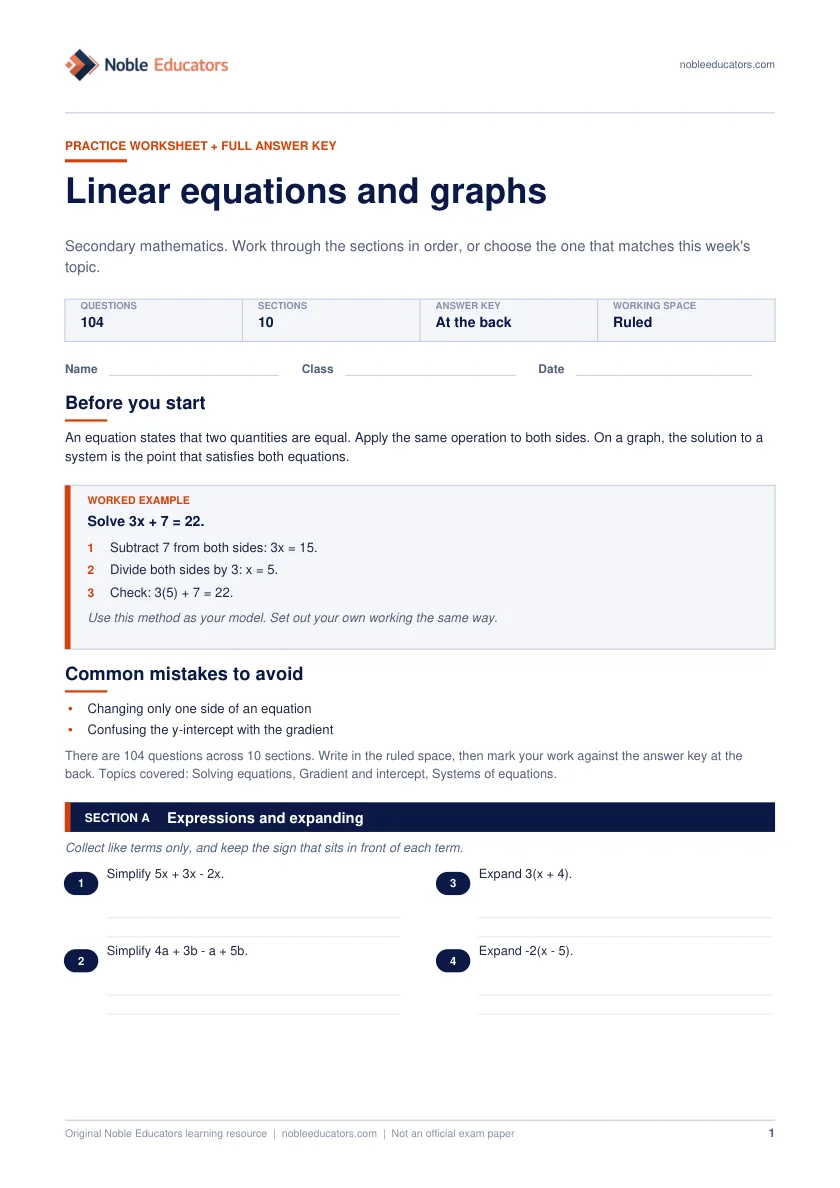
Solve 3x + 7 = 22.
- Subtract 7 from both sides: 3x = 15.
- Divide both sides by 3: x = 5.
- Check: 3(5) + 7 = 22.
Common mistakes to check
- Changing only one side of an equation
- Confusing the y-intercept with the gradient
Your Australian school pathway · Noble Educators
Mathematics is the most cumulative subject in the curriculum: every year assumes fluency in the last, and gaps compound rather than resolve. It is also the learning area that most often decides senior pathway options, because the higher-level courses gate entry to engineering, science, computing and medicine-adjacent degrees.

 Preview the worksheet
 Secondary mathematics. A focused topic sample with space to work and an answer key for checking your reasoning.
Original Noble Educators practice. Not an official exam paper or a complete course syllabus.
1
The first session finds what is actually breaking down — missing content, a weak method, or lost confidence — because practising the wrong thing wastes a term.
2
Lessons aim at the student's next school task — a SAC, assessment, trial, NAPLAN window or exam block — not a generic syllabus order.
3
Timed where the task is timed, written where it is written, with the calculator and formula rules the real assessment uses.
4
After lessons, parents get plain-language notes: what was covered, what improved, and the next piece of work — no jargon, no guesswork.
Number facts and place value in the early years support fractions, decimals and percentages in upper primary, which support ratio and proportional reasoning in Years 7 and 8, which support linear relationships and index laws in Year 9, which support the quadratics, trigonometry and functions of Year 10 — which are the direct entry requirement for Methods-style senior mathematics.
A student who is struggling in Year 10 almost never has a Year 10 problem. Tracing backwards to the first insecure link and rebuilding from there is more effective, and usually faster, than re-teaching the current topic repeatedly.

Setup rather than arithmetic: misreading the question, choosing the wrong model, or skipping the working that earns method marks. Senior marking schemes reward communicated reasoning, and students who write only the answer lose marks they had genuinely earned.
Sessions diagnose the actual break point, rebuild fluency there, then reconnect forward to the current classroom topic so school work stops feeling impossible while the repair happens. For senior students, exam-style practice runs alongside content from the start, because every Australian certificate moderates or weights external examinations heavily.
Version 9.0 of the Australian Curriculum sorts Foundation to Year 10 mathematics into six content strands: Number, Algebra, Measurement, Space, Statistics and Probability. Earlier versions grouped some of this differently, and the change matters mainly because Algebra now runs as a named thread from the earliest years instead of appearing abruptly in secondary school.
Alongside the content sit four proficiencies — understanding, fluency, reasoning and problem-solving — which describe how the content should be learned rather than what gets covered. A student can be strong in one and weak in another, and school reports rarely separate them, so a parent reading a single letter result cannot tell whether the trouble is recall of facts or the ability to apply them.
The strands are also unevenly weighted through schooling. Number dominates the primary years, Algebra and Measurement take over through the middle years, and Statistics and Probability arrive in short concentrated units that students often meet, learn and forget well before they are examined on them again.
Fluency is fast, accurate execution: knowing that seven eights are fifty-six without pausing, simplifying a fraction without thinking about it, expanding brackets reliably every time. Problem-solving is deciding what to do when the question does not say. Both are assessed, and a student can look entirely competent in one while failing the other.
Weak fluency starves problem-solving of working memory. A student who has to reconstruct a multiplication fact halfway through a multi-step question loses the thread of the question itself, so the visible failure looks like confusion about the problem when the underlying cause is arithmetic that never became automatic.
The reverse also happens. Some students are drilled into fluency and freeze the moment a question is worded unfamiliarly, because every problem they have met came pre-translated into an operation. Those students need less repetition and more exposure to unfamiliar phrasing, estimation, and questions that can be solved by more than one route.
Working out which one is missing takes about twenty minutes of the right questions, and it changes the entire plan. Extra worksheets are the right answer to a fluency gap and an active waste of time for a student whose fluency was never the problem.
Fractions are the most reliable predictor of later difficulty in the middle years, and the reason is structural rather than mysterious. A fraction is simultaneously a number, a division, a ratio and an operator, and students who only ever learned the procedural rule for each operation have no concept to fall back on when the context shifts.
Everything built on proportional reasoning inherits the weakness: percentages, rates, unit conversion, similar triangles, trigonometric ratios, probability, gradient, and eventually the manipulation of algebraic fractions. A Year 9 student who cannot confidently add two fractions with unlike denominators will struggle with algebraic fractions for reasons that have nothing to do with algebra.
Repair work starts with representation rather than rules — number lines, area models, and the constant question of what the whole actually is in this particular problem. It is slower than reteaching a procedure and it holds under pressure, which is the difference that matters when the same idea reappears disguised as a rate or a gradient two years later.
Moving from arithmetic into algebra is the largest conceptual jump in school mathematics, and it happens quickly. Students who have spent six years finding an answer are suddenly asked to work with an unknown, to accept that an expression can itself be a final answer, and to read the equals sign as a statement of balance rather than an instruction to compute.
That last misconception is worth naming because it is so common and so invisible. Primary work trains children to read the symbol as produce the answer, so an equation with operations on both sides feels wrong before the student has done anything incorrect. Until the reframing lands, solving equations stays a set of memorised moves rather than a reasoned process.
Letters cause a second problem. A pronumeral stands for a quantity, not for an object, and students who read the letter in a formula as an abbreviation for a thing make errors that look careless and are actually conceptual. Naming the misconception out loud, then testing it with deliberately awkward examples, resolves it faster than another twenty questions.
The numeracy assessment places a student against national proficiency levels in Years 3, 5, 7 and 9, and the online test adjusts the difficulty of later questions according to how a student answers earlier ones. That design gives a reasonably precise position on a national scale, which carries more information than the single figure families tend to focus on.
What it does not tell you is why. A result in the lower levels identifies that something is behind without identifying which strand, and the individual report is not detailed enough to plan from. The useful next step is asking the classroom teacher which specific content the student missed, or running a diagnostic conversation backwards through the chain of prerequisites.
It is also worth keeping the stakes in proportion. Numeracy results do not determine subject selection, they are one measure taken on one morning, and a nervous or unwell child can produce a result that badly misrepresents them. The pattern across two or three testing years carries far more signal than any single sitting.
Each year's achievement standard describes what a typical student can do by the end of that year, and in mathematics the progression is unusually concrete. Foundation students connect number names, numerals and quantities. By Year 4 they use fractions and decimals in familiar situations, by Year 7 they work with integers, rational numbers and simple linear relationships, and by Year 10 they solve quadratic equations, apply trigonometry and interpret bivariate data.
Because each standard assumes the last, the practical meaning of a middling result changes as the years pass. A student sitting in the middle of the range in Year 3 has a small distance to make up. The same relative position in Year 9 represents a much larger body of unfinished content, because the curriculum has been compounding underneath them the entire time.
That is the argument for acting on a soft result early rather than waiting to see whether it resolves itself. A term of targeted work in Year 5 is a small undertaking, while the equivalent repair in Year 10, with senior selection pressing, is a much larger project attempted with far less time available.
Senior mathematics is streamed, and the stream a student enters in Year 11 is largely set by their Year 10 result and by which Year 10 class the school placed them in. Most schools run at least two mathematics classes at that level, and the higher one is the entry point to the calculus-based course whether or not anybody says so plainly.
The courses carry different names around the country — Mathematical Methods, Mathematics Advanced, General Mathematics, Mathematics Applications, Specialist Mathematics, Essential Mathematics — but they sort into a small number of levels: an applied course aimed at everyday and vocational numeracy, a middle general course built on statistics and finance, a calculus-based methods course, and an extension course taken alongside methods.
The decision worth getting right is whether the calculus-based course stays available, because it is the prerequisite or assumed knowledge for engineering, the physical sciences, computing, actuarial studies and many commerce degrees. Dropping it in Year 11 closes doors quietly, and picking it up later usually means a bridging unit at university.
The opposite error happens too. A student pushed into the extension course to look strong, who then performs poorly across both mathematics subjects, finishes worse off than one who took the methods course and did it properly.
A shared digital whiteboard replaces the exercise book. Tutor and student write on the same surface, so the tutor watches working appear line by line and can intervene at the step where the reasoning bends rather than after a wrong answer has been reached.
That visibility is the main reason this subject suits one-to-one online delivery. A classroom teacher sees a finished attempt; a tutor watching live sees the hesitation, the crossing out and the moment a student reaches for the calculator, all of which are better diagnostic material than the answer on its own.
Sessions run to a fixed shape: a short retrieval warm-up on previously repaired content so it does not decay, then the current topic, then one problem attempted without help while the tutor stays deliberately quiet. That last part is intentional, because students need practice at being stuck, and being stuck is the state every assessment puts them in.
Work between sessions stays short and specific. Ten well-chosen questions with the answers checked immediately beat a thirty-question set marked a week later, since errors left uncorrected for a week get rehearsed rather than fixed.
Every learning area is charged at the student's year-level rate rather than by subject, from Foundation through to Year 10.
Booking a block reduces the per-session rate: 5% from 8 sessions, 8% from 12 sessions, 12% from 15 sessions, 15% from 20 sessions. At 12 sessions, Year 3 works out to $12.88 per session. The first lesson is free and there is no lock-in contract.
See the full rate cardOnline 1-on-1, a private in-person tutor and a tutoring centre are genuinely different products, and the cheapest is not automatically the right one. These are the typical advertised rates for each in Australia.
| Option | Typical cost per session | Format |
|---|---|---|
| Noble Educators | $12–$34 | 1-on-1, live |
| Private in-person tutor | $40–$100 | 1-on-1, in person |
| Tutoring centre | $45–$90 | Small group, sometimes 1-on-1 |
| Online marketplace tutor | $30–$70 | 1-on-1, live |
Ranges describe typical advertised rates for each type of tutoring in Australia and are provided as general guidance only. They are not quotes from specific providers, and actual prices vary by tutor, year level, subject, location and session length. Compare current published pricing directly before deciding.
See the full cost comparisonThe tutor match works from evidence, not a job title. Anything from the list below gives the first session a concrete starting point instead of a cold diagnostic.
Progress a parent cannot see is progress they cannot support. Reporting is part of the service, not an add-on you have to chase.
Assessment rules, dates and syllabus documents change. Whenever a decision depends on them, confirm the detail with the body that sets it — these are the official sites for this page.
Noble Educators is an independent tutoring provider and is not affiliated with, endorsed by or accredited by any of these organisations. Their sites are always the source of truth for official requirements.
Start with a free demo
Tell us the student's state, year level, subject and goal. We will recommend a tutor and a practical first lesson plan.