Your Australian school pathway · Noble Educators

    Languages tutoring for Australian students

    Languages are assessed across four skills — listening, speaking, reading and writing — and in senior years they carry an oral examination that many students find the most stressful assessment they sit. Consistent short practice beats intensive blocks, because language retention depends on frequency more than duration.

    Book a free demo
    Student working through a lesson in a notebook beside a laptop
    Live, one-to-one learningNoble Educators
    Understand it. Try it. Review it.

    Put your languages learning into practice.

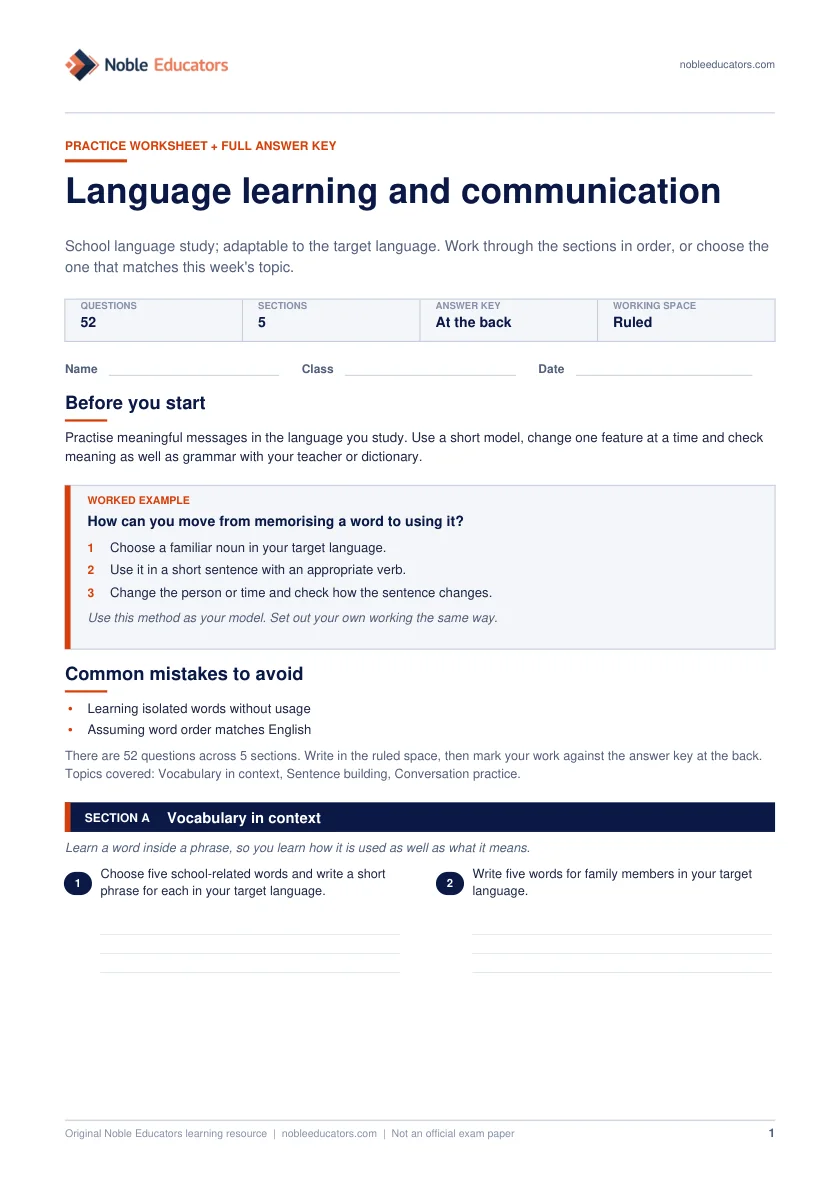
    Worked example · Language learning and communication

    How can you move from memorising a word to using it?

    1. Choose a familiar noun in your target language.
    2. Use it in a short sentence with an appropriate verb.
    3. Change the person or time and check how the sentence changes.
    Common mistakes to check
    • Learning isolated words without usage
    • Assuming word order matches English
    First page of the Language learning and communication worksheetPreview the worksheet
    Free PDF · 6 activities · Answers included

    Language learning and communication

    School language study; adaptable to the target language. A focused topic sample with space to work and an answer key for checking your reasoning.

    Download worksheet Preview questions and answers

    Original Noble Educators practice. Not an official exam paper or a complete course syllabus.

    1

    Diagnose before drilling

    The first session finds what is actually breaking down — missing content, a weak method, or lost confidence — because practising the wrong thing wastes a term.

    2

    Plan to the real calendar

    Lessons aim at the student's next school task — a SAC, assessment, trial, NAPLAN window or exam block — not a generic syllabus order.

    3

    Practise under matching conditions

    Timed where the task is timed, written where it is written, with the calculator and formula rules the real assessment uses.

    4

    Report so parents can see it

    After lessons, parents get plain-language notes: what was covered, what improved, and the next piece of work — no jargon, no guesswork.

    Four skills, assessed separately

    Listening comprehension of authentic-speed audio, spoken interaction and presentation under examination conditions, reading of unfamiliar texts, and writing across the text types the course specifies. Senior courses add cultural and intercultural understanding as an assessed dimension rather than background colour.

    The oral component is where preparation habits show most. Students who have only ever written the language freeze when required to produce it spontaneously, because those are genuinely different skills.

    Languages learning-area illustration for Australian Curriculum tutoring

    Where students lose marks in languages

    Vocabulary recognised but not retrievable under pressure; grammatical accuracy that collapses in spontaneous speech; and written responses that ignore the conventions of the required text type.

    • Vocabulary passively recognised but not actively usable
    • Oral fluency untrained until the weeks before the exam
    • Text-type conventions ignored in written responses
    • Listening practised only at slowed, unnatural speed
    • Cultural knowledge treated as optional background

    How languages tutoring works here

    Sessions prioritise spoken production from the start, use authentic-speed listening rather than slowed classroom audio, and drill the text types the certificate specifies. Short, frequent practice between lessons is structured deliberately, because that is what actually moves retention.

    How the languages curriculum is organised

    The Australian Curriculum publishes separate curricula for individual languages rather than one generic framework, because the demands genuinely differ. A language written in a non-Roman script asks something quite different of a beginner than a closely related European language does, and the published sequences reflect that reality.

    Each language curriculum is organised around two strands. Communicating meaning in the language covers interacting, creating and mediating, which is the productive and receptive use of the language itself. Understanding language and culture covers how the language works as a system and how it carries and shapes cultural meaning. The second strand is the one students most often treat as optional, and it is examined directly in senior courses.

    There are also distinct learner pathways within most languages: a second language pathway for students starting at school, a background language pathway for students with exposure at home, and in some cases a first language pathway. Which one a student sits in has real consequences at senior level, where eligibility rules are enforced.

    • Language-specific curricula rather than one generic sequence
    • Communicating meaning: interacting, creating, mediating
    • Understanding language and culture as a working system
    • Second language, background language and first language pathways

    Which languages Australian schools actually offer

    Provision varies sharply by state, by sector and by individual school. Beyond the commonly offered European and Asian languages there are programmes in Auslan, Arabic, Vietnamese, Korean, Modern Greek and Hindi in particular communities, and a growing number of schools teach Aboriginal and Torres Strait Islander languages in partnership with local speakers.

    Where a language is not offered locally, every state runs a school of languages or an equivalent body, delivering accredited study through Saturday morning or after-hours programmes right up to the senior certificate. Distance and online delivery also exist. Families frequently do not discover these options until somebody mentions them.

    Contact hours matter as much as availability. A programme running one period a week produces a very different outcome from one running four, and two schools nominally teaching the same language can be years apart in what their students can actually do. Asking about weekly minutes is more useful than asking which languages appear on the list.

    • State schools of languages cover what local schools cannot
    • Community language schools contribute accredited study
    • Weekly contact hours vary widely between schools
    • Senior availability is much narrower than junior availability

    Why continuity breaks, and what to do about it

    Languages suffer more than any other learning area from discontinuity. A family moves suburb, the new school teaches Indonesian instead of Japanese, and four years of study stop counting toward a certificate even though the learning itself was entirely real. No national mechanism prevents this, and the loss is quiet, because nobody sends a letter explaining what has been forfeited.

    It also breaks at the primary to secondary transition, where a feeder school's language may not match the high school's, and again around Year 9, when languages typically become elective and class numbers fall below viability. A course that attracts one student does not run.

    Where a break is coming, several options are worth investigating early. Continuing the original language through a school of languages, taking it as an external or online subject, or committing to the new language with intensive support in the first year are all workable. Doing nothing and hoping the student catches up is the option that reliably fails.

    • Check the high school's language before choosing one
    • External or online enrolment keeps a language alive
    • Year 9 electives are where programmes usually collapse
    • A restart needs deliberate support in the first year

    Vocabulary that is available under pressure

    The gap between vocabulary a student recognises and vocabulary they can produce is the central problem in school language learning. Reading a word and understanding it feels like knowing it, so students overestimate their command until an oral examination requires them to retrieve the word with no cue and about three seconds to do it.

    Spaced retrieval is the method that closes the gap, and it is thoroughly unglamorous. Short daily sessions in which the student produces the word from an English prompt, rather than recognising it in the target language, build the pathway that examinations actually use. Ten minutes a day genuinely outperforms an hour on a Sunday.

    Chunks work better than isolated words. Learning a whole useful phrase, such as a way to open an opinion, a way to hedge, or a way to ask for clarification, gives a student something to deploy under pressure and buys thinking time in conversation, which is precisely what an oral examiner is watching for.

    • Produce from English rather than merely recognising
    • Short daily sessions instead of weekly blocks
    • Learn phrases and collocations, not isolated words
    • Recycle old vocabulary deliberately, not only new

    Grammar, and how much to teach directly

    Explicit grammar teaching has swung in and out of fashion, and the honest position is that older students benefit from it substantially. An adolescent who understands why a verb takes a particular ending can generalise the rule, while one who has only absorbed patterns is stuck with the examples they happen to have met.

    The obstacle is often English. Many students have never been taught to identify a subject, an object, a tense or a case in their own language, so instruction about the target language's grammar lands on nothing at all. Ten minutes spent on English grammar frequently unblocks a term of confusion about the language being studied.

    That said, grammar is a means rather than the object. A student who conjugates flawlessly and cannot hold a conversation has been badly served, and the assessment structure in every senior language course reflects that by weighting communication heavily.

    The compromise most good teachers reach is to correct errors that impede understanding immediately, and to let smaller inaccuracies pass during fluency work, picking them up later in a written review.

    • Grammatical terms established in English first
    • Rules generalised rather than examples memorised
    • Accuracy targeted where it changes the meaning
    • Communication weighted above perfection in marking

    Listening at real speed, and why it feels impossible

    Classroom audio is usually recorded slowly and clearly, so students who work only with it are unprepared for native-speed speech, which runs words together, drops sounds and moves faster than any textbook recording. The first encounter with authentic audio is often demoralising and should be expected rather than avoided. It passes with consistent exposure, usually within a few weeks, and the students who push through early are the comfortable ones in the examination room.

    Building the skill takes exposure at natural speed with support, not exposure to slower speech. Short clips listened to several times, with a transcript introduced on the third pass, train the ear far more effectively than long passages played at reduced speed. Subtitled material in the target language does similar work.

    There is also a strategy component. Examination listening tasks reward reading the questions first, predicting the vocabulary likely to appear, accepting that some words will be missed without stopping to mourn them, and writing partial answers rather than nothing. Students often lose marks to panic rather than to comprehension.

    • Short clips at natural speed, replayed several times
    • Transcripts introduced after listening, never before
    • Questions read before the audio begins
    • Partial answers written rather than left blank

    How senior language courses are assessed

    Senior language assessment is unusually consistent across the country in shape, if not in detail. There is an oral component, an examination covering listening and reading comprehension, and written production across specified text types. Some certificates add a detailed study or an investigation built around a cultural theme.

    The oral is where marks separate. Students are assessed on fluency and coherence, on the range and accuracy of their language, and on their capacity to sustain and develop a conversation rather than simply answer questions. Rehearsed monologues are transparent to examiners, who probe with follow-up questions precisely to see what happens next.

    Text types are specified and their conventions are marked. A letter, a blog entry, a report, a speech and a narrative each carry expected registers, openings and structures in the target language, and a fluent piece written in the wrong form loses marks that a simpler piece in the right form keeps.

    Eligibility rules apply in most certificates, separating background and first-language speakers from second-language learners. They exist to keep comparison fair, they are enforced at selection, and families should check them well before Year 11 rather than assume.

    • Oral examination with unscripted follow-up questions
    • Listening and reading comprehension under time pressure
    • Written responses matched to specified text types
    • A cultural or detailed study in some certificates
    • Eligibility rules separating learner backgrounds

    What a languages report tells you, and what it hides

    Language reports are among the hardest for parents to interpret, because a strong grade can sit on top of a narrow competence. A student who performs well on vocabulary tests and written exercises may still be unable to hold a spontaneous conversation, and junior reports do not always separate the four skills.

    The question worth asking at an interview is which of the four skills is weakest in the teacher's judgement, and what the student would struggle to do with a native speaker their own age. That produces a far more useful answer than any discussion of the overall grade.

    Watch for enthusiasm as well, because this is the learning area where motivation most directly determines the outcome. Progress is slow and non-linear, plateaus are normal and demoralising, and a student who has decided they are bad at languages will stop the daily work that is the only thing capable of fixing it.

    Contact with the living language helps more than encouragement does. Film, music, cooking, a pen friend, a relative who speaks it, or a trip where that is possible — anything that turns the language into a means rather than a subject changes the trajectory.

    • Ask which of the four skills is weakest
    • Junior reports often merge speaking with participation
    • Plateaus are normal and rarely mean a wrong choice
    • Contact with real use sustains motivation

    Writing in the target language, text type by text type

    Written production in senior courses is not free composition. The certificate specifies a set of text types, and each carries expected conventions covering how it opens, how it addresses its reader, which register it adopts and how it closes. Markers assess whether those conventions were observed as well as whether the language was accurate.

    The efficient approach is to build one strong model of each required text type, learn its skeleton, then vary the content. A student who has internalised the opening and closing formulas of a formal letter has removed a third of the work before the examination begins, and can spend their thinking time on ideas and accuracy instead.

    Length discipline matters too. Word or character limits are enforced, and students who overrun tend to lose control of their accuracy in the final third. Writing to the limit repeatedly under timed conditions is dull, and it produces the largest single gain available in this component.

    Editing in a second language needs its own routine, because a student cannot rely on something sounding wrong. A fixed checklist covering verb endings, agreement, word order and the two or three errors that particular student repeats catches far more than rereading ever will.

    • One strong model learned per required text type
    • Opening and closing formulas committed to memory
    • Register matched to the reader the task specifies
    • Written to the word limit under timed conditions
    • A personal error checklist applied at the end
    Common questions

    What families ask about this

    Scaling varies by language and cohort, and some languages have historically scaled well because their cohorts are academically strong. Eligibility rules also apply in some courses for background and first-language speakers. The subject should be chosen for interest and strength, since a poorly performed language does not benefit from favourable scaling.

    It is one of the highest-value uses of tutoring in languages. Regular spoken interaction with a fluent speaker, plus rehearsal of the examination format and likely discussion areas, addresses exactly the skill that classroom time rarely provides enough of.

    Continuing an established language is realistic; beginning one at senior level is difficult because courses assume years of prior study. Beginners' senior courses exist for some languages and are the appropriate entry point where available.

    Fifteen to twenty minutes daily beats two hours weekly by a wide margin. Language retention responds to frequency, so tutors set short daily tasks — vocabulary retrieval, a listening clip, a few sentences written or spoken — rather than large weekly assignments.

    Japanese, Chinese, French, Italian, German, Indonesian and Spanish are the most widely offered, with community and heritage languages available in some states through Saturday schools or the school of languages. Availability drops sharply at senior level, so continuity from junior years matters.

    Availability at the intended high school should decide it, because continuity matters far more than the particular language chosen. Beyond that, family connection, community presence and genuine interest are better guides than assumptions about difficulty or usefulness. Every language taught in Australian schools leads to a full senior course somewhere in the country.

    Almost always an advantage, with two things to manage. The home variety may differ from the standard taught at school, which can produce marks a student finds unfair until somebody explains why. And eligibility rules may place the student in a background-speaker course, which is the correct placement even when it feels like a penalty.

    They are a good supplement and a poor substitute. Apps are excellent at spaced vocabulary retrieval and at maintaining a daily habit, which are real contributions. They cannot conduct an unscripted conversation, correct pronunciation reliably, or prepare a student for the specific text types and oral format a certificate requires.

    Each authority sets its own, and they generally consider whether the language is spoken at home, how many years the student was educated in a country where it is the medium of instruction, and time spent living there. The rules are checked when the senior course is chosen, so verify them during Year 10.

    Not in the way it is usually meant. Aptitude does vary, but the far more common cause is a broken sequence: a change of school, a year with a series of relief teachers, or a term missed while a grammatical foundation was being laid. This learning area is unforgiving of gaps because everything afterwards depends on what came before.

    There is reasonable evidence that it supports literacy in English, because learning another grammatical system makes the structure of your own visible for the first time. Students often report understanding English grammar properly only after studying a language that marks case or gender explicitly. The benefit is real without being dramatic.

    Longer than most families expect and shorter than a discouraged student believes. With four periods a week at school plus short daily work at home, a student can usually manage a simple sustained conversation after two or three years, and can handle a senior oral examination after five or six. Frequency determines the timeline more than talent does.

    What sessions cost

    Every learning area is charged at the student's year-level rate rather than by subject, from Foundation through to Year 10.

    Year 3
    $14 AUD per session
    Year 7
    $18 AUD per session
    Year 10
    $21 AUD per session

    Booking a block reduces the per-session rate: 5% from 8 sessions, 8% from 12 sessions, 12% from 15 sessions, 15% from 20 sessions. At 12 sessions, Year 3 works out to $12.88 per session. The first lesson is free and there is no lock-in contract.

    See the full rate card

    How that compares

    Online 1-on-1, a private in-person tutor and a tutoring centre are genuinely different products, and the cheapest is not automatically the right one. These are the typical advertised rates for each in Australia.

    Typical advertised cost per session for different types of tutoring in Australia
    OptionTypical cost per sessionFormat
    Noble Educators$12–$341-on-1, live
    Private in-person tutor$40–$1001-on-1, in person
    Tutoring centre$45–$90Small group, sometimes 1-on-1
    Online marketplace tutor$30–$701-on-1, live

    Ranges describe typical advertised rates for each type of tutoring in Australia and are provided as general guidance only. They are not quotes from specific providers, and actual prices vary by tutor, year level, subject, location and session length. Compare current published pricing directly before deciding.

    See the full cost comparison
    For parents

    Clarity before you book, visibility after every lesson.

    What to share before the first lesson

    The tutor match works from evidence, not a job title. Anything from the list below gives the first session a concrete starting point instead of a cold diagnostic.

    • The most recent school report or assessment result
    • The current task sheet, assessment notice or study design topic
    • Any teacher feedback, and the topic where confidence broke
    Send it through the enquiry form

    What you will see after every lesson

    Progress a parent cannot see is progress they cannot support. Reporting is part of the service, not an add-on you have to chase.

    • What the lesson covered and what changed, in plain language
    • The next piece of practice and why it comes next
    • A direct line to ask questions between lessons
    See how the whole process works

    Check the official source

    Assessment rules, dates and syllabus documents change. Whenever a decision depends on them, confirm the detail with the body that sets it — these are the official sites for this page.

    Noble Educators is an independent tutoring provider and is not affiliated with, endorsed by or accredited by any of these organisations. Their sites are always the source of truth for official requirements.

    Your next step with Noble Educators

    Let’s find your way forward.

    Tell us your year level, school pathway and questions. Discuss a suitable tutor, lesson fees and a schedule that works for you.

    Book a free demo

    Start with a free demo

    Find the right Australian tutor this week.

    Tell us the student's state, year level, subject and goal. We will recommend a tutor and a practical first lesson plan.

    Call now