
Your Australian school pathway · Noble Educators

    The Arts tutoring for Australian students

    The Arts — dance, drama, media arts, music and visual arts — combine practical work with written analysis and reflection, and in senior years the written component is where marks are most often lost. Students who are strong performers or makers frequently underperform because the folio, statement or analysis was treated as an afterthought.

    Book a free demo
    Student working through a lesson in a notebook beside a laptop
    Live, one-to-one learningNoble Educators
    Understand it. Try it. Review it.

    Put your the arts learning into practice.

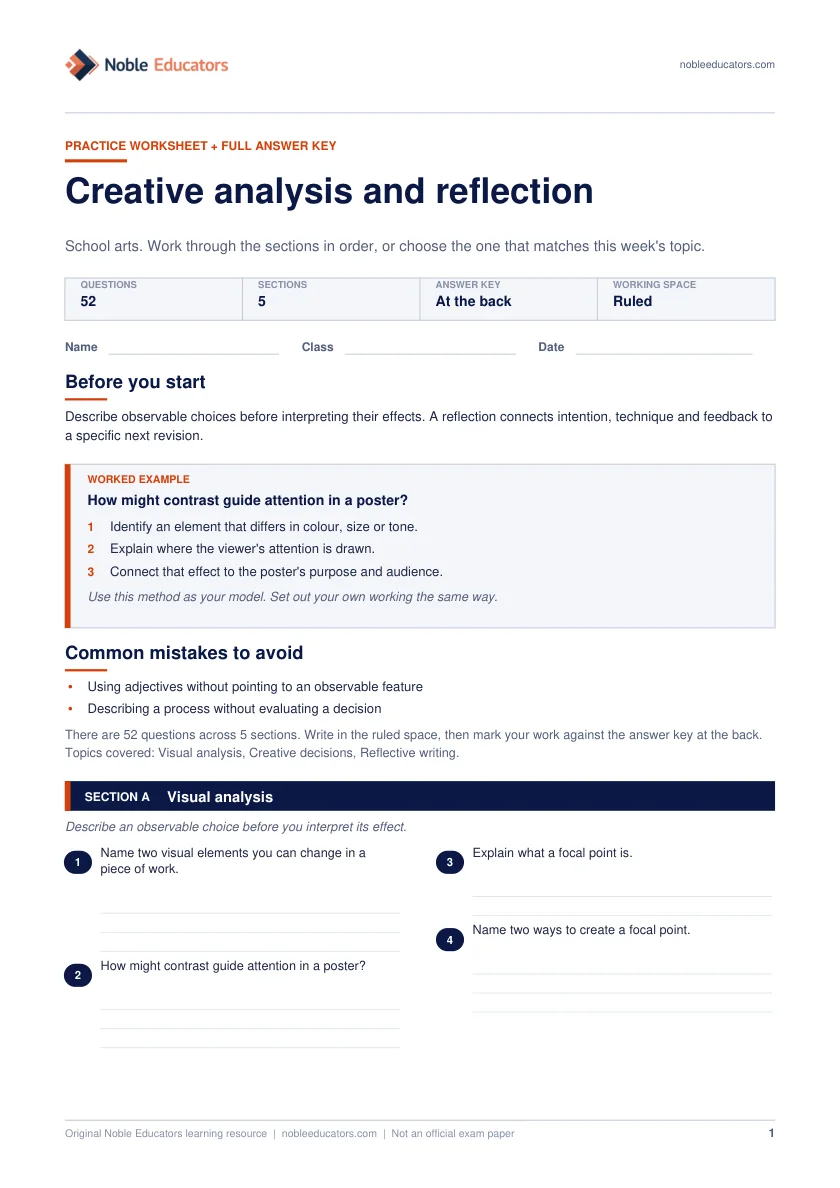
    Worked example · Creative analysis and reflection

    How might contrast guide attention in a poster?

    1. Identify an element that differs in colour, size or tone.
    2. Explain where the viewer's attention is drawn.
    3. Connect that effect to the poster's purpose and audience.
    Common mistakes to check
    • Using adjectives without pointing to an observable feature
    • Describing a process without evaluating a decision
    1

    Diagnose before drilling

    The first session finds what is actually breaking down — missing content, a weak method, or lost confidence — because practising the wrong thing wastes a term.

    2

    Plan to the real calendar

    Lessons aim at the student's next school task — a SAC, assessment, trial, NAPLAN window or exam block — not a generic syllabus order.

    3

    Practise under matching conditions

    Timed where the task is timed, written where it is written, with the calculator and formula rules the real assessment uses.

    4

    Report so parents can see it

    After lessons, parents get plain-language notes: what was covered, what improved, and the next piece of work — no jargon, no guesswork.

    The written half of a practical subject

    Senior arts subjects assess making and responding. The responding component asks students to analyse works using the discipline's terminology, situate them in context, and articulate their own creative intentions and decisions with evidence from their process.

    Folio and process documentation carry real weight in most certificates. A strong final work with thin documentation of how it developed loses marks that a moderately strong work with excellent documentation retains.

    The Arts learning-area illustration for Australian Curriculum tutoring

    Where arts students lose marks

    Describing what a work looks like rather than analysing how it produces its effect; documenting the process retrospectively at the end instead of as it happens; and writing about intention in general terms without pointing to the specific decisions that realised it.

    • Description substituted for analysis of technique
    • Process documentation reconstructed after the fact
    • Discipline terminology used loosely or avoided
    • Contextual knowledge omitted from responses
    • Reflection that praises rather than evaluates

    How arts tutoring works here

    Support concentrates on the written and analytical components: building the terminology, structuring analytical responses, and setting up documentation habits early so the folio records genuine development. Practical instruction generally stays with the student's specialist teacher or studio.

    Five distinct disciplines under one learning area

    The Arts covers dance, drama, media arts, music and visual arts. The Australian Curriculum treats them as one learning area with a shared framework, yet they are genuinely separate disciplines with their own languages, techniques and traditions, and a student strong in one may have no particular aptitude for another. The shared framework does create real common ground in how work is assessed, which is why study habits transfer across them even when talent does not.

    Schools are expected to give students experience of all five across the early years and then allow specialisation, though delivery varies enormously. A primary school with a specialist music teacher and no visual arts specialist produces a very different cohort from the school in the next suburb.

    That variability matters at senior selection, because a student picking a subject they last studied properly in Year 8 is choosing on the strength of a memory. Checking what the senior course actually requires is worth doing before committing, particularly in music, where prior instrumental study is usually assumed rather than stated.

    • Dance: choreography, technique, performance, analysis
    • Drama: devising, script work, performance, evaluation
    • Media arts: production, representation, audience, context
    • Music: performance, composition, aural skills, theory
    • Visual arts: making, folio development, art history and criticism

    Making and responding: the two assessed halves

    Every arts discipline is organised around two strands. Making covers the creation and performance of work, including the development process behind it. Responding covers the analysis and interpretation of works, both the student's own and those of established practitioners, using the discipline's terminology and situating the work in its context.

    Families tend to assume making carries most of the marks. In senior certificates the split is closer to even, and in some courses responding carries more, particularly where a written examination sits at the end of the year. A student who has spent two years on practical work and three weeks on written preparation is not prepared.

    Responding is also the part most amenable to one-to-one support. Practical technique needs a studio, an instrument or a rehearsal room, while analysis needs structure, vocabulary and repeated feedback on drafts, which is exactly what individual sessions can provide.

    The two strands are not really separable, which is the point of the design. A student who can analyse how a choreographer builds tension has a tool available next time they choreograph, and the reverse holds just as strongly.

    • Making: development, experimentation, refinement, final work
    • Responding: analysis, interpretation, context, evaluation
    • Written examinations exist in most senior arts courses
    • Process evidence assessed alongside the finished outcome

    How the arts build from Foundation to Year 10

    Early years arts education is exploratory. Children make, perform and share, and the responding strand amounts to describing what they noticed and what they liked about it. The vocabulary that later becomes technical language starts here informally, as words for what is happening in a piece of work.

    Through the middle primary years students begin using the elements of each discipline deliberately — shape and space in dance, tension and focus in drama, dynamics and pitch in music, line and colour in visual arts — and start explaining choices rather than only making them. By Years 5 and 6 they are expected to consider who the audience is.

    Secondary study formalises all of it. Students work to briefs, document development, use technical vocabulary accurately, and analyse works in their social and historical context. By Year 10 the achievement standard expects a student to evaluate how artists communicate meaning and to justify their own creative decisions with reference to intention and effect.

    • Foundation to Year 2: explore, make, share, describe
    • Years 3 to 4: elements used deliberately and named
    • Years 5 to 6: audience considered, choices explained
    • Years 7 to 8: briefs, documentation, technical vocabulary
    • Years 9 to 10: context, evaluation, justified intention

    Dance and drama: embodied practice, written marks

    Both subjects assess performance and both assess a substantial body of writing about performance. Dance students analyse choreographic works using the elements of dance and the movement vocabulary of particular styles, while drama students analyse plays and productions using dramatic elements, conventions and the theories of named practitioners. The performance mark is the one students worry about and rarely the one that decides their result.

    The written work asks for something students find genuinely difficult: describing a moment of movement or staging precisely enough that a reader who did not see it understands both the effect and how it was produced. Vague praise is the default failure, and it is fixed by insisting on the specific — which body part, which level, which lighting state, which pause.

    Devised work adds a documentation requirement. Students record the development of a piece from stimulus through experimentation to performance, and markers look for evidence of decisions taken and decisions abandoned. A neat account written after the season closes reads as reconstruction and is marked accordingly.

    • Movement or staging described precisely, not generally
    • Practitioner theory applied rather than name-dropped
    • Rehearsal decisions logged while they are being made
    • Audience effect linked to one specific technique

    Music: performance, theory and aural in one subject

    Senior music is unusual in combining three quite different demands. Performance requires prepared repertoire at a standard the course specifies. Theory and composition require written musicianship covering harmony, notation, structure and style. Aural requires the ability to hear intervals, chords, rhythms and modulations and write down accurately what was heard.

    Aural is the component most often neglected and the one that responds best to short frequent work. It is a trainable perceptual skill rather than a body of knowledge, and ten focused minutes each day across a year achieves more than any amount of concentrated effort in the final term.

    Instrumental tuition usually sits outside the school timetable, which means senior music quietly assumes a family is already resourcing lessons. That is worth knowing before Year 11 selection, along with the repertoire standard the course expects, because a student can be entirely enthusiastic and still be a year of playing short of the requirement.

    Analysis of set works is the fourth demand and the one closest to English. Students explain how a composer achieves a particular effect using the technical vocabulary of the discipline, and the same structural advice applies as in any analytical essay.

    • Repertoire prepared to a specified technical standard
    • Harmony, notation and structural analysis assessed in writing
    • Aural skills trained daily rather than crammed
    • Composition folios documented like any design process

    Media arts: production, representation and audience

    Media arts covers the making of moving image, sound, photographic and interactive work alongside the study of how media texts represent the world and position the people consuming them. The production side is technical and the analytical side is conceptual, and students rarely arrive strong at both.

    Assessment weights pre-production documentation heavily. Treatments, storyboards, shot lists, production schedules and reflective evaluations all carry marks, and a well-shot final piece submitted with thin planning evidence loses marks that a rougher piece with rigorous documentation keeps.

    The analytical strand asks students to discuss representation, audience, institutions and technologies: how a text constructs a version of reality, who it was made for, who paid for it, and what the medium itself contributes to the meaning. Students who can only describe what happens on screen sit in the middle band.

    Software fluency is assumed rather than taught in most senior courses, so a student intending to take the subject benefits from learning their editing package properly over a holiday. Time lost to fighting the software is time not spent on the ideas that are being assessed.

    • Treatments and storyboards marked as planning evidence
    • Representation analysed, not merely identified
    • Audience positioning explained through specific techniques
    • Copyright and permissions handled properly in submissions

    Visual arts: the folio as a document of thinking

    In most senior visual arts courses the developmental folio carries as much weight as the resolved work, and sometimes more. It is assessed on evidence of investigation, experimentation, refinement and reflection, which means the marker is reading a record of thinking rather than admiring a set of finished images. The practical consequence is that folio pages should be dated and annotated as work happens, in short entries, rather than assembled later from memory.

    The strongest folios include failures. An abandoned direction with a note explaining why it was abandoned demonstrates critical judgement, whereas a folio of uniformly successful pages suggests either a very unusual student or a document built in the final fortnight. Markers have seen a great many of both.

    The written strand covers art history and criticism: analysing works through formal, cultural and personal frames, situating artists in their context, and constructing arguments about meaning. It functions much like an English essay with a different object, and students who write well in English generally do well here once they have the vocabulary.

    • Investigation of other artists documented, not just admired
    • Experiments photographed and annotated as they happen
    • Abandoned directions retained with the reasons attached
    • Final work traceable back to earlier folio pages
    • Analysis written using formal and contextual frames

    Choosing senior arts subjects, and reading the report

    An arts subject in a senior programme is a substantial time commitment, because practical work expands to fill whatever hours are available and does not respect the timetable of other subjects. Students taking one alongside four demanding academic subjects need a plan for the fortnight before a folio is due.

    Choose on genuine engagement rather than on an assumption about workload. These subjects require voluntary hours, and a student who wants to be in the studio produces work that a student meeting a requirement never will. That difference is also what separates results at the top of the range.

    At report time, the comment worth reading is the one about process. Phrases such as develops ideas independently or evidences experimentation indicate a student on track for a strong folio, while comments about completing tasks or meeting deadlines suggest work is being produced without the thinking that actually gets marked.

    The other thing to watch is whether written components appear in the report at all. If every comment concerns practical work, ask directly how the analytical strand is travelling, because that is where marks are most often lost quietly.

    • Practical work expands beyond timetabled hours
    • Folio deadlines cluster with other subjects' assessments
    • Report comments about process predict folio outcomes
    • Ask specifically about the written strand

    Building the vocabulary that earns arts marks

    Every arts discipline has a technical vocabulary, and using it accurately is the fastest improvement available to most students. The words are not decoration, because they name distinctions a marker is actively checking for, and a response saying the music got louder where it could have said crescendo has demonstrated less, however accurate the observation was.

    The vocabulary is finite, which is the encouraging part. A senior course typically depends on perhaps sixty to eighty terms, and a student who learns them properly across a term has covered the ground. Learning them properly means applying each one to a real work rather than reciting a definition, because markers can tell the difference immediately.

    The common failure is decorative use, meaning terms sprinkled through a paragraph without the analysis they are supposed to carry. One term used precisely, with the effect it produced explained afterwards, is worth more than four dropped in for show, and it is considerably easier to write.

    A glossary the student maintains themselves works better than one handed to them. Writing the definition in their own words, beside a work where the technique actually appears, produces something they can retrieve in an examination room.

    • One term per point, used precisely
    • Each term attached to a real example
    • Definitions tested by application, not recitation
    • Effect explained after the technique is named
    Common questions

    What families ask about this

    With the assessed written components, substantially — analysis, contextual study, folio documentation and reflective writing are where most senior arts marks are lost. Practical technique is better served by a specialist instructor, and we say so rather than pretending otherwise.

    Yes, in every state, provided the course is an ATAR-eligible one. Scaling varies by subject and cohort like any other. Students should choose them for genuine interest and strength rather than assuming either a scaling advantage or penalty.

    In most senior arts certificates it carries substantial weight and is assessed on evidence of development — experimentation, refinement, decision-making. Students who photograph and annotate as they work produce far stronger folios than those who reconstruct a narrative in the final fortnight.

    Structured frameworks for analysis and reflection, plus the discipline's vocabulary. Talented makers often see clearly and articulate poorly; giving them a repeatable structure — intention, decision, effect, evidence — usually converts existing insight into marks quite quickly.

    It varies by discipline and school. Visual arts and media arts can carry material or software costs, while drama and music often rely on school resources. Schools usually publish a subject cost list at selection time, and it is a fair question to ask before committing.

    In practice, yes for most courses. Senior music assumes a performance standard that classroom time alone cannot build, and almost all successful candidates are receiving instrumental or vocal tuition alongside. Some schools provide it internally and most do not, so it is a cost worth confirming before selection rather than discovering afterwards.

    More than the timetable suggests. Practical development happens outside class, folios need consistent weekly attention rather than concentrated bursts, and rehearsal or studio access has to be booked around other commitments. Budgeting three to five hours a week beyond scheduled lessons is realistic for a student aiming at the top of the range.

    Often, and it can be a genuine benefit rather than a burden, because practical work uses a different kind of attention and breaks up a programme of written subjects. The risk is deadline collision rather than total workload, so map the assessment calendar across every subject at the start of each term.

    Description reports what is present: the colours, the composition, the instruments, the staging. Analysis explains how those choices produce an effect on the viewer or listener and why the artist might have made them. A useful test is whether a sentence could be replaced by a photograph of the work, because if it could, it is description.

    Many creative arts degrees require a portfolio, an audition or an interview alongside or instead of a rank, and the requirements differ substantially between institutions. Check them during Year 11, because a strong portfolio takes months to assemble and often needs work produced specifically for it rather than school assessments repurposed at the last minute.

    Set process deadlines rather than outcome deadlines. Perfectionists stall because finishing means being judged, so requiring three annotated experiments by Friday moves them where requiring a resolved work does not. Reminding them that folios are marked on documented thinking, including work they consider failed, also removes a surprising amount of the pressure.

    What sessions cost

    Every learning area is charged at the student's year-level rate rather than by subject, from Foundation through to Year 10.

    Year 3
    $14 AUD per session
    Year 7
    $18 AUD per session
    Year 10
    $21 AUD per session

    Booking a block reduces the per-session rate: 5% from 8 sessions, 8% from 12 sessions, 12% from 15 sessions, 15% from 20 sessions. At 12 sessions, Year 3 works out to $12.88 per session. The first lesson is free and there is no lock-in contract.

    See the full rate card

    How that compares

    Online 1-on-1, a private in-person tutor and a tutoring centre are genuinely different products, and the cheapest is not automatically the right one. These are the typical advertised rates for each in Australia.

    Typical advertised cost per session for different types of tutoring in Australia
    OptionTypical cost per sessionFormat
    Noble Educators$12–$341-on-1, live
    Private in-person tutor$40–$1001-on-1, in person
    Tutoring centre$45–$90Small group, sometimes 1-on-1
    Online marketplace tutor$30–$701-on-1, live

    Ranges describe typical advertised rates for each type of tutoring in Australia and are provided as general guidance only. They are not quotes from specific providers, and actual prices vary by tutor, year level, subject, location and session length. Compare current published pricing directly before deciding.

    See the full cost comparison
    For parents

    Clarity before you book, visibility after every lesson.

    What to share before the first lesson

    The tutor match works from evidence, not a job title. Anything from the list below gives the first session a concrete starting point instead of a cold diagnostic.

    • The most recent school report or assessment result
    • The current task sheet, assessment notice or study design topic
    • Any teacher feedback, and the topic where confidence broke
    Send it through the enquiry form

    What you will see after every lesson

    Progress a parent cannot see is progress they cannot support. Reporting is part of the service, not an add-on you have to chase.

    • What the lesson covered and what changed, in plain language
    • The next piece of practice and why it comes next
    • A direct line to ask questions between lessons
    See how the whole process works

    Check the official source

    Assessment rules, dates and syllabus documents change. Whenever a decision depends on them, confirm the detail with the body that sets it — these are the official sites for this page.

    Noble Educators is an independent tutoring provider and is not affiliated with, endorsed by or accredited by any of these organisations. Their sites are always the source of truth for official requirements.

    Your next step with Noble Educators

    Let’s find your way forward.

    Tell us your year level, school pathway and questions. Discuss a suitable tutor, lesson fees and a schedule that works for you.

    Book a free demo

    Start with a free demo

    Find the right Australian tutor this week.

    Tell us the student's state, year level, subject and goal. We will recommend a tutor and a practical first lesson plan.

    Call now