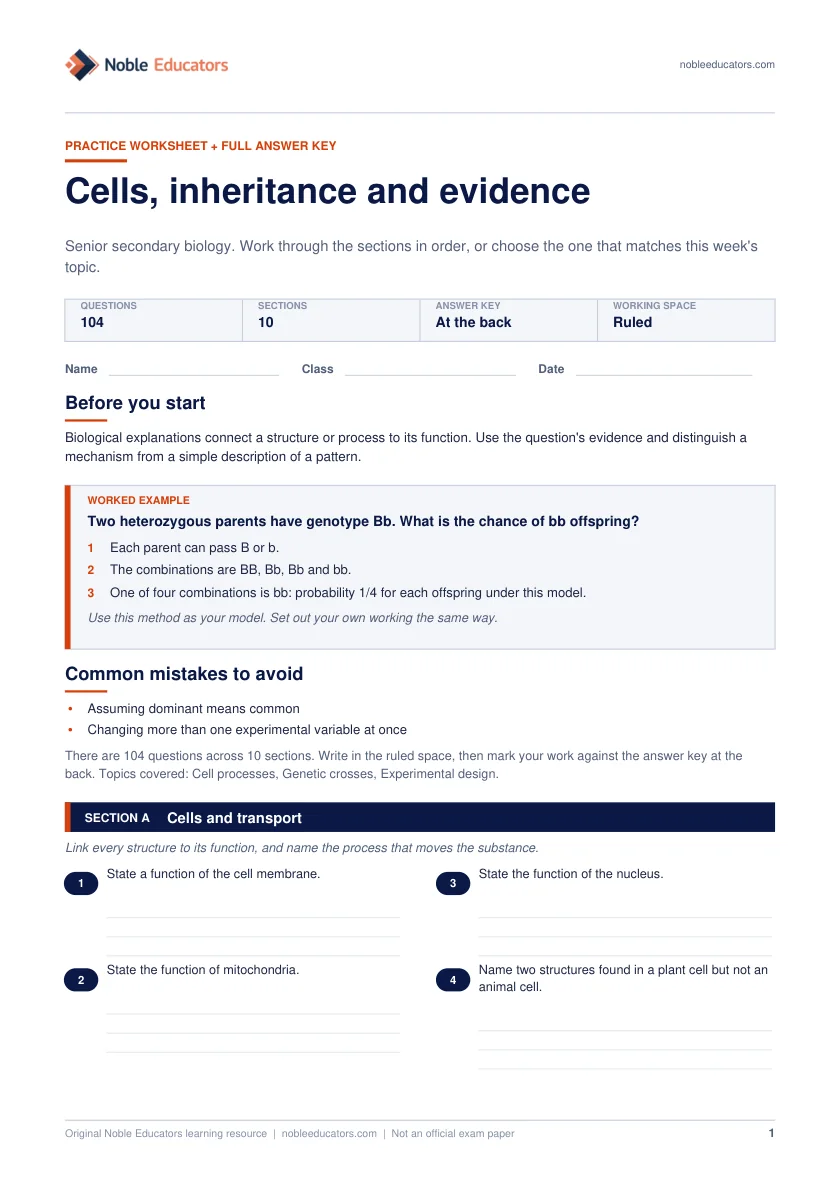
Biology tutoring for VCE students pairs a subject specialist with the way VCAA actually assesses: SACs during the year and the end-of-year VCAA examinations at the end. One-on-one lessons work on the student's current Biology topic, their next VCE assessment and the specific parts of the course that have stopped feeling secure. SACs are timetabled outcome by outcome through Units 3 and 4, so a weak fortnight shows up in the rank order almost immediately. That is why the opening fortnight of VCE Biology lessons maps the whole term's calendar before any drilling begins.
Original Noble Educators practice. Not an official exam paper or a complete course syllabus.
1
Diagnose before drilling
The first session finds what is actually breaking down — missing content, a weak method, or lost confidence — because practising the wrong thing wastes a term.
2
Plan to the real calendar
Lessons aim at the student's next school task — a SAC, assessment, trial, NAPLAN window or exam block — not a generic syllabus order.
3
Practise under matching conditions
Timed where the task is timed, written where it is written, with the calculator and formula rules the real assessment uses.
4
Report so parents can see it
After lessons, parents get plain-language notes: what was covered, what improved, and the next piece of work — no jargon, no guesswork.
Format
1-on-1 online
Live lessons with a subject specialist
Assessment
SACs
Plus the end-of-year VCAA examinations
Reporting
Parent updates
After every meaningful milestone
How Biology works in the VCE
VCE Biology carries the heaviest reading and writing load of the sciences: extended responses decide grades, and assessors mark the precision of language as much as the recall of content. Tutoring trains VCE students to answer the command verb — describe, explain, evaluate — rather than writing down everything they know.
The other VCE Biology mark-maker is data. Every VCE assessment presents unfamiliar experiments and expects students to reason about variables, controls and validity on the spot, so lessons practise that skill deliberately with new stimulus material each week rather than re-reading notes.
Genetics is the topic that most reliably separates VCE Biology students, because it demands a procedure rather than a memory. Pedigrees, crosses and inheritance patterns each follow a systematic method, and VCE lessons teach the method so that an unfamiliar cross becomes routine rather than alarming.
Terminology is worth real marks in VCE Biology, and everyday language quietly forfeits them. Writing that a cell "lets things in" instead of naming the transport mechanism will not earn what a VCE assessor is instructed to award, so lessons rebuild vocabulary inside the explanations that actually use it.
The volume of content in VCE Biology is genuinely large, which makes retrieval practice far more valuable than rereading. Students who test themselves on VCE Biology material weekly hold much more of it by the end of the year than students who highlight notes, so lessons set that testing rather than assuming it happens.
Finally, VCE Biology asks students to connect scales — molecule to cell, cell to organism, organism to ecosystem — and the harder questions cross those boundaries deliberately. Tutoring rehearses the links explicitly, because a VCE student who knows each level only in isolation stalls the moment a question joins two of them.
The VCE Biology topics that need the most work
Cells and molecular biology open most VCE Biology courses and quietly underpin everything after them. Enzymes, membranes, respiration, photosynthesis and gene expression supply mechanisms that later VCE topics assume are already understood, so a shaky start here resurfaces months afterwards in a different disguise.
Genetics and evolution form the analytical core of VCE Biology. Inheritance, variation, selection and speciation all reward a student who can reason from evidence, and the VCE questions carrying the most marks usually hand over unfamiliar data and ask what it implies.
Physiology, immunity and ecology round out the VCE Biology course and generate the longest written responses. Homeostasis, immune responses, sampling methods and population dynamics each require structured explanation, which is why VCE lessons spend as much time on the writing as on the biology itself.
Cell structure, membranes and transport
Enzymes, respiration and photosynthesis
DNA, gene expression and biotechnology
Inheritance, pedigrees and genetic crosses
Variation, natural selection and speciation
Immunity, pathogens and disease responses
Homeostasis and feedback systems
Ecosystems, sampling and population data
Where VCE students lose marks
These are the recurring pressure points tutors see in VCE Biology work, and they are diagnostic rather than universal — most students carry two or three of them, not the whole list. The first Biology session identifies which ones apply before any drilling starts, because practising the wrong VCE weakness is how a family loses a term.
Several of these VCE Biology weaknesses are structural rather than topical. A student who leaks marks through presentation, timing or misread instructions will keep leaking them in every VCE task until the habit itself changes, which is why lessons treat those as a skill to be taught rather than as carelessness to be scolded.
The list is worth revisiting at each VCE reporting point, because weaknesses migrate. A Biology gap closed in Term 1 is often replaced by a new one as the VCE course reaches material that assumes the first is now automatic and unremarkable.
Command verbs: describe versus explain versus evaluate
Respiration and photosynthesis at the level of detail required
Immune responses and disease terminology
Evolution, selection and speciation reasoning
Homeostasis and negative feedback explanations
Ecology: sampling methods and population data
Sheer content volume and retrieval under time
How does the VCE assess Biology?
Every VCE Biology result is assembled from more than one kind of evidence, and each kind rewards a different habit. Through the year the school runs SACs, alongside the end-of-year VCAA examinations; in VCE Biology, the split between coursework and examinations is set study by study, and SAC ranks are moderated against examination performance before the study score is calculated.
Because SACs are timetabled outcome by outcome through Units 3 and 4, so a weak fortnight shows up in the rank order almost immediately, no fortnight of the VCE year is genuinely free. Tutoring reads the published task schedule against the Biology topics each task draws on, so preparation for a VCE assessment begins three weeks out instead of three nights out.
Achievement is reported as a study score out of 50, set against a state-wide mean of 30, and the VCAA statistically moderates each school's SAC scores against how that same cohort performs in the examination. That mechanism explains more about a VCE Biology report than the number printed beside it, because it is the reason a comfortable class mark can still move once the whole cohort is compared.
Lessons therefore run in two modes. One builds Biology understanding; the other rehearses the response formats a VCE assessor is instructed to reward, which is the half students rarely practise alone and where the recoverable Biology marks usually sit.
Read the VCE assessment schedule in week one, not week six
Rebuild each Biology topic before the task that assesses it
Rehearse under the timing the VCE task will actually impose
Keep an error log so a Biology mistake is not paid for twice
Work from past VCAA examination papers and the examiners' report published after each sitting
Treat feedback on a returned VCE task as the next lesson's agenda
A term of Biology tutoring, mapped to the VCE
Because Units 3 and 4 run as one continuous assessment year, with SACs arriving from Term 1 onwards, weekly Biology lessons alternate between the topic being taught in class and maintenance of the earlier material that VCE assessment still draws on. As each SACs approaches, sessions shift to timed Biology practice and targeted review of the student's error log; once results come back, the tutor rebuilds whatever that task exposed. Approaching late October and November, preparation moves to full-length Biology papers under VCE conditions.
The maintenance half of that cycle is the part most VCE students skip. Earlier Biology topics decay quietly while attention sits on the current chapter, so each lesson spends a short block revisiting older material — enough to keep it retrievable under VCE conditions, not enough to crowd out the work immediately in front of the student.
Holidays are used differently again. A break is the only stretch long enough for a VCE Biology student to rebuild an entire topic from its foundations, so it is spent on the single area the term could only patch rather than on a general review of everything at once.
The VCE Biology year, term by term
Term 1 is where a VCE Biology year is quietly decided, because Term 1 already carries assessed SACs, so the year offers no unassessed warm-up. Lessons in this phase are deliberately diagnostic: they find which prerequisite Biology skills are missing while the VCE course is still close enough to its starting point for repairs to be cheap.
By the middle of the year the VCE Biology course has reached its harder centre section, and students who were coping start to feel the load. The year's rehearsal then arrives in the form of the General Achievement Test in June, followed by the practice examinations most Victorian schools run over the September holidays, and a sensible VCE Biology program reshapes around that date — preparation first, then an honest reading of what it exposed.
The weeks after the September practice examinations are the repair window for VCE Biology. Whatever the rehearsal exposed gets rebuilt while rebuilding is still realistic, and any VCE topic that was memorised rather than understood is re-taught until it survives an unfamiliar Biology question.
From late October and November, VCE Biology work becomes almost entirely about execution — timing, transcription accuracy, and the discipline of leaving a hard question early rather than feeding it ten minutes it will never repay.
Term 1: diagnose gaps and set the weekly Biology routine
Term 2: hold the harder middle of the VCE course
Rehearsal: sit the September practice examinations and read the result honestly
Afterwards: rebuild whatever the rehearsal exposed in Biology
Final weeks: full-length VCE Biology practice under real timing
All year: maintain earlier Biology topics so they stay usable
What happens inside a one-on-one VCE Biology lesson
A lesson opens with the student's own material rather than a generic worksheet — the current VCE Biology chapter, the last returned task, and the question set the class was given this week. That keeps the hour anchored to what the school is actually assessing for the VCE, instead of to a parallel Biology course of the tutor's own design.
The tutor then works one Biology problem or paragraph aloud, hands the next one straight back, and watches the working rather than the answer. Most VCE marks are lost inside the method, so the method is precisely what the lesson is built to observe.
Because the VCAA republishes its approved technology list each year, and the Mathematical Methods papers separate a technology-free examination from a technology-active one, lessons rehearse the tool conditions a VCE Biology task will impose rather than letting a student practise only in whichever mode feels comfortable. Moving between those modes on the same Biology question is a skill the VCE assessments quietly test.
The closing minutes set the week: two or three specific Biology tasks chosen because they target the gap this lesson found, not because they finish a chapter. Parents receive a short written note covering what was done and what the VCE student is working towards before the next session.
Bring the current VCE task sheet and any marked work
Attempt problems in front of the tutor rather than silently
Try the hard question before the explanation arrives
Leave with two or three specific Biology tasks, not a chapter
Log every error in one place and revisit it monthly
How will you know the Biology tutoring is working?
The first signal is not a mark. It is that a VCE Biology student starts describing what a question is asking before attempting it, which is the habit separating an average response from a strong one under VCE marking.
The second signal is a shrinking VCE Biology error log. Tutors keep a running list of the specific Biology mistakes a student makes, and in a program that is working the same entry stops reappearing across three or four consecutive VCE tasks.
The third signal is the reported VCE Biology result, delivered as a study score out of 50, set against a state-wide mean of 30. It lags the other two by a full assessment cycle, because VCE Biology evidence accumulates slowly, and families watching only this number tend to change tutors about a month before the change would have shown.
No honest VCE Biology tutor will promise a number in advance. What can be committed to is the process — weekly Biology contact, work marked with specific written feedback, and an accurate reading of where the student currently sits against VCE standards.
What parents can do without knowing Biology
Very few parents can help with senior Biology content, and attempting it usually costs more goodwill than it earns. What genuinely helps under the VCE is logistics: knowing the assessment dates, protecting the study block, and noticing early when a subject has quietly stopped making sense.
Ask for the VCE assessment schedule and put it somewhere visible. Because SACs are timetabled outcome by outcome through Units 3 and 4, so a weak fortnight shows up in the rank order almost immediately, a family that knows what lands in week six behaves very differently in week three from a family that discovers it the weekend before.
The more useful question after a returned VCE Biology task is not how it went but what the feedback said. A marked task carries specific comments, and a VCE student who can paraphrase them has understood something the mark by itself never communicates.
It also helps to know how the subject travels into tertiary selection, since a scaled study score feeds a VTAC aggregate built from four studies at full weight plus increments from two more. That context stops one disappointing VCE Biology task from being read at home as the end of a pathway.
Print the VCE assessment calendar and keep it on the fridge
Ask what the feedback said, not what the mark was
Protect one predictable Biology study block every week
Watch for avoidance — the topic never mentioned is the weak one
Raise concerns with the VCE subject teacher early, not in Term 3
Is Biology the right VCE choice?
Subject selection shapes a VCE outcome more than most families expect, and Biology is one of the choices worth thinking through properly. Under the VCE, many Victorian students complete one Unit 3–4 sequence during Year 11, which brings a study score forward by a year, which limits what can still be changed once the year is underway.
The honest test is not interest alone but current fluency in the prerequisites, because the VCE Biology course moves at a pace that assumes those are already automatic. One diagnostic Biology session usually settles the question faster than another VCE term of hoping it resolves itself.
Dropping a VCE subject is sometimes correct and sometimes an expensive overcorrection. Because a scaled study score feeds a VTAC aggregate built from four studies at full weight plus increments from two more, the arithmetic of dropping VCE Biology deserves to be worked through on paper rather than settled in the week after a single poor result.
Prerequisites matter too: some degrees name Biology or a companion course as assumed knowledge, so the VTAC prerequisite guide is worth reading a year before it feels urgent to a VCE family.
Common questions
What families ask about this
Recall matters less than application. VCE Biology assessments present unfamiliar scenarios and data, then ask students to apply concepts precisely. Tutoring balances content review with weekly VCE practice on unseen questions so that knowledge becomes usable rather than merely stored.
Tutors cannot run the school prac, but they prepare VCE students for what it feeds: experimental design logic, variable control, error discussion and the write-up. Students bring their VCE practical tasks and lessons sharpen the scientific reasoning inside them.
Almost always because the VCE response answered a different command verb from the one printed. A question asking students to evaluate wants a judgement argued both ways, and a beautifully written description of the same content will not collect those VCE Biology marks.
More than most students expect when they choose VCE Biology. Extended responses carry a large share of the marks, so lessons treat paragraph structure, sequencing and precision as biology skills rather than as English ones borrowed for the VCE exam room.
Yes, more readily than in the mathematical sciences, because VCE Biology topics are less strictly sequential. The catch-up still has to be scheduled rather than hoped for, so tutoring rebuilds the missed unit alongside current VCE content instead of waiting for a holiday break.
Active retrieval spread across weeks, using unseen VCE Biology questions rather than familiar notes. A student who can explain a mechanism aloud without prompts is ready; one who merely recognises it on a page is not, and VCE assessment tests the first of those.
Lessons work backwards from each VCE Biology assessment: the tutor reviews what that task actually assesses, rebuilds the underlying Biology skills, then runs practice under matching conditions. Because Units 3 and 4 run as one continuous assessment year, with SACs arriving from Term 1 onwards, Biology preparation is spread across the VCE term rather than crammed into the week before.
Earlier than the first disappointing Biology result. In the VCE, school-based SAC ranks and the November examinations combine into a study score out of 50, which VTAC then scales for the ATAR — so Biology evidence built early in the year carries real weight. Students who begin in Term 1 spend late October and November consolidating Biology rather than repairing it.
One hour a week is the standard rhythm for VCE Biology, because the gap between lessons stays short enough that a student still remembers the question that stopped them. Families usually add a second Biology session in the fortnight before a major task or the September practice examinations, then return to weekly.
Often, in part. Because the split between coursework and examinations is set study by study, and SAC ranks are moderated against examination performance before the study score is calculated, one weak Biology task rarely settles the VCE outcome by itself — but the gap behind it keeps charging interest until somebody repairs it. The realistic aim is to break the pattern before the next VCE task rather than to erase the last one.
The school's, in almost every case. A VCE Biology tutor works from the class sequence, the school's task schedule and past VCAA examination papers and the examiners' report published after each sitting, bringing in outside material only where a prerequisite gap has to be filled before the current topic can land.
The tutor works through recent Biology work with the student, asks for two or three questions attempted unaided, and establishes which parts of the VCE course are genuinely secure rather than merely familiar. Families then receive a written summary of what was found and what the first month of VCE Biology work will target.
What sessions cost
Senior certificate subjects are booked at the Year 11 or Year 12 rate, depending on where the student currently sits.
Year 11
$22–$24 AUD per session
Year 12
$26 AUD per session
Booking a block reduces the per-session rate: 5% from 8 sessions, 8% from 12 sessions, 12% from 15 sessions, 15% from 20 sessions. At 12 sessions, Year 11 works out to $20.24 per session. The first lesson is free and there is no lock-in contract.
Students preparing for UCAT ANZ alongside senior subjects are booked at the Special Prep rate for that component, because the reasoning and timing work sits outside the school syllabus.
Online 1-on-1, a private in-person tutor and a tutoring centre are genuinely different products, and the cheapest is not automatically the right one. These are the typical advertised rates for each in Australia.
Typical advertised cost per session for different types of tutoring in Australia
Option
Typical cost per session
Format
Noble Educators
$12–$34
1-on-1, live
Private in-person tutor
$40–$100
1-on-1, in person
Tutoring centre
$45–$90
Small group, sometimes 1-on-1
Online marketplace tutor
$30–$70
1-on-1, live
Ranges describe typical advertised rates for each type of tutoring in Australia and are provided as general guidance only. They are not quotes from specific providers, and actual prices vary by tutor, year level, subject, location and session length. Compare current published pricing directly before deciding.
Clarity before you book, visibility after every lesson.
What to share before the first lesson
The tutor match works from evidence, not a job title. Anything from the list below gives the first session a concrete starting point instead of a cold diagnostic.
The most recent school report or assessment result
The current task sheet, assessment notice or study design topic
Any teacher feedback, and the topic where confidence broke
These are independent Noble Educators resources, not official NAPLAN, ACARA or certificate-authority material. Confirm current dates and requirements with the relevant official body.
Check the official source
Assessment rules, dates and syllabus documents change. Whenever a decision depends on them, confirm the detail with the body that sets it — these are the official sites for this page.
Noble Educators is an independent tutoring provider and is not affiliated with, endorsed by or accredited by any of these organisations. Their sites are always the source of truth for official requirements.
Your next step with Noble Educators
Let’s find your way forward.
Tell us your year level, school pathway and questions. Discuss a suitable tutor, lesson fees and a schedule that works for you.