What to focus on in Geography
Connect a geographical description to a process or a piece of evidence. For numerical work, identify the units and scale; for explanations, show the sequence that links a cause to an observed pattern.
Build understanding in Geography with one-to-one online lessons for National Curriculum in England. Share your level, current topic and school specification so the tutor can focus on the next skill you need.

Connect a geographical description to a process or a piece of evidence. For numerical work, identify the units and scale; for explanations, show the sequence that links a cause to an observed pattern.
EYFS covers early years; the National Curriculum covers Key Stages 1–4. Sixth-form qualifications are a separate next step. Academies and independent schools may follow a different programme. Tell us the school, exam board and specification. Reception · Years 1–13. Your school’s subject choices, topic sequence and assessment tasks determine the detailed plan. The practice set below samples geography: maps, rivers and geographical evidence; it is not a complete syllabus or an official exam paper.
Bring one attempted question and show your working or first draft. Explain what you tried and where the reasoning stopped. Together, identify whether the difficulty is confusing straight-line distance with route distance or a missing prerequisite, then try a fresh problem independently.
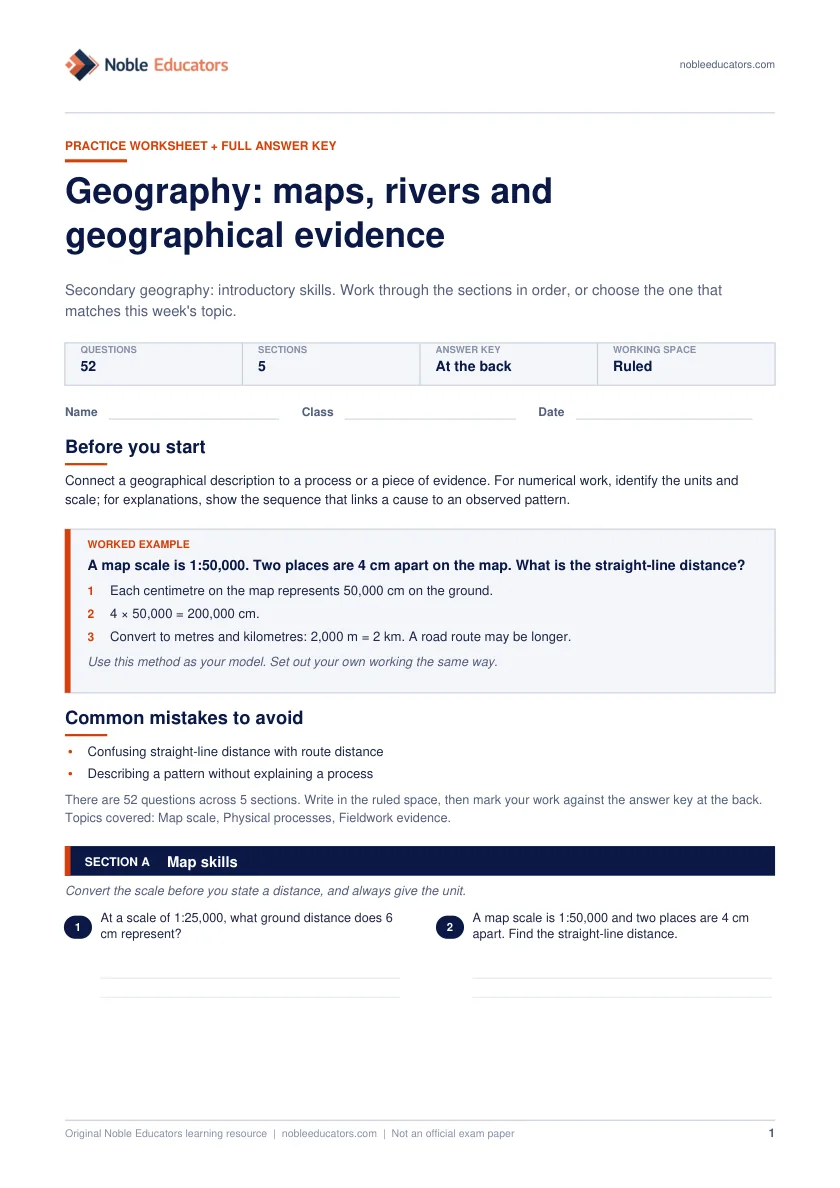 Preview the worksheet
 Secondary geography: introductory skills. A focused topic sample with space to work and an answer key for checking your reasoning.
Original Noble Educators practice. Not an official exam paper or a complete course syllabus.
Your questions shape the lesson. Your learning continues afterwards.
Work through a difficult idea with a teacher who can adapt the explanation to your questions.
Connect your geography lessons with focused practice and review the steps behind each answer.
Revisit an explanation between sessions and bring your follow-up questions to the next lesson.
Keep your lessons and available learning resources together in one place.
Find the relevant test, subject guidance, practice resources and next steps.
Use the current school or awarding-body guidance for full requirements. Noble Educators provides independent tutoring.
National Curriculum in England: official guidance ↗