01What Chemistry 11 covers
The BC curriculum for Chemistry 11 covers the quantum mechanical model and electron configuration; Lewis structures, molecular geometry, polarity and chemical bonding; organic compounds and their applications; the mole and dimensional analysis; reactions and stoichiometric calculations, including green chemistry; and solubility, solution stoichiometry and analysis techniques.
02How Chemistry 11 is assessed
Your school sets the tests, labs and the final exam; there is no provincial exam for Chemistry 11. Chemistry 11 is the usual prerequisite for Chemistry 12.
03Your course, clearly identified
Chemistry 11 is listed in British Columbia’s course catalogue at Grade 11. Ask your school for the current course outline and assessment expectations, then share them with your tutor.
04Chemistry 11: topics to discuss
Atomic structure and bonding, chemical reactions, quantities in reactions, solutions and gases. Build reliable mole calculations and explain the particle model behind them. Track units through each conversion, balance the equation and use the correct mole ratio. Confirm the current topic sequence and full coverage using your school’s outline and the official source below.
05Building confidence in science
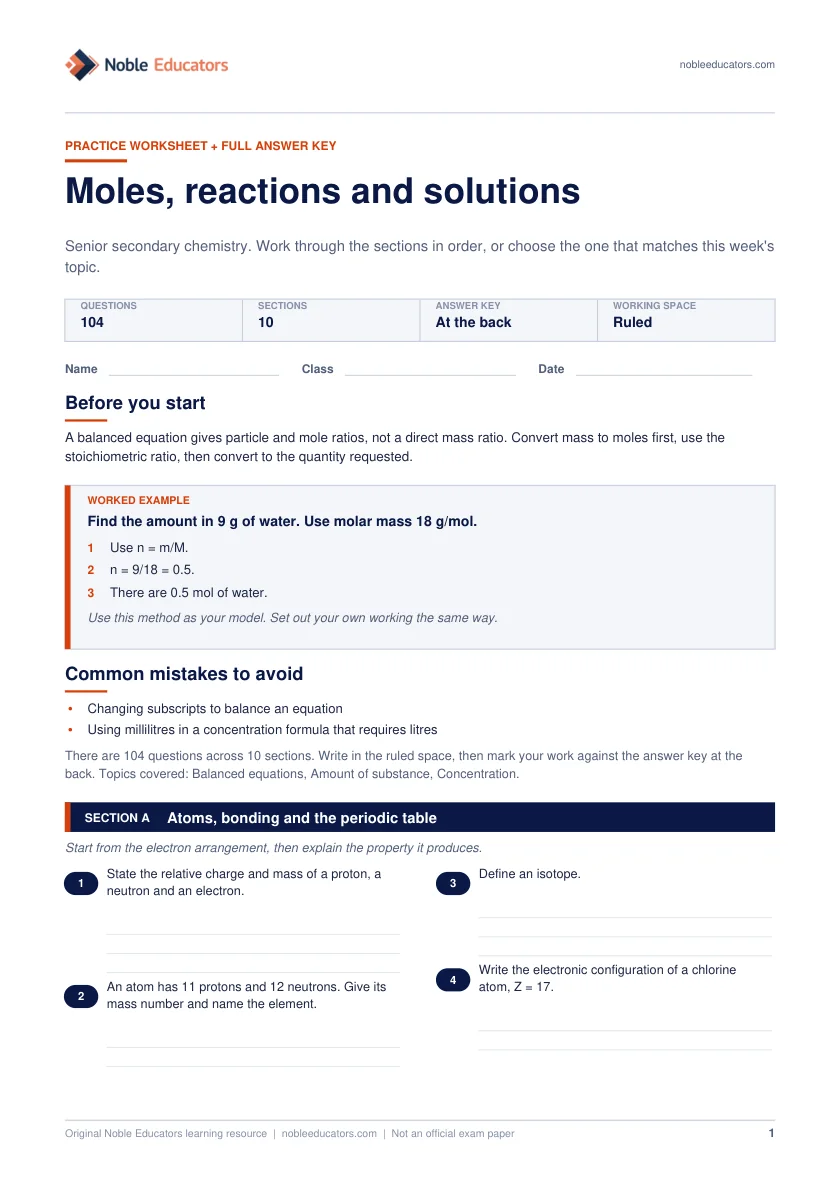
A balanced equation gives particle and mole ratios, not a direct mass ratio. Convert mass to moles first, use the stoichiometric ratio, then convert to the quantity requested. Lessons can alternate a modelled example, a question attempted together and an independent attempt so the tutor can see where understanding changes.
06Use school feedback to guide revision
Bring a recent question, marked solution or topic checklist. Explain where you got stuck. The next practice task should check that particular skill before introducing more complexity. Tutoring supports learning; assessed submissions remain the student’s own work.