What Chemistry 20 covers
The Alberta program of studies for Chemistry 20 has four units: The Diversity of Matter and Chemical Bonding; Forms of Matter: Gases; Matter as Solutions, Acids and Bases; and Quantitative Relationships in Chemical Changes.
One-to-one online tutoring for Chemistry 20 in Alberta. We work through chemical bonding, the gas laws, solutions, acids and bases, and stoichiometry, plus labs and unit tests, at your school’s pace, so Chemistry 30 starts on solid ground.

The Alberta program of studies for Chemistry 20 has four units: The Diversity of Matter and Chemical Bonding; Forms of Matter: Gases; Matter as Solutions, Acids and Bases; and Quantitative Relationships in Chemical Changes.
Your school sets the tests, labs and the final exam; there is no diploma exam for Chemistry 20. The diploma exam comes in Chemistry 30, which builds on this course. The prerequisite is Science 10.
Chemistry 20 (Chemistry 20) is listed in Alberta’s course catalogue at Grade 11. Ask your school for the current course outline and assessment expectations, then share them with your tutor.
Atomic structure and bonding, chemical reactions, quantities in reactions, solutions and gases. Build reliable mole calculations and explain the particle model behind them. Track units through each conversion, balance the equation and use the correct mole ratio. Confirm the current topic sequence and full coverage using your school’s outline and the official source below.
A balanced equation gives particle and mole ratios, not a direct mass ratio. Convert mass to moles first, use the stoichiometric ratio, then convert to the quantity requested. Lessons can alternate a modelled example, a question attempted together and an independent attempt so the tutor can see where understanding changes.
Bring a recent question, marked solution or topic checklist. Explain where you got stuck. The next practice task should check that particular skill before introducing more complexity. Tutoring supports learning; assessed submissions remain the student’s own work.
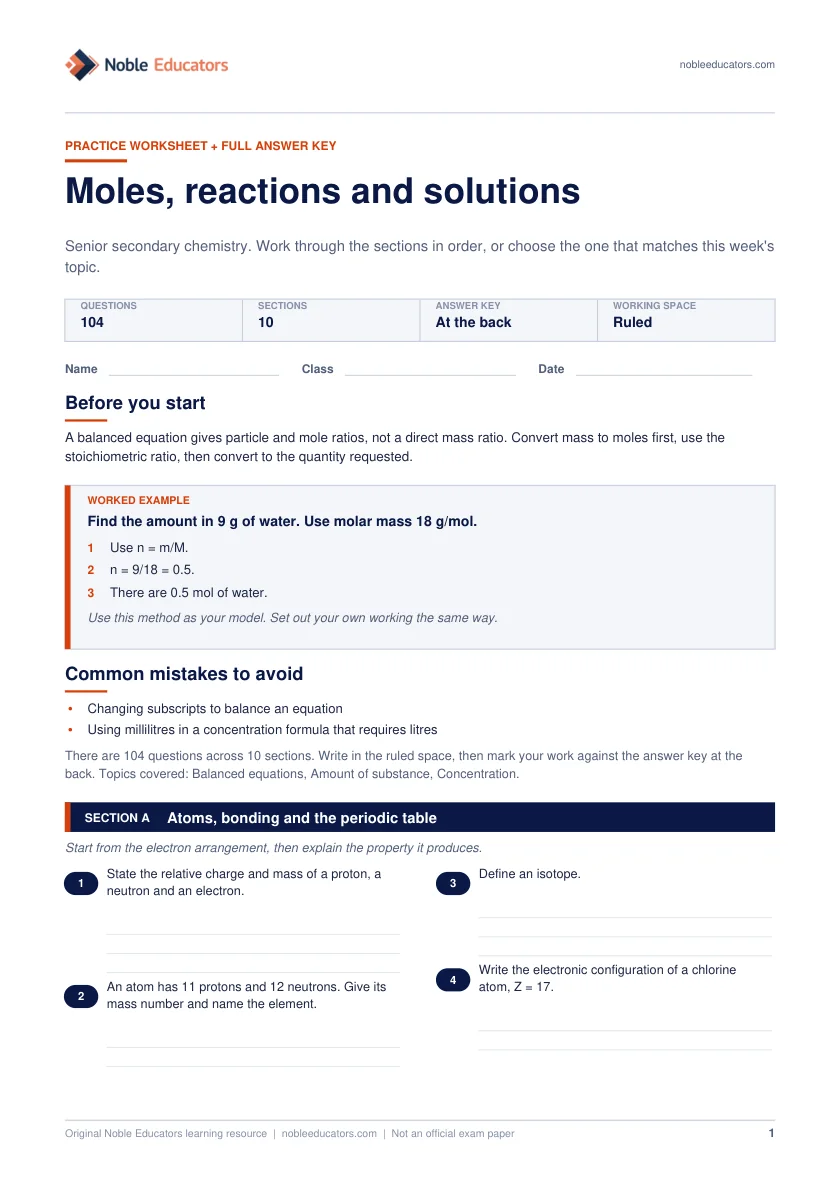 Preview the worksheet
Senior secondary chemistry. A focused topic sample with space to work and an answer key for checking your reasoning.
Original Noble Educators practice. Not an official exam paper or a complete course syllabus.
How it works
From your first enquiry to a learning routine that fits.

Tell us the province, grade, subject and what your child would like help with. A course code or recent assignment helps us understand the starting point.

We use those details to look for a tutor suited to the subject and school pathway. Share any learning or communication preferences with our team.

Meet your tutor online at an agreed time. Ask questions, try a topic and see whether the approach feels right before continuing.

Plan focused lessons and practice around schoolwork. Use progress notes to see what was covered and what to work on next.
No obligation to continue.

Personal support, every lesson
Private online tutoring that starts with what your child needs to understand.
Province, grade and subject guide the tutor match. Bring their schoolwork so lessons can focus on the topics that matter now.
Work through difficult steps, revisit foundations and practise at a pace that works for your child.
Ask about optional lesson recordings. Availability and consent are discussed before recording.
Agree on a time in your family’s time zone
Know what was covered and what comes next
Meet your tutor before deciding to continue
Assessments & exam prep
Find a starting point for school assessments, senior courses and university application goals.

The relevant assessment depends on the province, grade, subject and school programme. These links describe different pathways, not a list of exams every student takes.
Check the pathway that applies to your school.
OntarioEQAOOntario literacyOSSLTBritish ColumbiaGraduation assessmentsAlbertaDiploma examsTell us the exact exam, level and target date.
US applicationsSAT preparationAP subjectsAdvanced courseworkIB programmesCourse supportMore examsExplore test preparationShare your province, grade and school details. We’ll help you find the right starting point.
No. Diploma exams are written only in 30-level courses. Your school’s tests, labs and final exam make up the Chemistry 20 mark.
Most students find stoichiometry the hardest, because mole calculations need careful, step-by-step working. Tutoring helps most when that unit starts.
Yes. Chemistry 20 is the prerequisite for Chemistry 30, which many science, engineering and health science programs require.
Use the current school or awarding-body guidance for full requirements. Noble Educators provides independent tutoring.
Alberta official course catalogue ↗