What Chemistry 30 covers
The Alberta program of studies for Chemistry 30 has four units: Thermochemical Changes; Electrochemical Changes; Chemical Changes of Organic Compounds; and Chemical Equilibrium Focusing on Acid–Base Systems.
One-to-one online tutoring for Chemistry 30 in Alberta. We work through thermochemical changes, electrochemical changes, organic chemistry and chemical equilibrium at your school’s pace, and prepare for the diploma exam.

The Alberta program of studies for Chemistry 30 has four units: Thermochemical Changes; Electrochemical Changes; Chemical Changes of Organic Compounds; and Chemical Equilibrium Focusing on Acid–Base Systems.
The diploma exam counts for 30% of the final mark and the school-awarded mark for 70%. Diploma exams are offered in several sessions a year, including January and June. The prerequisite is Chemistry 20.
Chemistry 30 (Chemistry 30) is listed in Alberta’s course catalogue at Grade 12. Diploma-exam course.
Organic chemistry, structure and properties, energy and reaction rates, equilibrium and electrochemistry. Explain how particle interactions support a macroscopic observation. For multi-step calculations, state the reaction, assumptions and units before substituting numbers. Confirm the current topic sequence and full coverage using your school’s outline and the official source below.
A balanced equation gives particle and mole ratios, not a direct mass ratio. Convert mass to moles first, use the stoichiometric ratio, then convert to the quantity requested. Lessons can alternate a modelled example, a question attempted together and an independent attempt so the tutor can see where understanding changes.
Bring a recent question, marked solution or topic checklist. Explain where you got stuck. The next practice task should check that particular skill before introducing more complexity. Tutoring supports learning; assessed submissions remain the student’s own work.
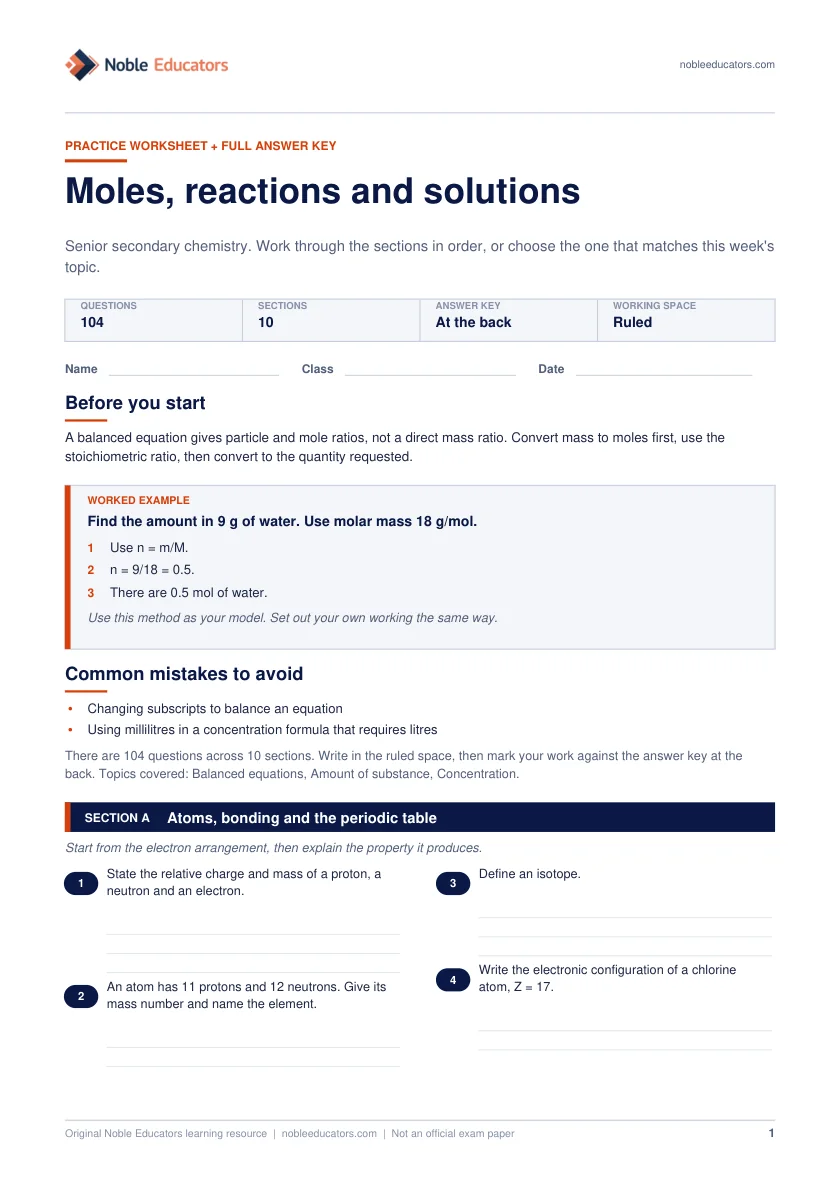 Preview the worksheet
Senior secondary chemistry. A focused topic sample with space to work and an answer key for checking your reasoning.
Original Noble Educators practice. Not an official exam paper or a complete course syllabus.
How it works
From your first enquiry to a learning routine that fits.

Tell us the province, grade, subject and what your child would like help with. A course code or recent assignment helps us understand the starting point.

We use those details to look for a tutor suited to the subject and school pathway. Share any learning or communication preferences with our team.

Meet your tutor online at an agreed time. Ask questions, try a topic and see whether the approach feels right before continuing.

Plan focused lessons and practice around schoolwork. Use progress notes to see what was covered and what to work on next.
No obligation to continue.

Personal support, every lesson
Private online tutoring that starts with what your child needs to understand.
Province, grade and subject guide the tutor match. Bring their schoolwork so lessons can focus on the topics that matter now.
Work through difficult steps, revisit foundations and practise at a pace that works for your child.
Ask about optional lesson recordings. Availability and consent are discussed before recording.
Agree on a time in your family’s time zone
Know what was covered and what comes next
Meet your tutor before deciding to continue
Assessments & exam prep
Find a starting point for school assessments, senior courses and university application goals.

The relevant assessment depends on the province, grade, subject and school programme. These links describe different pathways, not a list of exams every student takes.
Check the pathway that applies to your school.
OntarioEQAOOntario literacyOSSLTBritish ColumbiaGraduation assessmentsAlbertaDiploma examsTell us the exact exam, level and target date.
US applicationsSAT preparationAP subjectsAdvanced courseworkIB programmesCourse supportMore examsExplore test preparationShare your province, grade and school details. We’ll help you find the right starting point.
30% of your final mark. Your school-awarded mark makes up the other 70%.
Most students find electrochemistry and equilibrium the hardest, because they combine calculations with careful reasoning. Tutoring helps most when those units start.
Yes. We review each unit and practise diploma-style questions under time in the weeks before your exam session.
Use the current school or awarding-body guidance for full requirements. Noble Educators provides independent tutoring.
Alberta official course catalogue ↗