01What Calculus 12 covers
The BC curriculum for Calculus 12 covers functions and graphs (including piecewise and inverse trigonometric functions); limits and continuity; differentiation (the rules, implicit differentiation, and applications such as related rates and optimization); and integration (Riemann sums, the fundamental theorem of calculus, substitution and integration by parts, and applications such as area, volume and differential equations).
02How Calculus 12 is assessed
Your school sets the tests and the final exam; there is no provincial exam for Calculus 12. Students usually take it after, or alongside, Pre-calculus 12.
03Your course, clearly identified
Calculus 12 is listed in British Columbia’s course catalogue at Grade 12. Ask your school for the current course outline and assessment expectations, then share them with your tutor.
04Calculus 12: topics to discuss
Rates of change, differentiation, optimisation and geometric or algebraic vector reasoning. Build from function fluency to the derivative as a rate of change. For vectors, draw the geometry and label directions before calculating. Use your course outline to distinguish the calculus and vector strands. Confirm the current topic sequence and full coverage using your school’s outline and the official source below.
05Building confidence in math
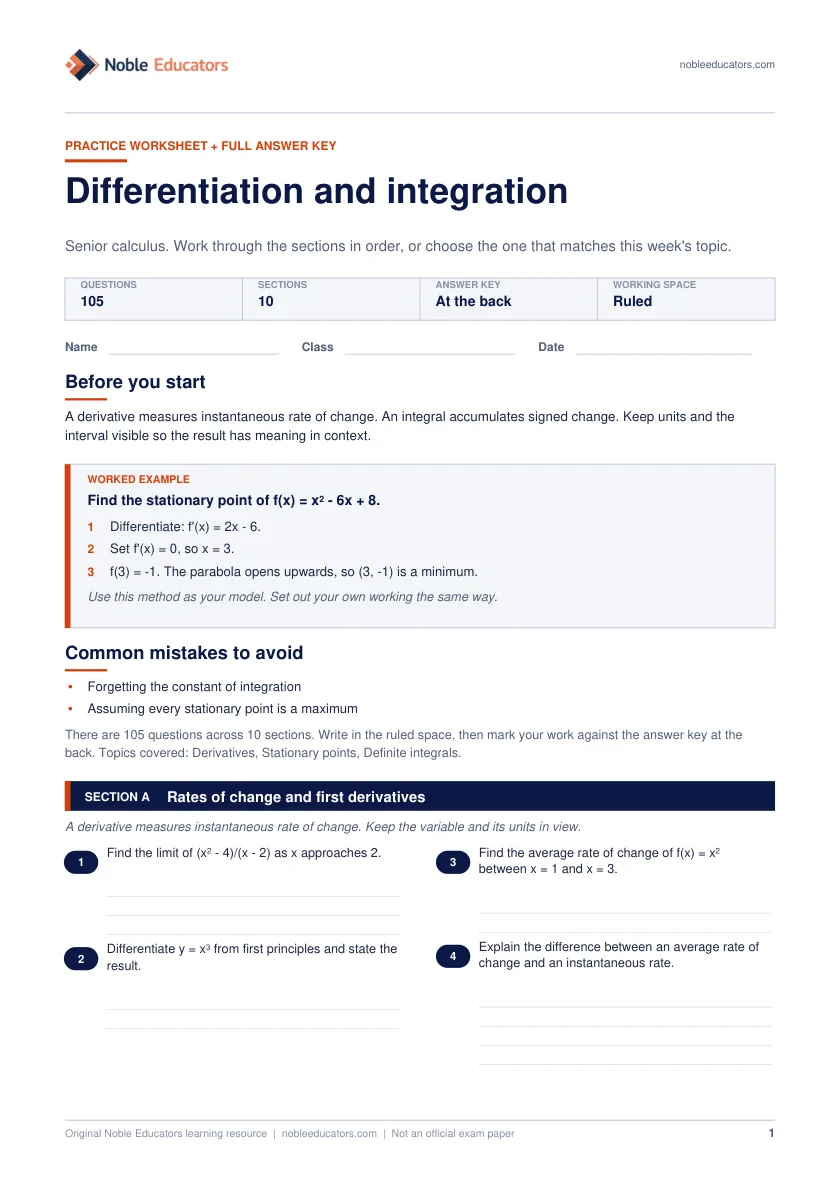
A derivative measures instantaneous rate of change. An integral accumulates signed change. Keep units and the interval visible so the result has meaning in context. Lessons can alternate a modelled example, a question attempted together and an independent attempt so the tutor can see where understanding changes.
06Use school feedback to guide revision
Bring a recent question, marked solution or topic checklist. Explain where you got stuck. The next practice task should check that particular skill before introducing more complexity. Tutoring supports learning; assessed submissions remain the student’s own work.