Your course, clearly identified
Chemistry, University Preparation (SCH4U) is listed in Ontario’s course catalogue at Grade 12. Ask your school for the current course outline and assessment expectations, then share them with your tutor.
One-to-one SCH4U tutoring for Grade 12 students following the Ontario curriculum. Bring your course outline and a question you found difficult: we connect the underlying ideas, show a method and help you practise it independently.

Chemistry, University Preparation (SCH4U) is listed in Ontario’s course catalogue at Grade 12. Ask your school for the current course outline and assessment expectations, then share them with your tutor.
Organic chemistry, structure and properties, energy and reaction rates, equilibrium and electrochemistry. Explain how particle interactions support a macroscopic observation. For multi-step calculations, state the reaction, assumptions and units before substituting numbers. Confirm the current topic sequence and full coverage using your school’s outline and the official source below.
A balanced equation gives particle and mole ratios, not a direct mass ratio. Convert mass to moles first, use the stoichiometric ratio, then convert to the quantity requested. Lessons can alternate a modelled example, a question attempted together and an independent attempt so the tutor can see where understanding changes.
Bring a recent question, marked solution or topic checklist. Explain where you got stuck. The next practice task should check that particular skill before introducing more complexity. Tutoring supports learning; assessed submissions remain the student’s own work.
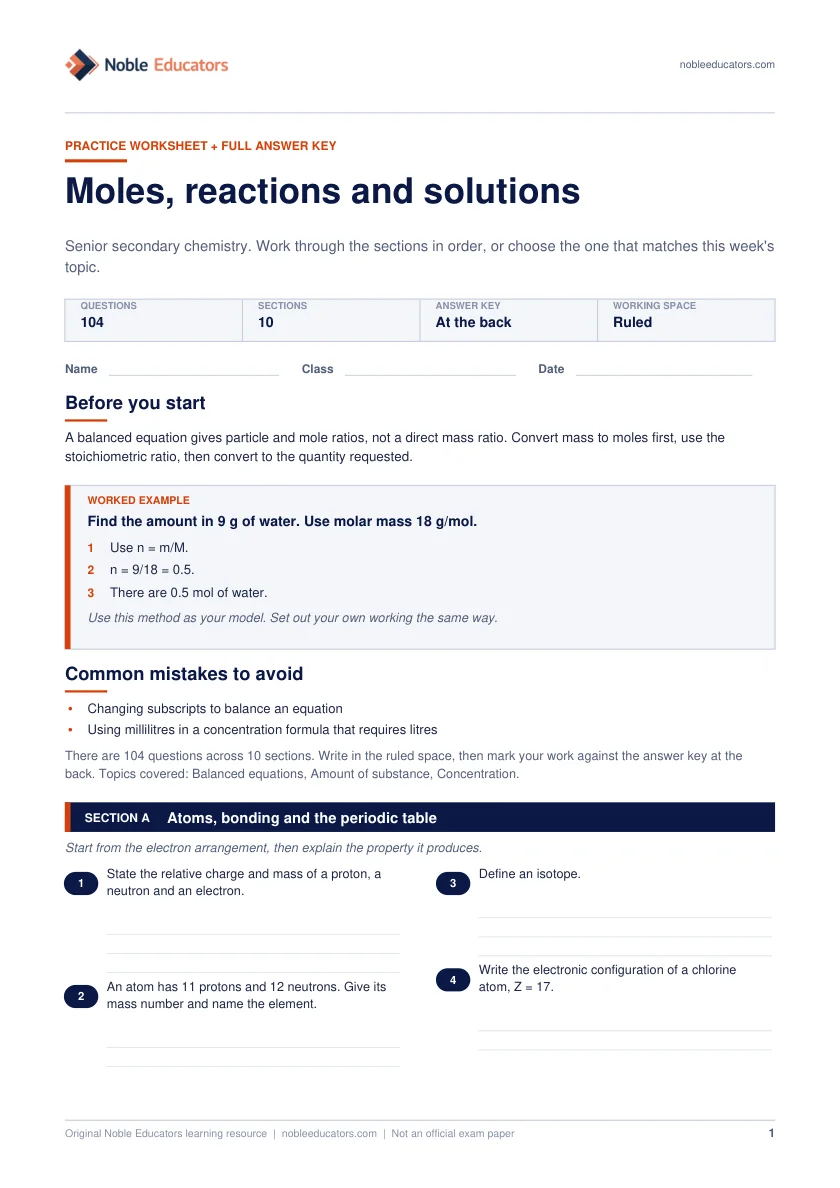 Preview the worksheet
 Senior secondary chemistry. A focused topic sample with space to work and an answer key for checking your reasoning.
Original Noble Educators practice. Not an official exam paper or a complete course syllabus.
Your questions shape the lesson. Your learning continues afterwards.

Work through a difficult idea with a teacher who can adapt the explanation to your questions.
Connect your science lessons with focused practice and review the steps behind each answer.
Revisit an explanation between sessions and bring your follow-up questions to the next lesson.
Keep your lessons and available learning resources together in one place.
Find the relevant test, subject guidance, practice resources and next steps.
Use the current school or awarding-body guidance for full requirements. Noble Educators provides independent tutoring.
Ontario official course catalogue ↗