
Lines, angles, and constructions
- angle relationships and parallel lines
- perpendicular bisectors and constructions
- distance, midpoint, and coordinate setup
- clear diagram labeling
Help your child move from staring at a diagram to knowing what to mark, which theorem applies, and how to write a proof or calculation that makes sense.
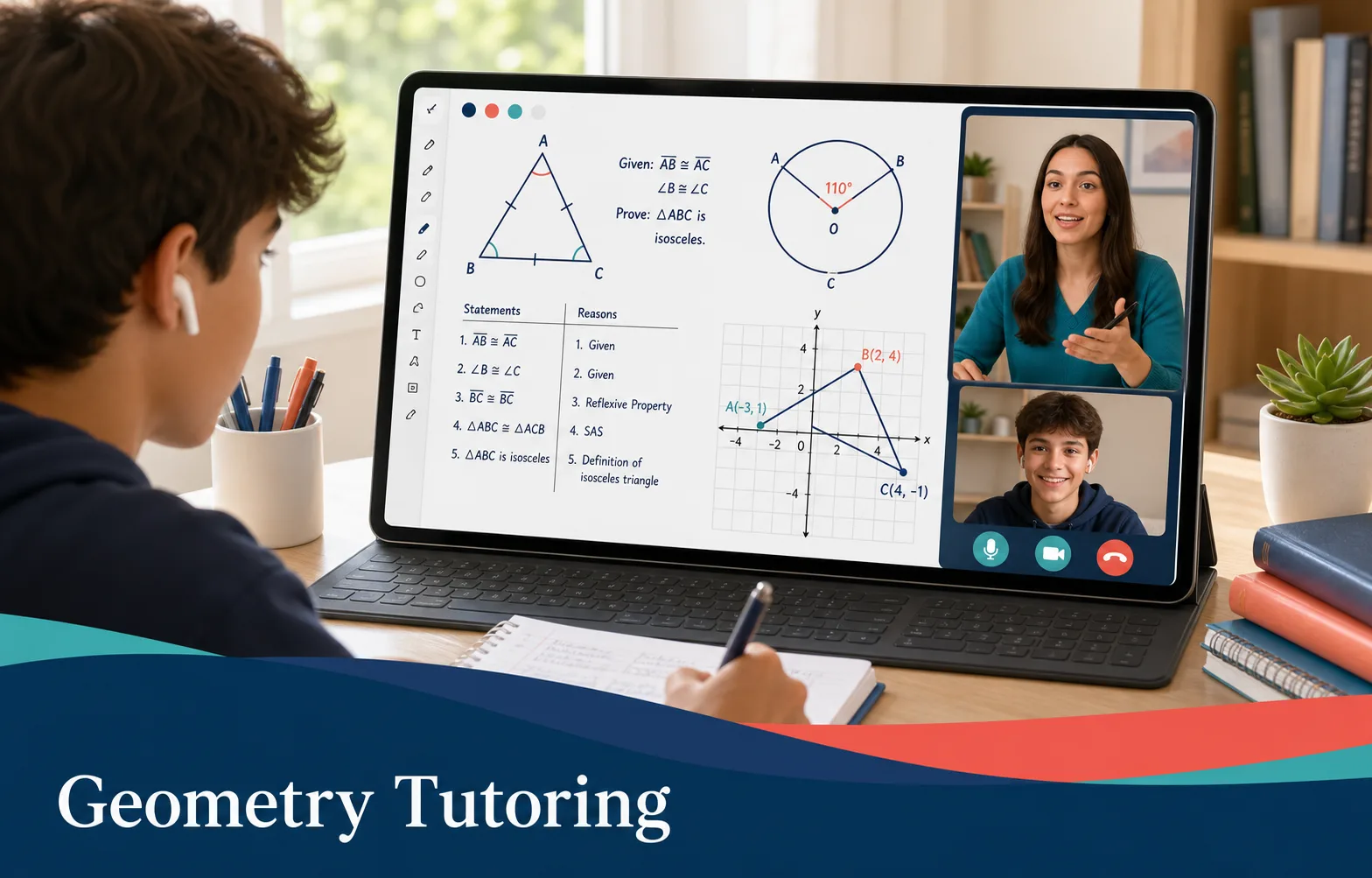
Geometry Tutoring
Proofs, diagrams, circles, area, and volume
Geometry topics
Tutoring follows the student's school sequence while keeping the big Geometry habits visible: mark the diagram, name the relationship, show the reason, and check the result.
How tutoring works
Geometry improves when students stop relying on the picture alone. The tutoring process makes each relationship, theorem, and proof step explicit.
Identify what is given, what needs proving or solving, and which hidden relationships the diagram suggests.
Match the problem to a geometry rule, then write why that rule applies instead of guessing from the picture.
Use labeled diagrams, algebra, proof statements, and units so each step can be checked and repeated.
Decide whether the error came from setup, theorem choice, algebra, diagram reading, or incomplete explanation.
Goal
Prove triangle ABC congruent to triangle DEF
Find matching sides and angles before choosing SSS, SAS, ASA, AAS, or HL.
Given
AB = DE
Mark
included angle
Rule
SAS
Step 1
Read the givens
Step 2
Mark the diagram
Step 3
Name the theorem
Tutor prompt
Explain the reason
"Which fact proves those angles are congruent?"
Response checklist
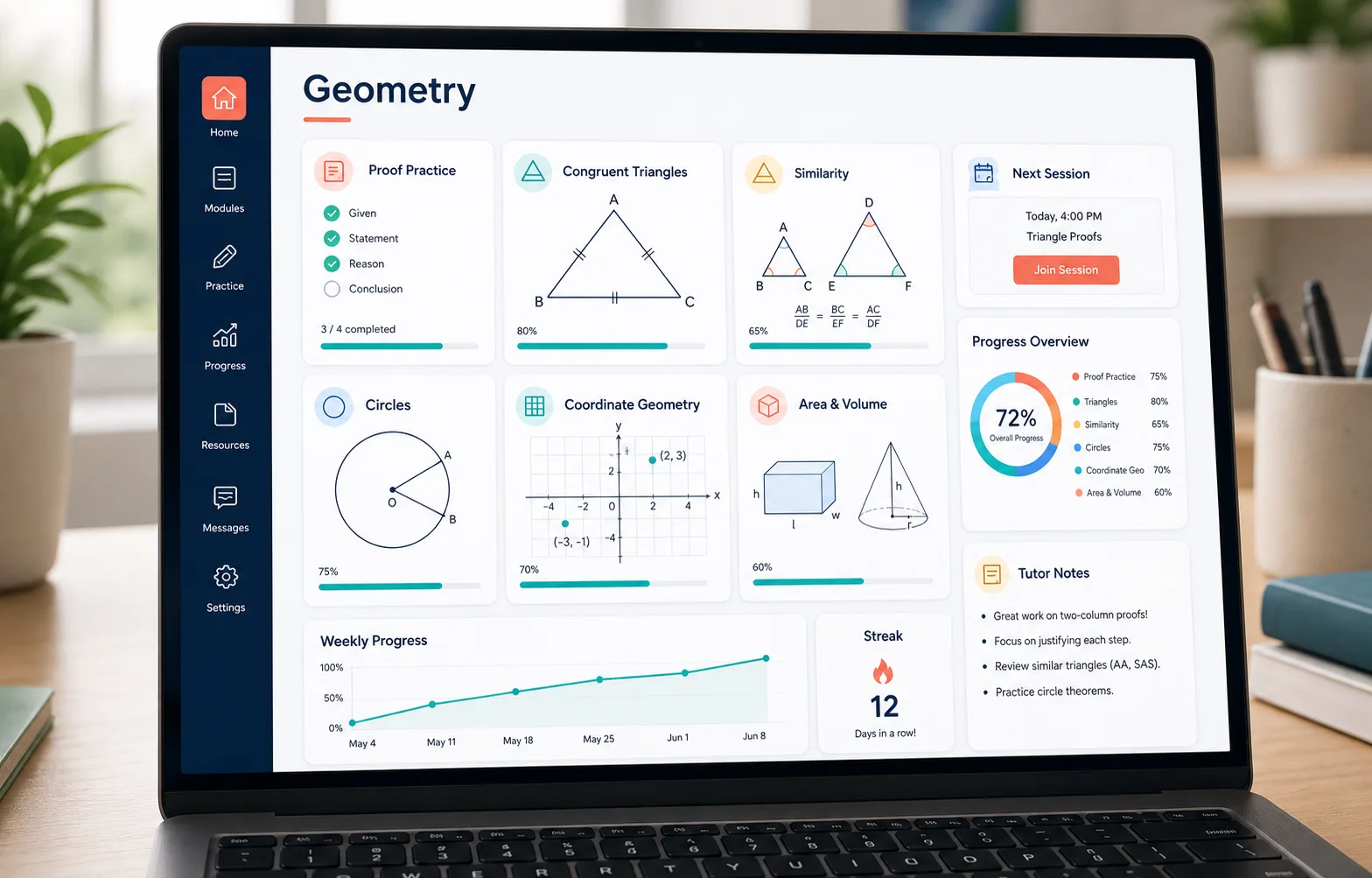
Geometry Tutoring
Personal learning hub
Student learning hub
A useful Geometry workspace makes the next practice target clear. Students can keep tutoring sessions, marked diagrams, proof notes, and upcoming assessments connected to the same learning plan.
Keep the join link, current unit, and upcoming Geometry session details ready before tutoring starts.
Organize proof templates, theorem reminders, and the next diagram skill the student needs to practice.
Save marked diagrams, constructions, coordinate setups, and tutor feedback in one learning workspace.
Track which topics are secure and which need another pass before quizzes, tests, finals, or Regents-style review.
1-on-1 class interface
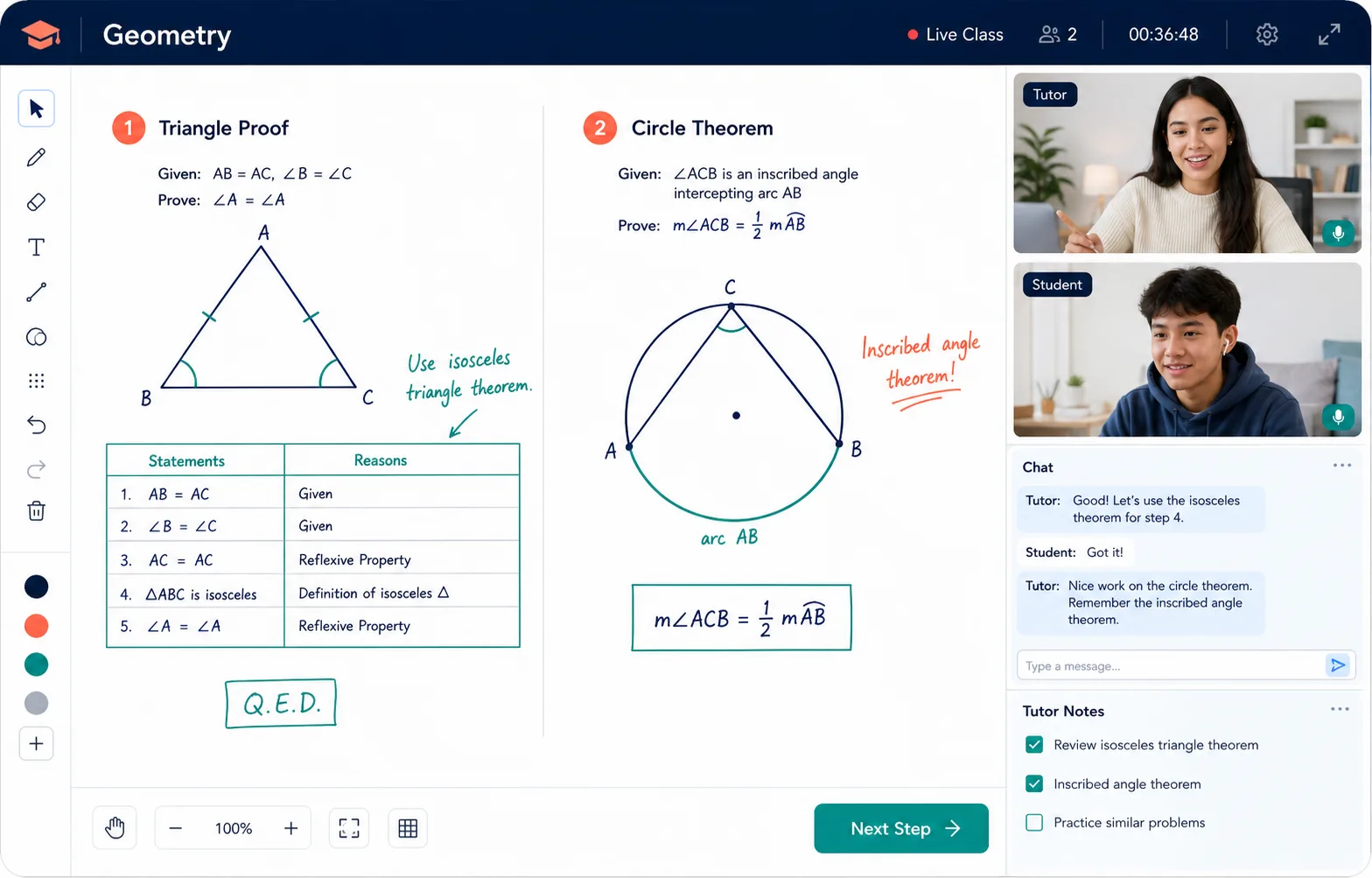
The shared class space makes the work visible: a tutor can mark a diagram, write a proof table, test a theorem, and help the student explain why each step follows.
A shared whiteboard keeps the diagram, theorem choice, algebra, proof statements, and final explanation visible together.
The tutor can ask why a student chose a congruence or similarity rule before refining the reasoning.
Each session ends with the next diagram or proof habit to practice, so Geometry feels less like memorizing isolated rules.
Geometry readiness planning
Geometry is usually the first math course where students must justify each step in writing. Tutoring builds the course around four practical habits: read the diagram, name the relationship, show the reason, and check the result against the shape.
Common first-session materials
A recent proof, a quiz, homework photos, a teacher review guide, or a unit list helps the tutor decide whether to start with theorem choice, algebra setup, diagram annotation, or written explanation.
Students practice converting givens into marked diagrams, then into statements and reasons. The goal is to make proof writing feel like a chain of justified decisions instead of a blank page.
Coordinate geometry, similarity, right triangles, circles, area, and volume often depend on equation solving, slope, radicals, proportions, and careful substitution. Tutoring repairs those algebra gaps as they appear.
The tutor helps students annotate what is known, separate what is drawn from what is proven, and choose a theorem only after the diagram supports it.
Sessions can work from teacher review packets, Regents-style questions, state assessment practice, or a school final so review stays tied to the format the student will actually face.
Geometry resources
These branded resources keep proof routines, triangle relationships, circles, coordinate geometry, and measurement formulas together. They are designed to support a tutoring session, independent review, or a conversation with a parent about the next study target.
Given statements, definitions, postulates, theorems, CPCTC, and two-column or paragraph-proof structure.
Congruence, similarity, right-triangle relationships, special triangles, and basic trigonometry.
Distance, midpoint, slope, parallel and perpendicular lines, and classifying shapes from coordinates.
Arc measures, chords, tangents, secants, inscribed angles, sector area, and circle equations.
Area, perimeter, surface area, volume, composite figures, units, and precision.
Mixed-review sets, diagram annotation, theorem selection, algebra checks, and written explanations.
Five print-friendly pages covering proof strategy, angle relationships, congruent triangles, similarity, circles, coordinate geometry, area, surface area, and volume.
Open Review Guide PDFSix printable pages with 50 Geometry questions across proofs, triangles, circles, coordinate geometry, measurement, and written reasoning, with a full answer key.
Open Practice Worksheet PDFPricing comparison
Provider pricing and packages change, so families should confirm current terms directly. This comparison shows how the Noble Educators session model differs from other familiar online learning options.
| Provider | Pricing model shown | Format | Best fit |
|---|---|---|---|
Noble EducatorsNoble rate | $17 / session | 1-on-1 online Geometry tutoring | Families who want school-aligned Geometry support, proof practice, diagram reasoning, and a clear per-session rate. |
Wyzant | Tutor-set rates | Tutor marketplace | Families who prefer browsing individual tutor profiles and rates. |
Varsity Tutors | Plan-based pricing | Live tutoring and memberships | Families considering a larger tutoring package or membership model. |
Tutor.com | Subscription plans | On-demand tutoring | Students who need quick homework help across several subjects. |
Outschool | Class-specific pricing | Live and self-paced classes | Families looking for group classes as well as private learning options. |
Khan Academy | Free self-guided practice | Videos and practice activities | Independent review, rather than recurring live 1-on-1 tutoring. |
Common challenges
Geometry asks students to read visuals, justify relationships, and combine algebra with spatial reasoning. Focused tutoring makes that thinking visible.
Tutors help students connect each statement to a definition, postulate, theorem, or previous step so proof writing becomes a repeatable process.
Lessons train students to mark congruent parts, parallel lines, right angles, arcs, and coordinates before choosing a rule or equation.
Students practice choosing a formula from the shape, labeling units, and checking whether the answer makes geometric sense.
Some students need proof support before congruence and similarity. Others need coordinate geometry, circles, area and volume, or final-exam review. Noble Educators can match the inquiry to a tutor who fits the student's level, curriculum, and goal.
Meet our teachersParents can share a current unit, worksheet photo, proof attempt, quiz, or teacher note before tutoring begins. That gives the tutor a practical starting point and helps each session focus on the Geometry skill that matters next.
See how it worksQuestions parents ask
Related tutoring
Compare related math support, tutor options, pricing, and the next steps behind a focused tutoring plan.
Share the student's grade, current Geometry focus, and what feels difficult. Noble Educators will help you choose the most useful next step.