Read the physics system
Start with the object, reference frame, directions, known and target quantities, variables, graph labels, and prompt parts before deciding what relationship matters.
Help your child connect Honors Physics diagrams, graphs, equations, measurements, and lab observations into accurate physical explanations. A dedicated tutor can support kinematics, forces, energy, momentum, waves, and electricity while building stronger homework, lab, and assessment habits.

Today's focus
Forces, graphs, and physical evidence
Connect a model and units to a clear explanation.
Start with the object, reference frame, directions, known and target quantities, variables, graph labels, and prompt parts before deciding what relationship matters.
Use a free-body diagram, vector drawing, motion graph, energy model, circuit, data table, or equation to organize the evidence before writing the response.
Practice naming the observation, units, graph slope or area, experimental result, or model feature that makes a physics conclusion defensible.
Turn a correct fact or calculation into a complete response by connecting the direction, force, energy change, or evidence to a precise scientific explanation.
What we support
Strong Honors Physics work requires more than a correct formula or number. Tutoring helps students identify the system, diagram, graph, quantity, or evidence in front of them, make an accurate model or calculation, and explain the relationship in context.
How tutoring works
Physics support is most useful when the student sees how the system, directions, diagram, equation, units, observation, evidence, calculation, and explanation work together. The tutoring process keeps that chain visible and repeatable from one honors unit to the next.
Review the unit, diagram, graph, lab, assessment result, or teacher feedback to identify whether the real gap is a concept, system model, calculation path, data analysis, or written explanation.
Name the object, reference frame, known and target quantities, forces, axes, independent and dependent variables, or graph trend before starting work.
Use a free-body diagram, motion graph, energy bar chart, circuit, data table, or equation setup with guided practice that includes units, evidence, and an accurate explanation.
Confirm every answer responds to the prompt, shows a valid model or observation, uses appropriate significant figures, and explains the physical relationship precisely.
Free-body setup
Sum F parallel = m a
A 5.0 kg block is on a 30 degree incline. A 40 N force acts up the plane and 8.0 N friction acts down the plane.
Mass
5.0 kg
Net force
7.5 N up
Acceleration
1.5 m/s^2 up
Step 1
Choose the object
Step 2
Resolve forces
Step 3
Check units and direction
Tutor prompt
Connect forces to acceleration
"Which forces act along the incline, and what does the sign of the net force say about the acceleration?"
Response checklist
Honors Physics Tutoring
Physics learning workspace
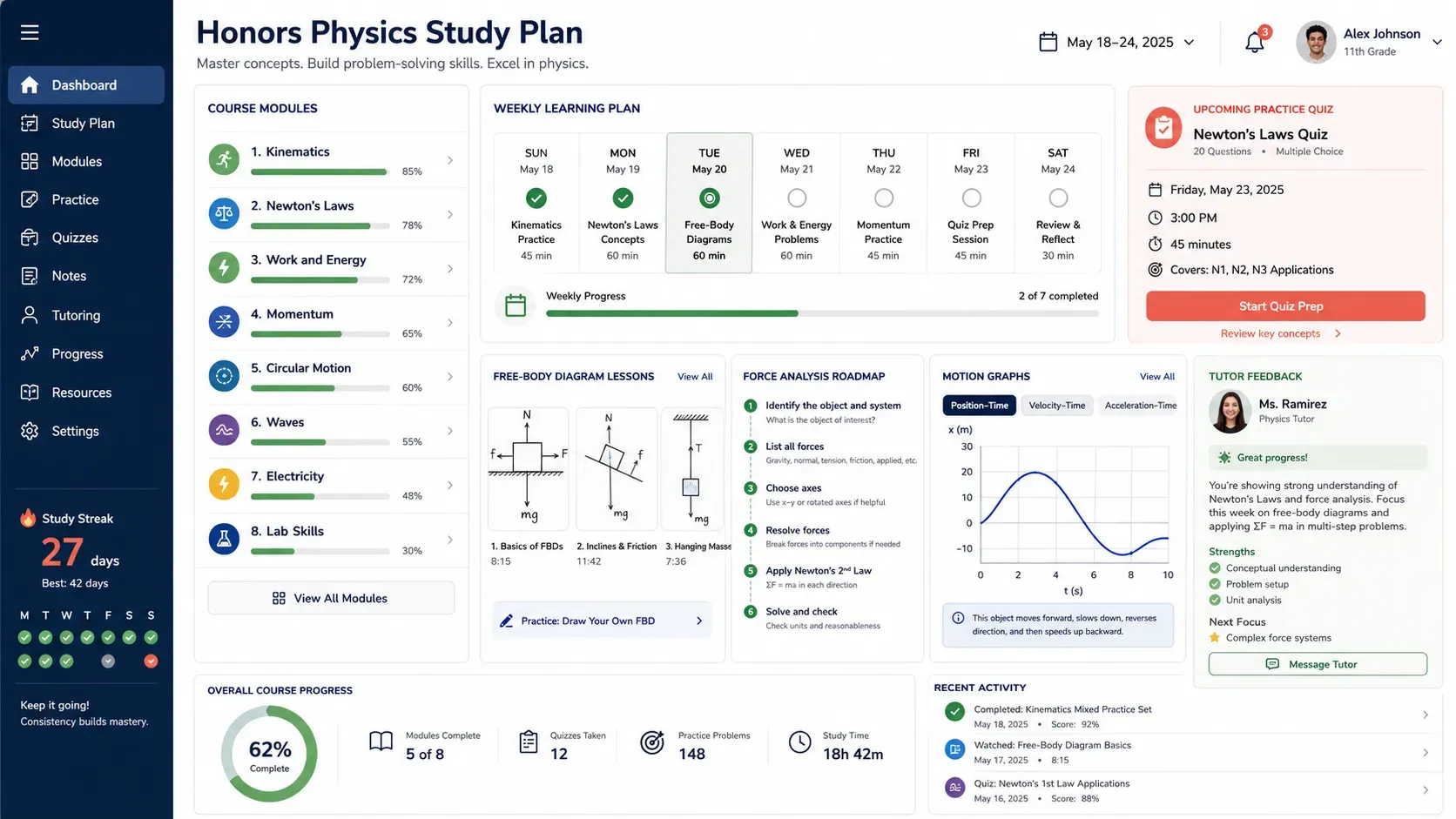
Student learning hub
A useful learning hub makes the next practice target clear. Students can keep tutoring sessions, diagrams, equations, class notes, lab preparation, progress checks, study resources, and upcoming assessments connected to the same learning plan.
Keep the join link, lesson focus, current unit, model practice, and upcoming assessment details easy to find before tutoring starts.
Keep motion, forces, energy, circuits, lab vocabulary, diagrams, and unit-check reminders close during review.
Organize classroom work, diagrams, calculations, data-response questions, and next-step review around the physics skill the student needs.
Print structured Honors Physics practice with space to show diagrams, units, calculations, evidence, and a complete answer key.
Bring free-body diagrams, motion graphs, equation references, and lab measurements together in one workspace.
1-on-1 class interface
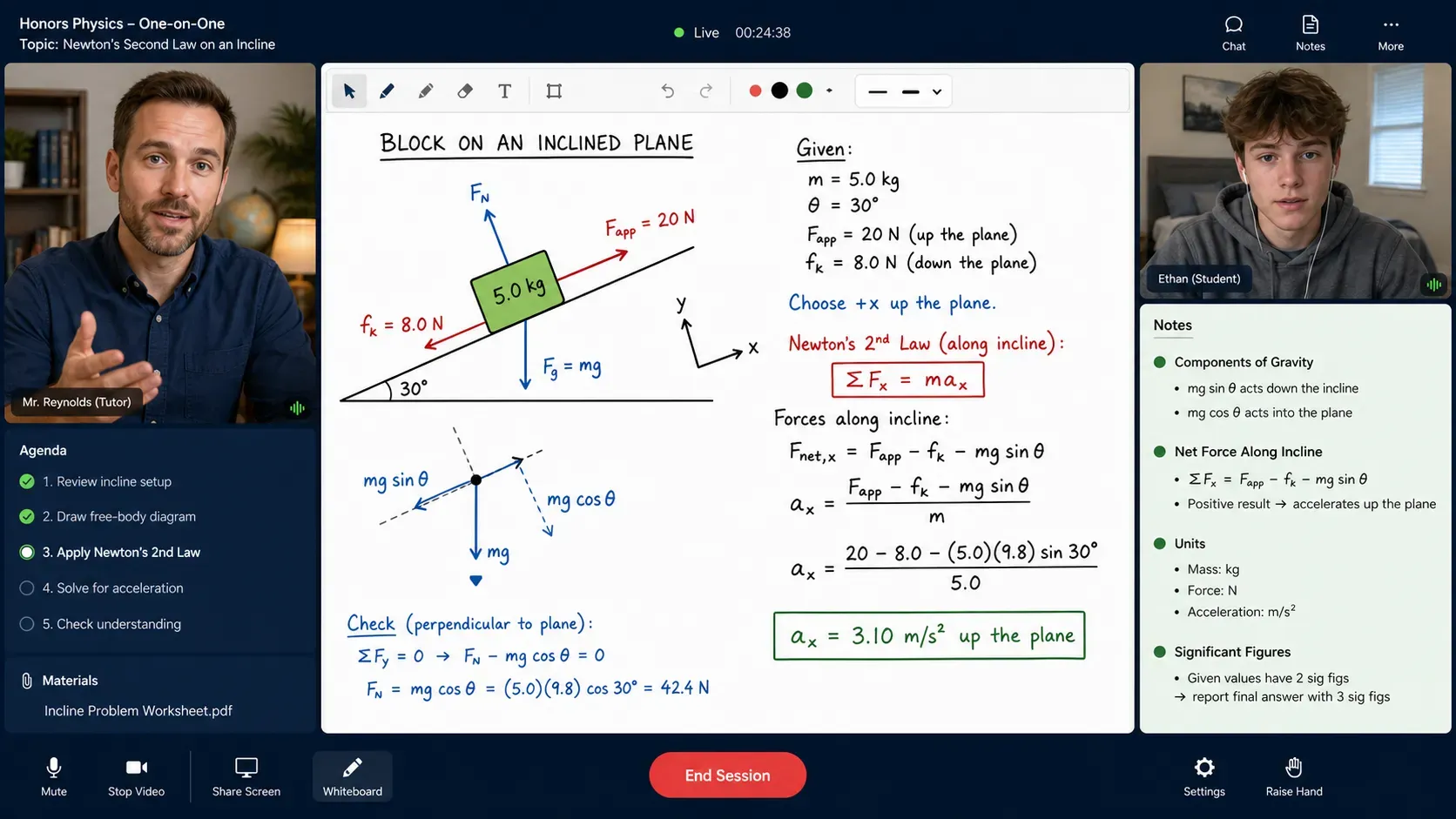
A strong online class gives the student a visual workspace for the physical system, free-body or vector diagram, units, equation path, evidence, calculation, and physics explanation. The tutor can guide the response without hiding the reasoning that matters.
A shared whiteboard keeps the system, free-body diagram, chosen axes, force components, net-force equation, units, and directional conclusion visible together while the tutor guides each step.
Video-based 1-on-1 support lets the tutor hear how a student interprets a motion graph, force system, circuit, experiment, or energy model before refining the physical reasoning.
A focused checklist, notes, and worked examples help students practice the complete chain from model to equation to units to calculation to explanation.
Honors Physics assessment planning
Honors Physics courses are school-specific, so tutoring begins with the student's syllabus, current unit, teacher expectations, and upcoming tests or labs. Lessons combine core content, diagrams, vectors, unit-aware calculations, data interpretation, and the physical explanations students need for quizzes, written responses, practical work, and unit assessments.
Noble Educators is an independent tutoring provider. Families can share the teacher's rubric, course sequence, accommodations, and assessment dates so practice fits the student's own Honors Physics course.
Systems | vectors | graphs | equations
Prepare: Review terms through relationships, not isolated lists: force to acceleration, graph feature to motion, energy change to work, and current to circuit behavior.
Practice: Draw free-body diagrams, label vectors, read slopes and areas, choose an equation, and connect a system-level change to an observable outcome.
Units | variables | evidence | conclusions
Prepare: Identify the question, known and target quantities, system boundaries, axes, independent and dependent variables, comparison groups, controls, and data pattern before writing.
Practice: Use diagrams, signed equations, significant figures, and claim-evidence-reasoning to connect a result to a physical model and acknowledge limits where appropriate.
Plan from the current school calendar
Bring an upcoming quiz, test, lab report, problem set, or project due date. Tutoring can sequence concept review, practice, and feedback around the student's actual course pace.
Tutoring uses the course rubric or teacher feedback when available. Students learn to show diagrams and units, use appropriate significant figures, cite relevant evidence, use accurate physics vocabulary, and explain the force, motion, energy, or circuit relationship that links evidence to conclusion.
Study resources
Use the structured study guide to review motion, forces, energy, momentum, circular motion, waves, electricity, and laboratory reasoning, then use the printable worksheet for focused practice with room to show diagrams, units, interpret evidence, and use a complete answer key.
Study guide: 5 detailed pages for motion, forces, energy, waves, circuits, and lab reasoning.
Worksheet: 5 printable pages with guided practice, response space, and answers.
Vectors, motion equations, position-time and velocity-time graphs, slopes, areas, and directional interpretation.
Free-body diagrams, Newton's laws, net force, friction, tension, inclines, components, and acceleration.
Work, power, kinetic and potential energy, conservation, impulse, collision models, and efficiency.
Centripetal acceleration, radial forces, gravitation, orbital motion, and clear direction analysis.
Wave relationships, sound, light, charge, current, voltage, resistance, circuits, and electric power.
Units, significant figures, variables, uncertainty, graph interpretation, evidence, and clear conclusions.
Pricing comparison
Providers revise their rates and bundles regularly, so confirm the current terms yourself. Use this table to see how a straightforward per-session Honors Physics plan sits next to marketplace, subscription, and group-class alternatives.
| Provider | Pricing model shown | Format | Best fit |
|---|---|---|---|
Noble EducatorsNoble rate | $18 / session | 1-on-1 online Honors Physics tutoring | Families who want school-aligned Honors Physics support, lab and assessment practice, and a clear per-session rate. |
Wyzant | Tutor-set rates | Tutor marketplace | Families who prefer to browse individual tutor profiles and available rates. |
Varsity Tutors | Plan-based pricing | Live tutoring and memberships | Families considering a larger tutoring package or membership model. |
Tutor.com | Subscription plans | On-demand tutoring | Students who need quick homework help across several subjects. |
Outschool | Class-specific pricing | Live and self-paced classes | Families looking for group classes as well as individual learning options. |
Khan Academy | Free self-guided practice | Videos and practice activities | Independent review, rather than recurring live 1-on-1 tutoring. |
Common challenges
Honors Physics asks students to connect diagrams, directions, equations, measurements, calculations, and evidence instead of only memorizing formulas. Focused tutoring makes the model behind each response more visible.
Tutors connect a variable, diagram, graph, and equation so students can explain how an object moves or interacts instead of only substituting numbers into a formula.
Students learn to choose the object, draw every force, set axes, resolve components, write net-force equations, and use the sign of the result to interpret direction.
Guided practice makes variables, controls, measurement uncertainty, graph slopes and areas, sources of error, and evidence-based conclusion writing visible before the student writes.
Some students need a patient return to vectors, units, and motion before forces or energy. Others need help with a difficult lab report, velocity-time graph, free-body diagram, circuit problem, upcoming assessment, or stronger physical explanations. Noble Educators can match the inquiry to a tutor who fits the student's level, curriculum, and goal.
Meet our teachersParents can share a current unit, lab prompt, data table, diagram, motion graph, equation, calculation, recent score, or teacher note before tutoring begins. That gives the tutor a practical starting point and helps each session focus on the physics skill that matters next in class.
See how it worksQuestions parents ask
Related tutoring
See how Honors Physics connects to the other honors sciences and to AP Physics 1, or check pricing as you plan the next step.
Share the student's grade, current Honors Physics focus, and what feels difficult. Noble Educators will help you choose the most useful next step.