Draw the system first
Start with the object or system, a diagram, and a coordinate direction before choosing an equation.
Help your child connect motion, forces, energy, momentum, rotation, and gravitation to the calculus behind them, and to complete, defensible AP Physics C: Mechanics responses. A dedicated tutor supports classwork and AP exam preparation with live explanation, calculus-based problem solving, and clear next steps.

Today's focus
Model, set up the calculus, and check
Let the math serve the physics.
Start with the object or system, a diagram, and a coordinate direction before choosing an equation.
Decide whether Newton's laws, energy, momentum, or rotation is the fastest route to the answer.
Translate the principle into the right derivative or integral, and keep track of variables and units.
Confirm units, signs, and limiting cases, and write the justification a reader can follow.
What we support
Strong AP Physics C: Mechanics work is more than a memorized formula. Tutoring helps students draw the model, choose a governing principle, carry out the calculus, and explain why the result is physically reasonable across classwork and AP-style practice.
How tutoring works
AP Physics C: Mechanics rewards students who can move from a diagram, to the right principle, to the calculus, to a checked answer. The tutoring process keeps that chain visible and repeatable from one unit to the next.
Review the unit, a problem set, or a released free-response question to decide whether the gap is the physics model, the calculus, the vectors, or the written explanation.
Before computing, draw a free-body or system diagram, choose the governing principle (Newton's laws, energy, momentum, or rotation), and set up the derivative or integral.
A tutor models one problem end to end — diagram, equation, calculus, and a check — then guides fresh practice on a similar item.
Confirm the result has the right units, sign, and limiting behavior, and that the explanation would earn full free-response credit.
Non-uniform acceleration
a(t) = 6t, v(0) = 0
Find v(t) and the velocity at t = 2 s by integrating the acceleration.
Integrate
v = INT a dt
Apply
v(0) = 0
Evaluate
v(2) = 12 m/s
Step 1
Set up the integral
Step 2
Use the initial condition
Step 3
Evaluate and check units
Tutor prompt
Reason with calculus
"Why does the constant of integration matter here?"
Response checklist
AP Physics C: Mechanics Tutoring
AP readiness workspace
Student learning hub
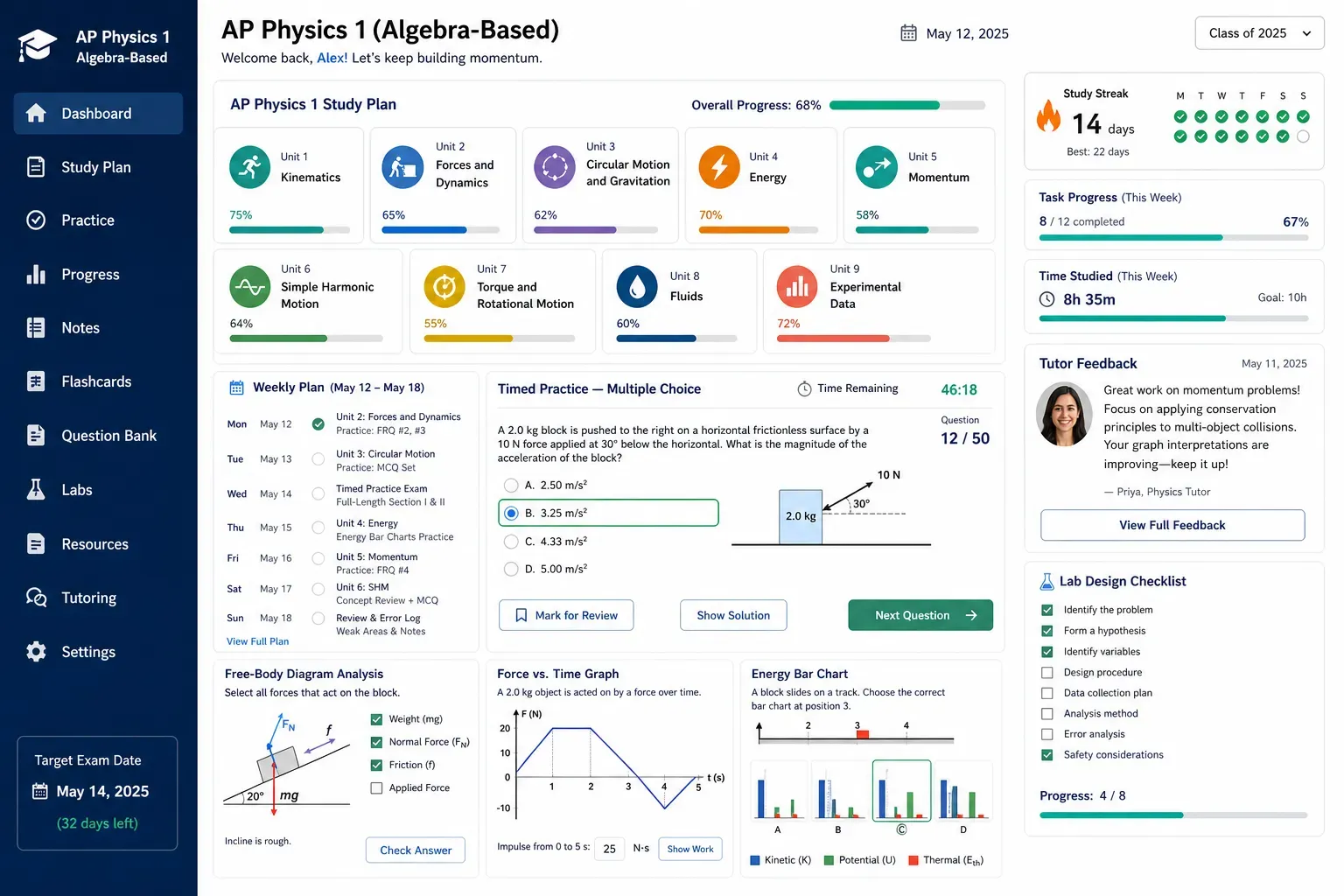
A useful learning hub makes the next practice target clear. Students can keep tutoring sessions, AP-style prompts, progress checks, study resources, and upcoming assessments connected to the same learning plan.
Keep the join link, lesson focus, current problem set, and upcoming AP Physics C: Mechanics session details ready before tutoring begins.
Keep kinematics, dynamics, energy, momentum, rotation, oscillations, gravitation, and the equation sheet in one branded guide.
Organize calculus setups, diagram work, tutor feedback, and the next study target in one place.
Print structured AP Physics C: Mechanics practice with room to draw a model, show the calculus, track units, and check a clear answer key.
Bring classroom notes, the equation sheet, diagrams, lab data, and review material together in one focused workspace.
1-on-1 class interface
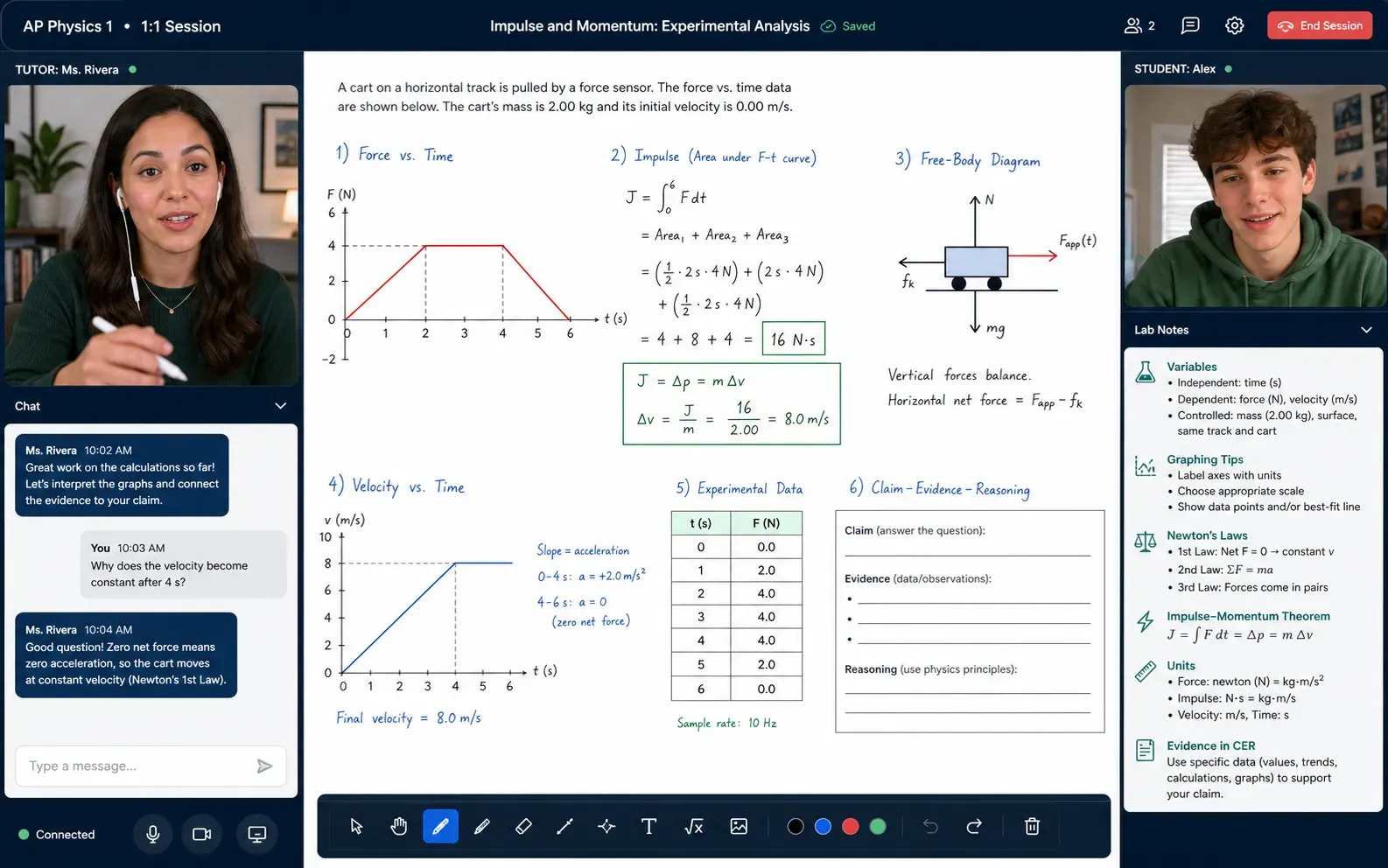
The shared class space makes the work visible: a tutor can draw a free-body diagram, set up an integral or derivative, annotate a graph, and help the student explain why the result is physically reasonable.
A shared whiteboard keeps the system, the free-body diagram, the graph, the calculus, the units, and the written conclusion visible together while the tutor guides each decision.
Video-based 1-on-1 support lets the tutor hear why a student chose a system, a principle, or a calculus step before refining the reasoning.
Focused notes, a diagram-first routine, and a units-and-limits check help students repeat a complete AP Physics C: Mechanics response on a new prompt.
AP Physics C: Mechanics exam planning
AP Physics C: Mechanics is a calculus-based exam with two equally weighted sections — multiple choice and free response. A calculator and the official equation sheet are permitted throughout. Because question counts, timing, and delivery format can change, confirm the current specifications and your exam date directly with College Board.
Noble Educators is an independent tutoring provider and is not affiliated with or endorsed by College Board. Confirm the exam date, format, scoring, and accommodations directly with College Board.
A multiple-choice section and a free-response section, each worth half of the score, spanning kinematics through gravitation.
Questions use derivatives and integrals throughout, so students must show calculus-based setups rather than only plugging into formulas.
A calculator and the official AP Physics C equation sheet are permitted for the whole exam. Tutoring builds both the setups and the reasoning behind them.
Confirm the current question counts, timing, and delivery format with College Board, then plan timed practice and released free-response work backward from your exam date.
Official AP exam datesAP Physics C: Mechanics resources
These branded resources keep the seven AP Physics C: Mechanics units, the equation sheet, calculus setups, and free-response review together. They are designed to support a tutoring session, independent review, or a conversation with a parent about the next study target.
Motion as derivatives and integrals, vectors, free-body diagrams, Newton's laws, and differential equations of motion.
Work integrals for variable forces, potential energy, conservation of energy, power, and F = -dU/dx.
Center of mass, impulse-momentum theorem, force-time graphs, and elastic and inelastic collisions.
Moment of inertia, torque, rotational energy, rolling, and conservation of angular momentum.
Simple harmonic motion, energy in oscillators, universal gravitation, orbits, and gravitational potential energy.
The equation sheet, calculus-based setups, showing work, carrying units, and clear physics justification.
Five detailed pages for kinematics, dynamics, energy, momentum, rotation, oscillations, gravitation, and free-response strategy.
Open Review Guide PDFFive printable pages with calculus-based practice across kinematics, forces, energy, momentum, and rotation, with a full answer key.
Open Practice Worksheet PDFPricing comparison
Provider pricing and packages change, so families should confirm current terms directly. This comparison shows how the Noble Educators session model differs from other familiar online learning options.
| Provider | Pricing model shown | Format | Best fit |
|---|---|---|---|
Noble EducatorsNoble rate | $28 / session | 1-on-1 online AP Physics C: Mechanics tutoring | Families who want school-aligned, calculus-based Physics C support, problem-solving and free-response practice, and a clear per-session rate. |
Wyzant | Tutor-set rates | Tutor marketplace | Families who prefer to browse individual tutor profiles and available rates. |
Varsity Tutors | Plan-based pricing | Live tutoring and memberships | Families considering a larger tutoring package or membership model. |
Tutor.com | Subscription plans | On-demand tutoring | Students who need quick homework help across several subjects. |
Outschool | Class-specific pricing | Live and self-paced classes | Families looking for group classes as well as individual learning options. |
Khan Academy | Free self-guided practice | Videos and practice activities | Independent review, rather than recurring live 1-on-1 tutoring. |
Common challenges
AP Physics C: Mechanics asks students to model a system, choose a principle, carry out calculus, and explain what a result means. Focused tutoring makes the reasoning behind each response part more visible.
Tutors help students set up the derivative or integral only after the system, the forces, and the governing principle are clear, so the math serves the physics.
Lessons connect torque, moment of inertia, angular momentum, and rotational energy so rotation stops feeling like a separate set of rules.
Lessons model the full free-response chain: a labeled diagram, the chosen principle, the calculus, units, and a physical check on the result.
Some students need a patient review of kinematics and free-body diagrams before energy or rotation. Others need help with the calculus behind momentum, rotation, or oscillations, or with free-response writing before an assessment. Noble Educators can match the inquiry to a tutor who fits the student's level, curriculum, and goal.
Meet our teachersParents can share a current unit, a lab prompt, a data table, a free-body diagram, the equation sheet, a recent score, or a teacher note before tutoring begins. That gives the tutor a practical starting point and helps each session focus on the AP Physics C: Mechanics skill that matters next.
See how it worksQuestions parents ask
Related tutoring
Compare related science support, tutor options, pricing, and the next steps behind a focused tutoring plan.
Share the student's grade, current AP Physics C: Mechanics focus, and what feels difficult. Noble Educators will help you choose the most useful next step.