Logical Reasoning accuracy
- identify conclusion and support
- strengthen, weaken, flaw, and assumption questions
- conditional logic
- wrong-answer trap review
Prepare for the current LSAT format with live coaching for Logical Reasoning, Reading Comprehension, 35-minute section pacing, Argumentative Writing, and a score plan built around your target application cycle.
4
35-minute MC sections
120-180
official score scale
50 min
argumentative writing
What we cover
LSAT tutoring is built around reasoning habits: find the claim, prove the answer, control pace, and review misses deeply enough that the next section changes.
Student dashboard
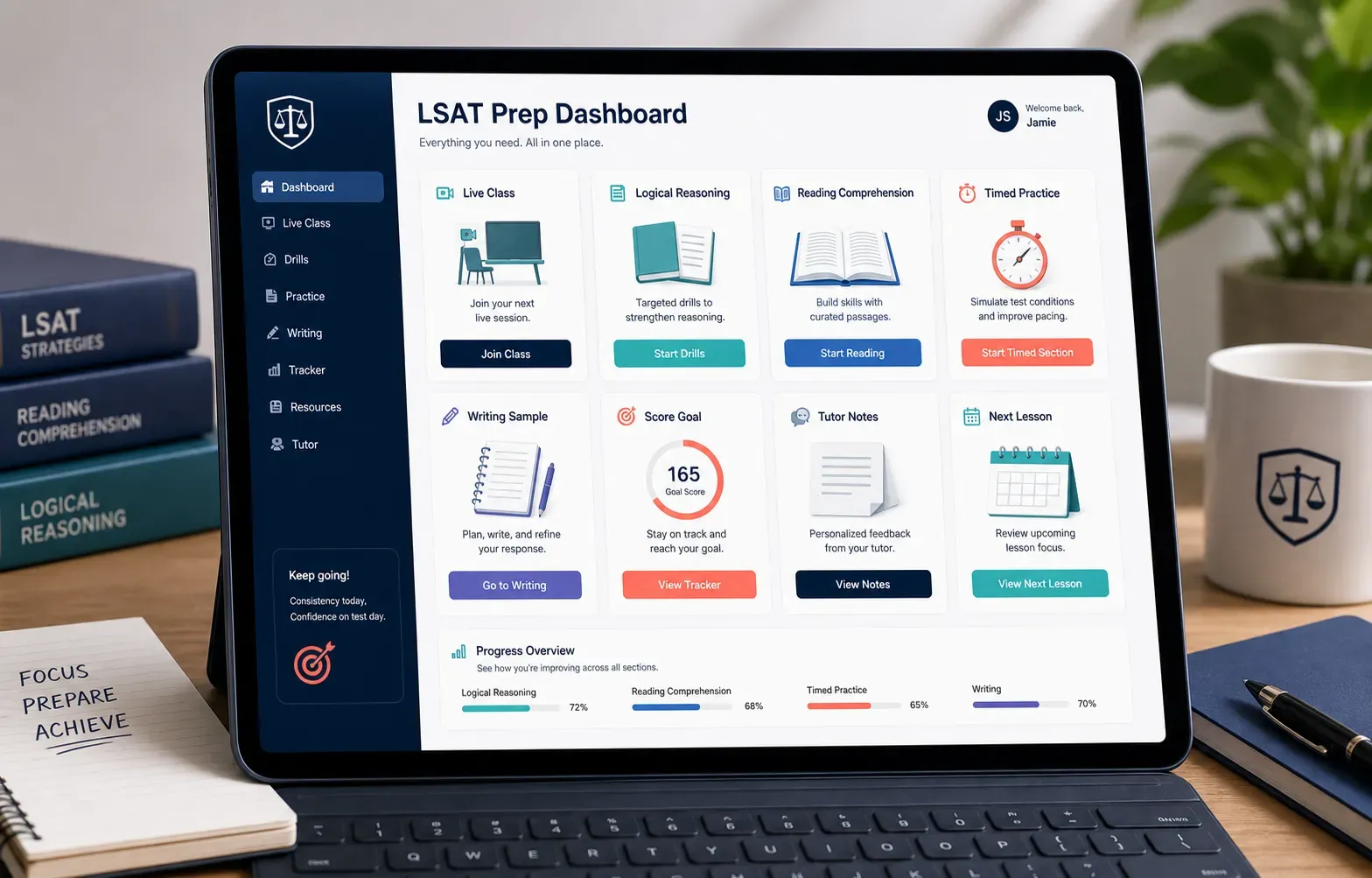
Students can keep their LSAT prep organized across live tutoring, Logical Reasoning drills, Reading Comprehension sets, timed sections, writing practice, and tutor feedback.
Keep LSAT session links, tutor notes, and the next Logical Reasoning or Reading Comprehension focus in one place.
Download the LSAT guide with section structure, timing, scoring, writing, and score-planning reminders.
Organize LR drills, RC passages, timed sections, full practice tests, and review sessions around one score plan.
Print guided prompts for argument analysis, passage mapping, writing outlines, score review, and demo prep.
Bring missed-question notes, law school deadlines, tutor feedback, and application reminders together.
Reasoning chain
Premise -> Assumption -> Conclusion
Predict the gap before evaluating answer choices.
Task
Flaw
Pace
35 min
Review
why missed
Step 1
Read
Step 2
Predict
Step 3
Prove
Tutor prompt
Explain before choosing
"What has to be true for that conclusion to follow?"
Review checklist
1-on-1 class interface
A good LSAT session makes invisible reasoning visible. The tutor listens to how the student reads the stimulus or passage, then rebuilds the answer choice process step by step.
The tutor maps the stimulus into premise, conclusion, assumption, flaw, and prediction before the student evaluates answer choices.
For Reading Comprehension, the class interface keeps passage structure, viewpoints, purpose, and evidence checks visible together.
Timed practice review connects each miss to the next drill so lessons do not become passive explanation sessions.

LSAT exam planning
LSAC publishes the LSAT test schedule one testing year at a time, and each administration carries its own registration, change, and score-release deadlines. Confirm the current cycle on LSAC before committing to a test month, because application timing usually depends on the score-release date rather than the test date itself.
LSAT, LSAC, and LawHub references identify the applicable exam. Noble Educators is an independent tutoring provider. Confirm dates, fees, score release, accommodations, and test-center rules directly with LSAC.
4 sections | 35 minutes each
Scored: two Logical Reasoning sections and one Reading Comprehension section.
Unscored: one variable section, either Logical Reasoning or Reading Comprehension.
50 minutes | unscored
15 min: prewriting analysis.
35 min: essay writing. A completed approved sample is required for score release.
120-180 scaled score
LSAC states the score is based on raw correct answers. There is no deduction for incorrect answers, and questions are weighted equally.
Dates are released annually
Test format and location rules also change between cycles. Confirm the current administrations, testing mode, and the exact rule for your location in LSAC JD Services.
| Planning item | What to expect each cycle |
|---|---|
| Administrations | LSAC publishes the LSAT test schedule one testing year at a time, typically with several multi-day administrations spread across the cycle. |
| Registration deadline | Each administration closes on its own registration deadline, usually several weeks before testing begins. |
| Changes and withdrawals | Date changes, test-format changes, and withdrawals run on separate deadlines after registration closes. |
| Score release | Scores are released on a published date for each administration, which is what usually drives retake and application timing. |
Study resources
Use the guide to review current LSAT sections, scoring, schedule planning, LR and RC strategy, and writing requirements. Then use the worksheet for printable argument maps, passage maps, timed-section review, and writing outlines.
Study guide: 5 detailed pages covering current LSAT format, scoring, LR, RC, writing, and 12-week prep.
Worksheet: 5 printable pages with argument maps, passage maps, timed review, writing outline, and answer guide.
Argument parts, flaw patterns, strengthen/weaken, necessary and sufficient assumptions, inference, parallel reasoning, and conditional logic.
Main point, author attitude, comparative passages, passage organization, evidence lines, and dense legal-style reading.
35-minute pacing, question triage, confidence marks, blind review, stamina, and section-by-section score tracking.
Issue analysis, competing perspectives, thesis, concessions, organization, and clear persuasive writing.
120-180 score scale, raw-score conversion, no penalty for wrong answers, retake timing, and law school application milestones.
Bring the student's diagnostic, target score, intended test month, application year, and biggest LSAT concern.
12-week plan
A strong plan includes diagnostic review, focused Logical Reasoning repair, Reading Comprehension structure, timed-section stamina, writing completion, score release awareness, and retake planning.
Ask for LSAT Plan
Pricing comparison
LSAT providers change plans, discounts, and packages frequently. This comparison sets out the format differences so applicants can confirm current pricing directly.
| Provider | Pricing model shown | Format | Best fit |
|---|---|---|---|
Noble EducatorsDemo-based plan | custom LSAT plan | 1-on-1 online LSAT tutoring | Students who want a tailored LSAT prep plan, live tutor feedback, and support around score goals and application timing. |
Blueprint | Course and tutor packages | LSAT courses, self-paced prep, and tutoring | Students comparing structured commercial LSAT programs. |
Kaplan | Course and tutoring plans | Test prep courses and private tutoring | Students who prefer a large test-prep brand with broad program options. |
Princeton Review | Course and tutoring plans | LSAT classes, self-paced prep, and tutoring | Students who want a packaged LSAT course experience. |
7Sage | Subscription and tutoring options | Digital LSAT curriculum and analytics | Independent learners who want a self-guided platform plus optional support. |
LSAC LawHub | Free and paid official prep | Official practice tests and prep materials | Students who need official practice material alongside tutoring. |
Common challenges
LSAT improvement comes from repeatable reasoning. A tutor helps the student turn each miss into a clear habit change.
Tutoring turns each miss into a reason code: conclusion error, stimulus misread, answer trap, assumption gap, conditional setup, or pacing decision.
Students learn to map structure, author purpose, viewpoints, and evidence so they stop rereading whole passages for every question.
Each section review becomes a study plan. Tutors separate content habits, reasoning habits, timing habits, and test-day endurance.
Review the student's current score range, law school goals, application timing, and strongest or weakest section patterns before choosing a study path.
For each missed question, identify whether the issue was reading, argument structure, inference, assumption, trap answer, timing, or confidence calibration.
Use a shared whiteboard to mark premises, conclusions, viewpoints, paragraph roles, and evidence lines so the student can explain the answer.
After each timed set, assign focused drills, reading routines, writing practice, or full-section work based on what actually moved the score.
Some students need LR accuracy. Others need RC timing, writing completion, a retake plan, or score review before application deadlines. Noble Educators can match the inquiry to a tutor who fits the student's current score and target.
Meet our teachersApplicants often need more than question drills: test-month selection, writing completion, score-release planning, a retake buffer, and law school application timing all shape the study plan.
See how it worksQuestions applicants ask
Related tutoring
Compare related test prep, tutor options, pricing, and the next steps behind a focused tutoring plan.
Share the applicant's target score, current diagnostic, intended test month, and biggest LSAT concern. Noble Educators will help you choose the most useful next step.