Chemical and Physical Foundations
- general chemistry, organic chemistry, physics, and biochemistry
- passage-based calculation setup
- units, graphs, equations, and experimental context
- 95-minute section pacing
Build a practical MCAT plan for pre-med coursework, AAMC-style passages, full-length review, CARS consistency, score goals, and medical-school application timing.
Total questions
230
Seated time
about 7h 30m
Score range
472-528

MCAT coverage
The MCAT rewards content knowledge, passage reasoning, experimental design, and endurance. Tutoring should connect all four instead of treating them as separate flashcard lists.
Start with a free demo. A tutor reviews your diagnostic or last full-length, your planned test date, and your section splits before recommending a plan.
Student dashboard
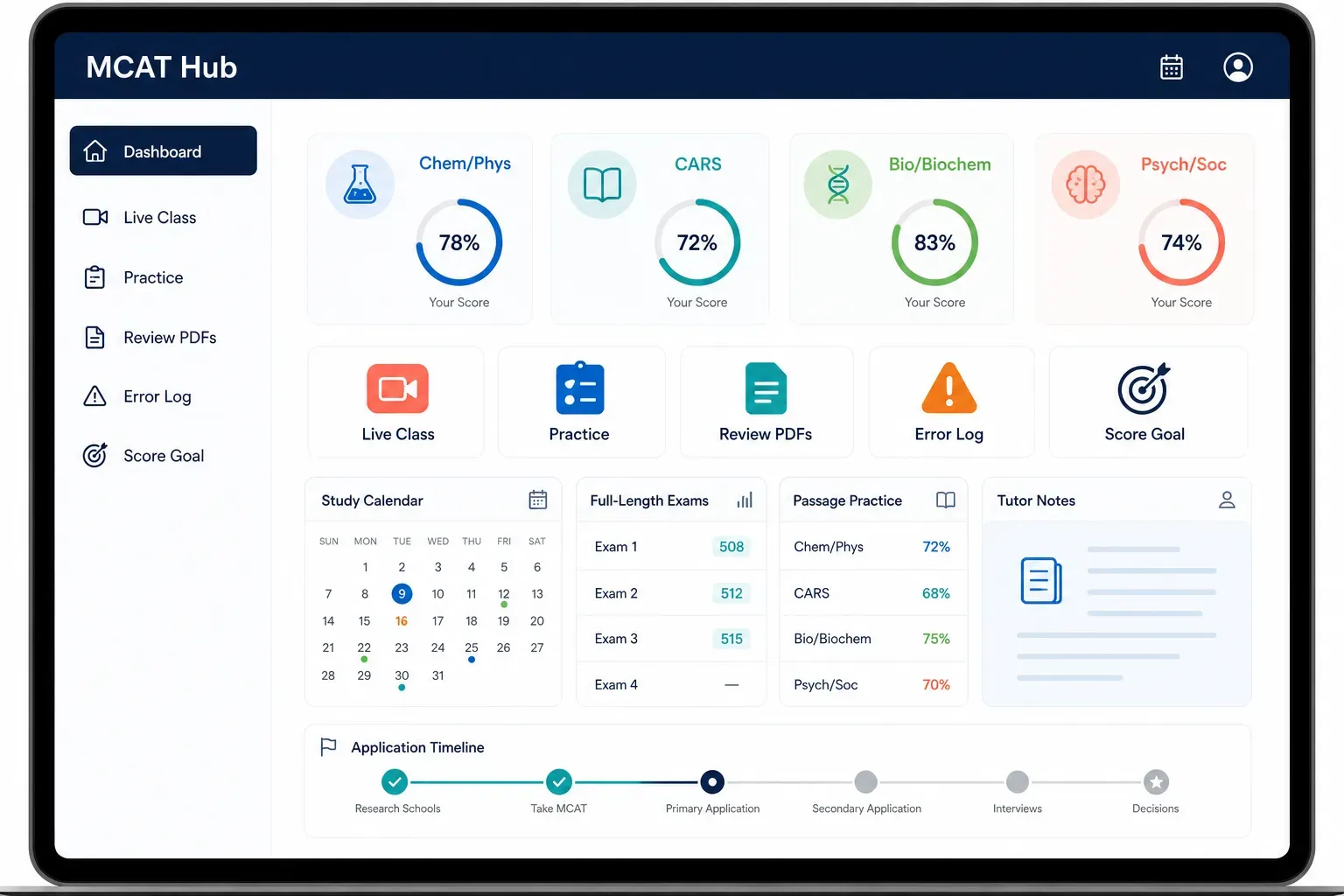
A pre-med student needs fast access to review materials, tutor notes, passage practice, full-length exam tracking, and application milestones. The dashboard concept keeps the whole plan visible.
Keep the join link, current MCAT section focus, tutor notes, and next passage set easy to find before each session.
Use polished resources for section timing, formulas, high-yield science, CARS routines, and full-length review.
Track Chem/Phys, CARS, Bio/Biochem, Psych/Soc, and total score readiness against the target medical-school goal.
Print structured MCAT diagnostics, passage review prompts, study-plan blocks, and answer-check routines.
Plan MCAT prep around AMCAS, score release timing, school lists, recommendation letters, and secondary prep.
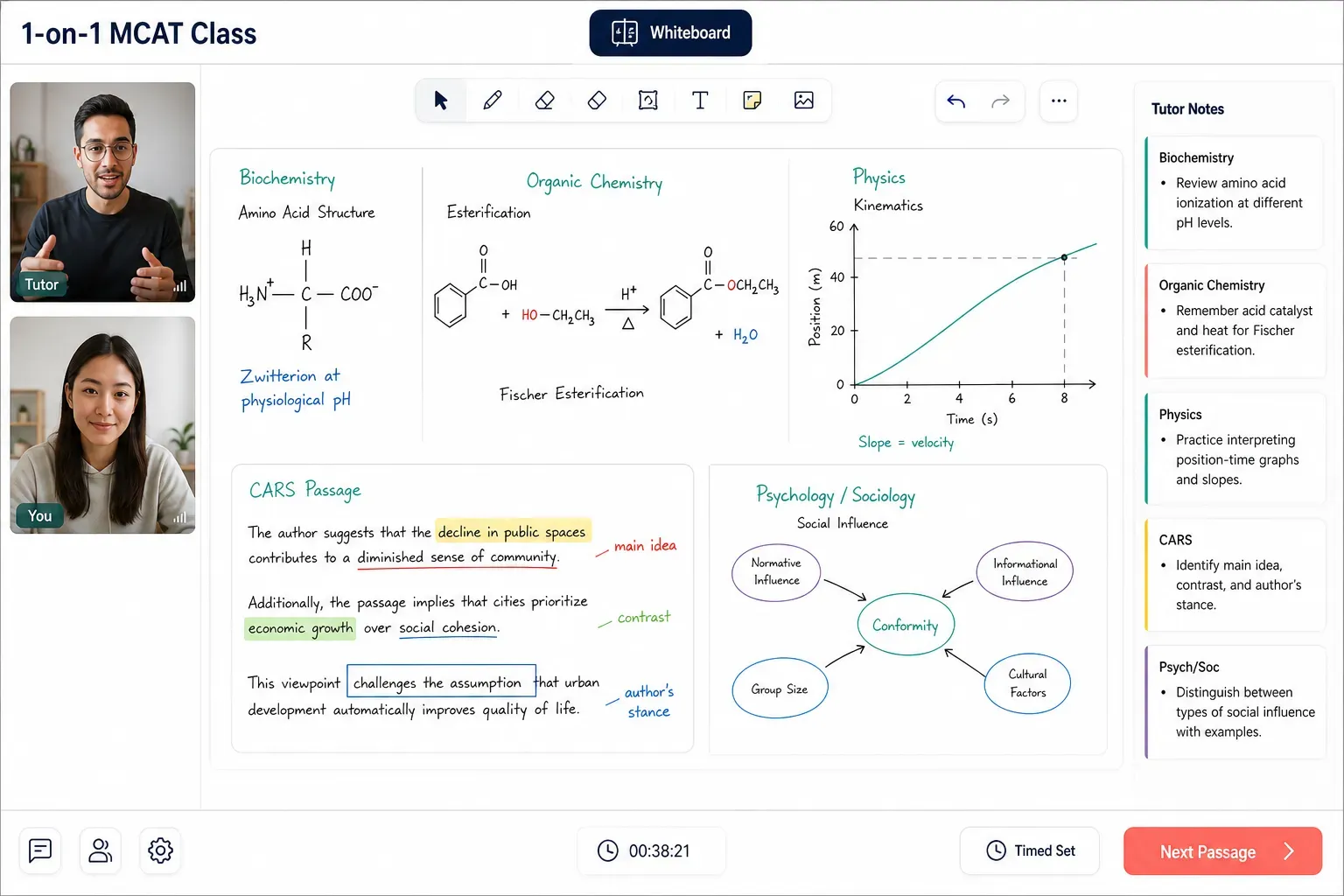
1-on-1 class interface
The tutor can see whether the student is using the passage, misreading a graph, missing a scientific relationship, or choosing from memory too quickly. That makes each MCAT session more useful than answer checking alone.
Science passage
experiment + concept
Read variables, graph, and mechanism before solving.
CARS
main idea + proof
Return to the passage before choosing.
Today
Bio/Biochem
Next
CARS set
Goal
full-length review
Step 1
Read
Step 2
Predict
Step 3
Answer
Step 4
Review
Tutor prompt
Explain the evidence
"Which passage clue tells us this is the right biological or chemical relationship?"
Review checklist
The free demo is a real session, not a sales call. Bring a passage you missed and work through it with a tutor.
AAMC MCAT
Official-format reference
MCAT exam parameters
AAMC lists the MCAT as a standardized, computer-based exam with four multiple-choice sections. Registration for the 2026 testing year is open for January through September dates, and students should confirm current deadlines, score release dates, fees, and accommodations directly with AAMC.
MCAT and AAMC marks are referenced only to identify the applicable test. Noble Educators is an independent tutoring provider.
AAMC describes the MCAT as a standardized, computer-based exam divided into four multiple-choice sections: Chem/Phys, CARS, Bio/Biochem, and Psych/Soc.
The science sections each include 59 questions in 95 minutes, and CARS includes 53 passage-based questions in 90 minutes.
AAMC lists 6 hours and 15 minutes of content time and about 7 hours and 30 minutes of total seated time, not including check-in.
Each section is scored from 118 to 132, and the four section scores combine for a total score range of 472 to 528. AAMC states there is no wrong-answer penalty.
Common challenges
MCAT improvement depends on knowing whether the issue is content recall, passage reasoning, experimental design, calculation setup, timing, or endurance.
MCAT questions often reward applying a concept inside an experiment, graph, or unfamiliar passage. Tutoring builds the bridge between content review and passage decisions.
CARS improvement usually comes from consistent passage work, evidence-based review, and reducing overthinking. It should not be left only for the final month.
A full-length score is useful only when every miss is sorted by cause: knowledge gap, graph reading, passage clue, math setup, timing, or fatigue.
Send your planned test month, diagnostic or last full-length score, and weekly study time. We will reply with tutor availability, a suggested schedule, and MCAT pricing.
How tutoring works
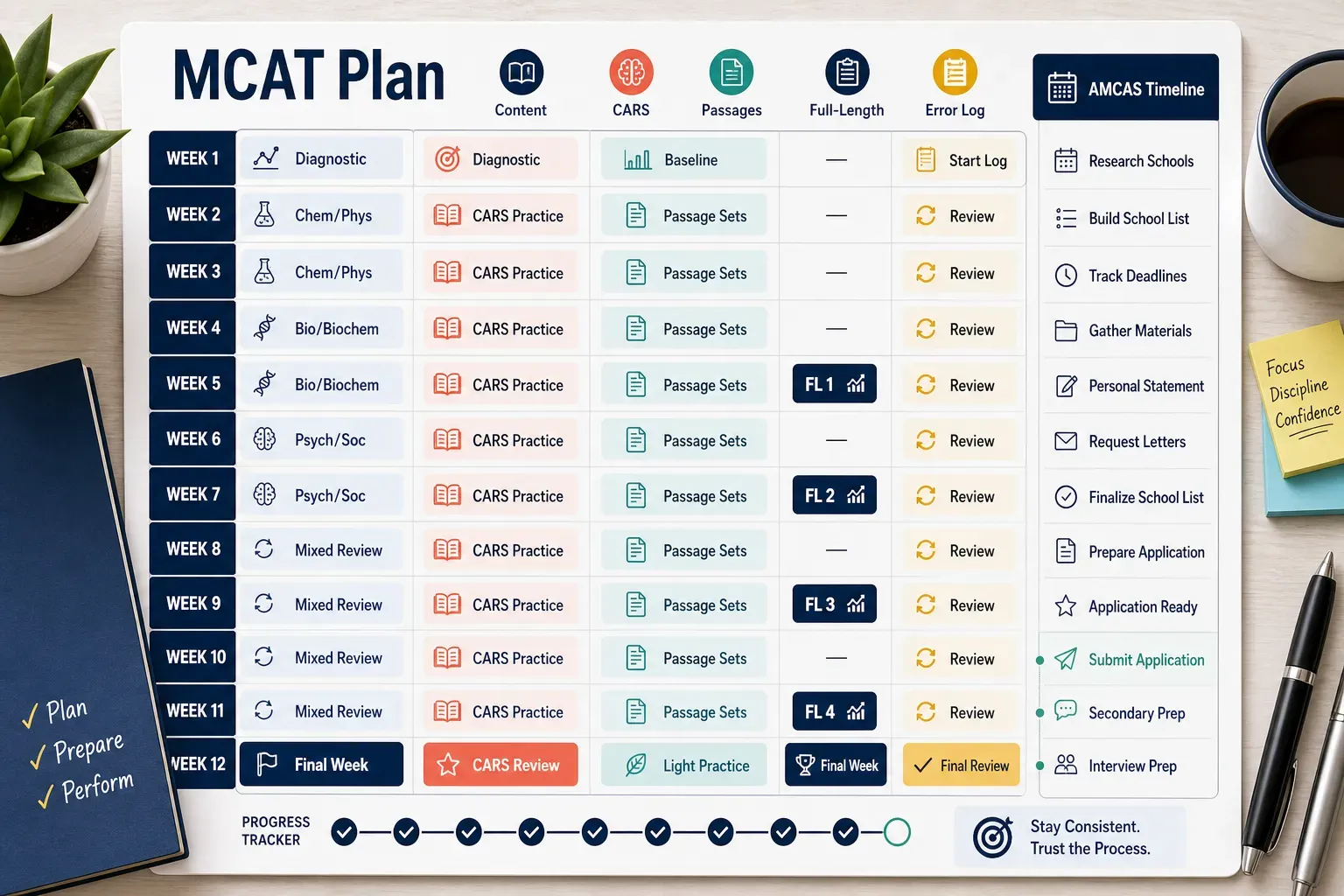
The best MCAT plan starts with a test date and diagnostic, then uses full-length review and passage sets to decide what to study next.
Review the planned test month, application cycle, coursework, current diagnostic score, available weekly time, and whether the student needs a retake buffer.
Separate Chem/Phys, CARS, Bio/Biochem, and Psych/Soc gaps into content, passage reasoning, data analysis, timing, or endurance issues.
Use guided MCAT-style passages so the student practices reading the stem, finding relevant evidence, applying science, and choosing an answer under timed pressure.
Review score trends, missed-question patterns, timing notes, and fatigue points so the next two weeks of prep are targeted instead of generic.
Study resources
Use the guide to understand MCAT format, section strategy, full-length review, CARS routines, score planning, and application timing. Use the worksheet for diagnostics, passage review, and study planning.
Study guide: 5 detailed pages for MCAT format, section strategy, full-length review, score planning, and application timing.
Worksheet: 5 printable pages with diagnostics, passage review prompts, CARS practice, score tracker, and answer guidance.
Section order, timing, questions, breaks, scoring scale, seated time, and test-day planning.
Equations, units, graphs, experimental setup, acid-base, electrochemistry, fluids, forces, and passage math.
Main idea, author's tone, passage structure, inference, wrong-answer patterns, and evidence-based review.
Amino acids, enzymes, metabolism, genetics, physiology, experimental design, and data interpretation.
Learning, memory, identity, social structure, research methods, and applying terms to passage evidence.
How to convert AAMC-style full-length results into targeted next steps and weekly assignments.
Pricing comparison
Provider pricing and packages change, so students should confirm current terms directly. This comparison shows how Noble Educators' live 1-on-1 MCAT plan differs from marketplaces, prep programs, and official practice tools.
| Provider | Pricing model shown | Format | Best fit |
|---|---|---|---|
Noble Educators1-on-1 plan | custom MCAT plan | 1-on-1 online MCAT tutoring | Pre-med students who want a targeted MCAT plan for science sections, CARS, full-length review, and application timing. |
Wyzant | Tutor-set rates | Tutor marketplace | Students who prefer browsing individual tutors and comparing posted hourly rates. |
Varsity Tutors | Plan-based pricing | Live tutoring and memberships | Students considering broader tutoring packages across STEM coursework and test prep. |
Kaplan | Course and tutoring packages | MCAT courses, bootcamps, and tutoring | Students comparing large standardized MCAT prep programs. |
Princeton Review | Course and tutoring packages | MCAT classes, programs, and tutoring | Students who want a packaged prep-program path with published course options. |
AAMC Official Prep | Free and paid official practice | Official MCAT practice exams and resources | Benchmarking and official practice alongside live tutoring and review. |
A student struggling with CARS needs a different routine than a student missing Chem/Phys calculations or Bio/Biochem pathways. Demo details help match the student to the right MCAT focus.
Meet our teachersMCAT prep works better when AMCAS timing, score release, school lists, recommendation letters, coursework, and possible retake timing are part of the plan from the start.
Ask for MCAT PricingQuestions students ask
Related tutoring
Start from the US online tutoring hub for the full subject list, or open a related page when an MCAT gap traces back to AP Biology and AP Chemistry foundations, or overlaps with GRE and LSAT reasoning work.
Share your target score, test date, current level, and biggest section concern. Noble Educators will help you choose the most useful next step.