Read the full task
Start with the context, required output, data, graph, and all prompt parts before deciding which calculation is needed.
Help your child turn AP Precalculus concepts into complete, defensible responses. A dedicated tutor can connect advanced function behavior, trigonometry, data, and modeling with the evidence and explanations the student needs in class and on assessments.

Today's focus
Amplitude, period, and midline
Model the relationship and explain it.
Start with the context, required output, data, graph, and all prompt parts before deciding which calculation is needed.
Use a graph, table, function rule, labeled feature, or contextual statement when it gives the clearest evidence.
Practice naming the mathematical feature and showing the evidence that makes an answer defensible.
Turn a correct calculation into a complete response by stating what it means in the actual situation.
What we support
Strong AP Precalculus work requires more than a correct answer. Tutoring helps students choose a model, label the important mathematics, support a conclusion, and explain the result in the context of the problem.
How tutoring works
AP support is most useful when the student sees how a model, a graph, a calculation, and a sentence work together. The tutoring process keeps that chain visible and repeatable from one unit to the next.
Review the prompt, recent assignment, classroom unit, or assessment results to see whether the issue is content, representation, interpretation, or response structure.
Identify the graph feature, function property, calculation, data point, or contextual statement that will make the student's response complete.
Use a worked example and guided practice that includes setup, reasoning, notation, and a written interpretation rather than only a final value.
Check whether each part answers the actual question, gives mathematical evidence, and states the meaning of the result in context.
Ferris wheel model
h(t) = 30 sin((pi/20)t - pi/2) + 32
Height h in feet, time t in seconds
Amplitude
30 ft
Period
40 sec
Midline
32 ft
Step 1
Define
Step 2
Justify
Step 3
Interpret
Tutor prompt
Explain the parameter
"What does the amplitude tell us about the rider's motion?"
Response checklist
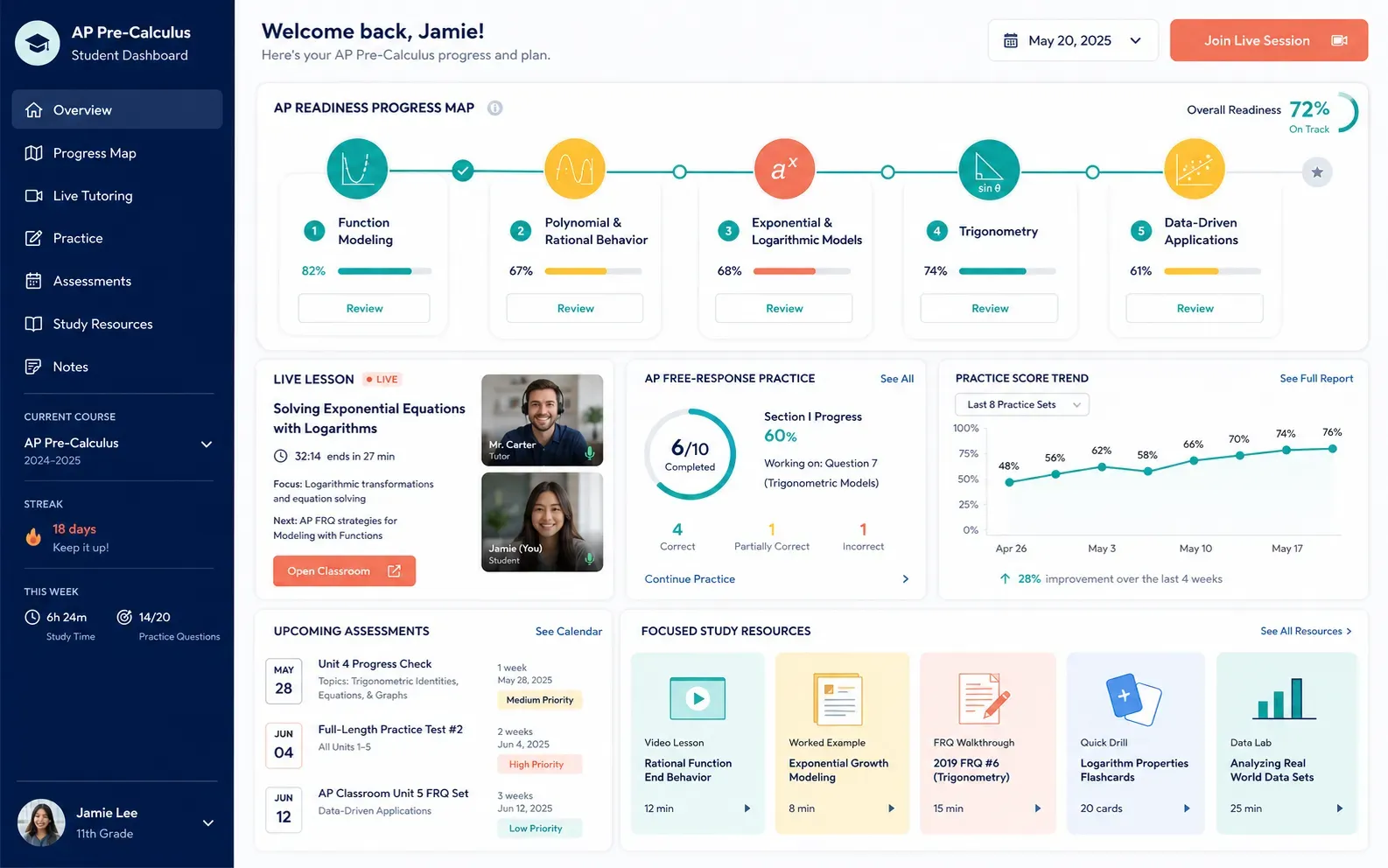
AP Precalculus Tutoring
AP readiness workspace
Student learning hub
A useful learning hub makes the next practice target clear. Students can keep tutoring sessions, AP-style prompts, progress checks, study resources, and upcoming assessments connected to the same learning plan.
Keep the join link, lesson focus, and upcoming AP Precalculus session details easy to find before tutoring starts.
Keep function, modeling, trigonometry, and AP-style response reminders close during review.
Organize classroom work, practice prompts, and next-step review around the exact response skill the student needs.
Print structured AP Precalculus practice with space to show reasoning and check a complete answer key.
Bring lesson notes, modeling references, response checks, and review materials together in one workspace.
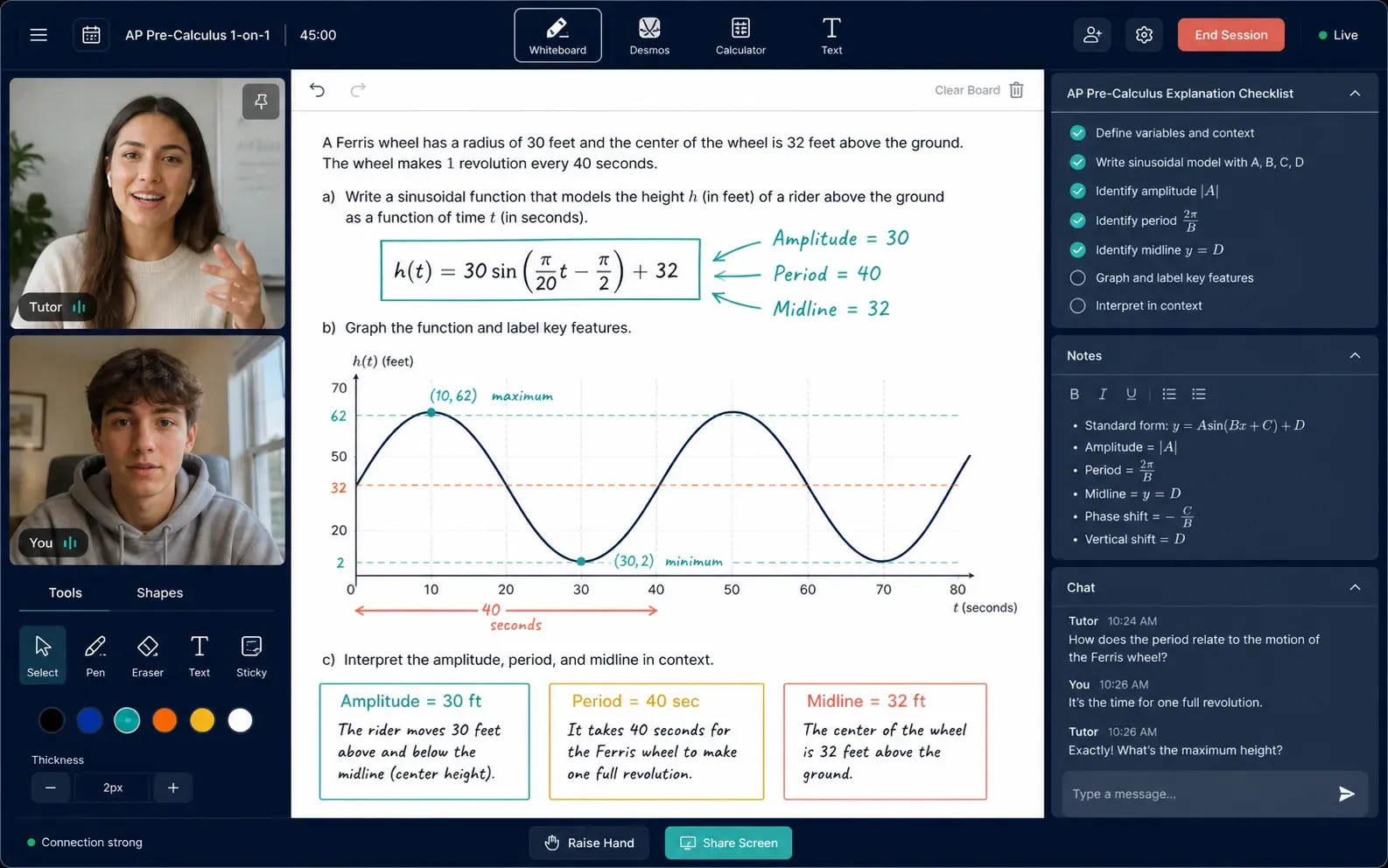
1-on-1 class interface
A strong online class gives the student a visual workspace for the model, calculation, graph, evidence, and final interpretation. The tutor can guide the response without hiding the reasoning that matters.
A shared whiteboard keeps the function model, labeled graph, calculations, and contextual interpretation visible together while the tutor guides each step.
Video-based 1-on-1 support lets the tutor hear how a student chose a model or explained a feature before refining the written response.
A focused checklist, notes, and examples help students practice the complete chain from prompt to evidence to interpretation.
Study resources
Use the structured study guide to review high-impact AP Precalculus areas and response prompts, then use the printable worksheet for focused practice with room to show reasoning and a complete answer key.
Study guide: 5 detailed pages for advanced functions, modeling, and AP-style reasoning.
Worksheet: 5 printable pages with guided practice, response space, and answers.
Define variables, choose a model, label features, and write the interpretation that answers the context.
Zeros, asymptotes, end behavior, and graph evidence for a complete response.
Growth, decay, parameter meaning, inverse relationships, and contextual statements.
Sinusoidal relationships, amplitude, period, shifts, key points, and model interpretation.
Read a pattern, compare model options, and describe what data can and cannot support.
Prompts for planning a clear setup, using evidence, checking notation, and answering every part.
Pricing comparison
Provider pricing and packages change, so families should confirm current terms directly. This comparison shows how the Noble Educators session model differs from other familiar online learning options.
| Provider | Pricing model shown | Format | Best fit |
|---|---|---|---|
Noble EducatorsNoble rate | $22 / session | 1-on-1 online AP Precalculus tutoring | Families who want school-aligned AP Precalculus support, modeling practice, and a clear per-session rate. |
Wyzant | Tutor-set rates | Tutor marketplace | Families who prefer to browse individual tutor profiles and available rates. |
Varsity Tutors | Plan-based pricing | Live tutoring and memberships | Families considering a larger tutoring package or membership model. |
Tutor.com | Subscription plans | On-demand tutoring | Students who need quick homework help across several subjects. |
Outschool | Class-specific pricing | Live and self-paced classes | Families looking for group classes as well as individual learning options. |
Khan Academy | Free self-guided practice | Videos and practice activities | Independent review, rather than recurring live 1-on-1 tutoring. |
Common challenges
AP Precalculus asks students to select and explain sophisticated function models, not only carry out procedures. Focused tutoring makes the reasoning behind each response more visible.
AP-style work rewards a clear setup and interpretation. Tutors help students name the feature, support it with math, and explain what it means in the stated context.
Lessons connect polynomial, rational, exponential, logarithmic, and trigonometric behavior through the questions each model is designed to answer.
Students practice reading the prompt, defining variables, selecting a model, labeling key features, and checking that every answer part is addressed.
Some students need a patient return to functions and Algebra 2 foundations. Others need help responding to a difficult modeling prompt, preparing for an assessment, or strengthening AP-style explanations. Noble Educators can match the inquiry to a tutor who fits the student's level, curriculum, and goal.
Meet our teachersParents can share a current unit, prompt, graphing task, recent score, or teacher note before tutoring begins. That gives the tutor a practical starting point and helps each session focus on the response skill that matters next in class.
See how it worksQuestions parents ask
Related tutoring
Compare related math support, tutor options, pricing, and the next steps behind a focused tutoring plan.
Share the student's grade, current AP Precalculus focus, and what feels difficult. Noble Educators will help you choose the most useful next step.