Read the calculus task
Start with the given representation, quantity, units, and all prompt parts before deciding whether a limit, derivative, or integral is useful.
Help your child turn AP Calculus AB concepts into complete, defensible responses. A dedicated tutor can connect limits, derivative applications, integrals, and differential equations with the evidence and explanations needed in class and while preparing for the upcoming May 2027 AP exam cycle.

Today's focus
Rate, accumulation, and interpretation
Choose the calculus relationship and explain it.
Start with the given representation, quantity, units, and all prompt parts before deciding whether a limit, derivative, or integral is useful.
Use the equation, graph, table, or context to identify what is changing and whether the problem asks about rate, accumulation, or behavior.
Practice showing the expression, derivative, integral, table value, or graph feature that makes an answer defensible.
Turn a correct calculation into a complete response by stating what the result means in the actual situation.
What we support
Strong AP Calculus AB work requires more than a correct answer. Tutoring helps students identify the quantity that is changing, choose the right derivative or integral relationship, support a conclusion, and explain the result in the context of the problem.
How tutoring works
AP support is most useful when the student sees how a graph, table, equation, calculation, and sentence work together. The tutoring process keeps that chain visible and repeatable from one unit to the next.
Review the prompt, classroom unit, or assessment result to decide whether the real gap is limits, derivative meaning, derivative application, accumulation, differential equations, or response structure.
Mark what is changing, what is being measured, and whether the prompt gives a graph, table, equation, or context. That determines the useful calculus tool.
Use a worked example and guided practice that includes notation, mathematical evidence, units, and a written interpretation rather than only a final value.
Confirm every response part has been answered, the work matches the given representation, and the conclusion explains what the calculation means in context.
Accumulation function
A(t) = integral from 0 to t of r(x) dx
A(t) is the total amount accumulated by time t.
Given
rate r(t)
Find
net change
State
units
Step 1
Translate
Step 2
Calculate
Step 3
Interpret
Tutor prompt
Connect rate and accumulation
"What does A(10) represent in the context of the rate table?"
Response checklist
AP Calculus AB Tutoring
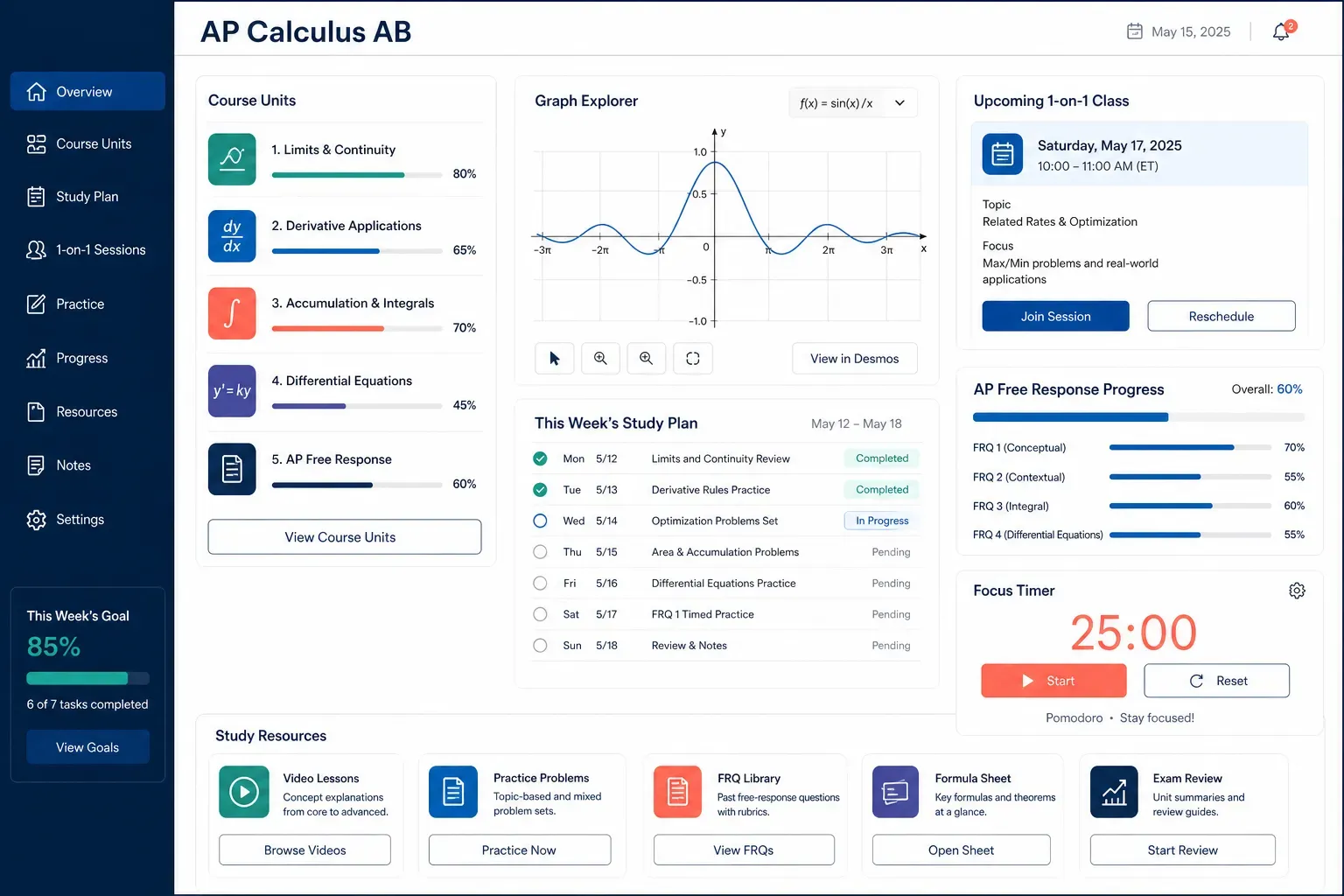
AP readiness workspace
Student learning hub
A useful learning hub makes the next practice target clear. Students can keep tutoring sessions, AP-style prompts, progress checks, study resources, and upcoming assessments connected to the same learning plan.
Keep the join link, lesson focus, and upcoming AP Calculus AB session details easy to find before tutoring starts.
Keep limits, derivatives, integrals, differential equations, and AP-style response reminders close during review.
Organize classroom work, calculator and non-calculator practice, and next-step review around the response skill the student needs.
Print structured AP Calculus AB practice with space to show reasoning, units, and a complete answer key.
Bring lesson notes, modeling references, response checks, and review materials together in one workspace.
1-on-1 class interface
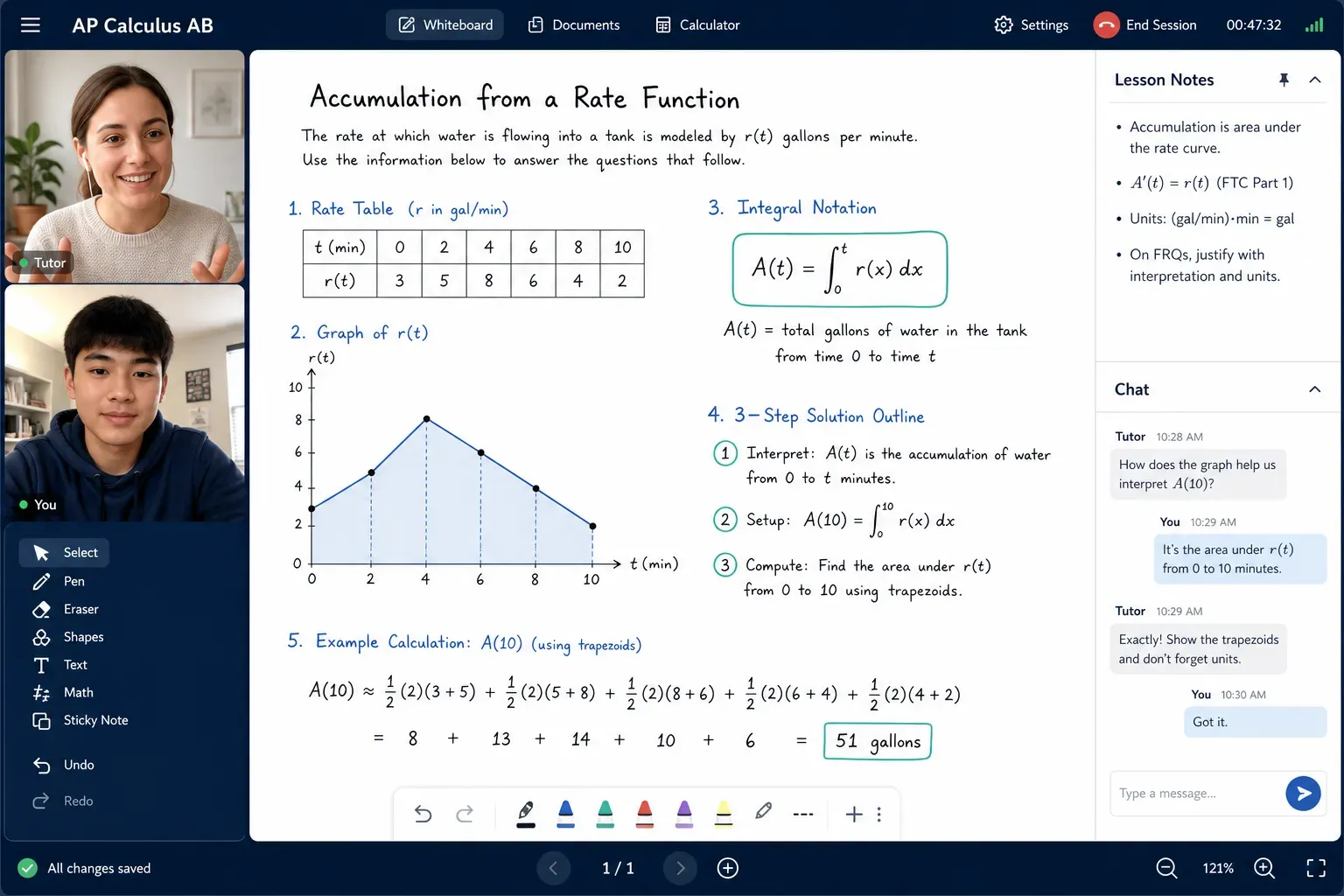
A strong online class gives the student a visual workspace for the quantity, calculation, graph or table, evidence, and final interpretation. The tutor can guide the response without hiding the calculus reasoning that matters.
A shared whiteboard keeps the graph or table, derivative or integral setup, calculation, units, and interpretation visible together while the tutor guides each step.
Video-based 1-on-1 support lets the tutor hear how a student chose a calculus tool before refining the written reasoning and notation.
A focused checklist, notes, and examples help students practice the complete chain from prompt to quantity to evidence to interpretation.

AP Calculus AB exam planning
For families preparing for the upcoming AP testing cycle, College Board's published 2027 schedule places AP Calculus AB in Session 1 on Monday, May 10, 2027. The AP coordinator confirms the exact local time and location. The exam is a hybrid digital assessment: students complete multiple-choice questions and view free-response questions in Bluebook, then handwrite free-response answers in paper booklets.
AP and College Board marks are shown only to identify the applicable course and exam. Noble Educators is an independent tutoring provider. Confirm dates, policies, and accommodations directly with College Board.
42 questions | 1 hour 40 minutes
Part A: 29 questions, graphing calculator not permitted, 35% of the score.
Part B: 13 questions, graphing calculator required for some questions, 15% of the score.
6 questions | 1 hour 30 minutes
Part A: 2 problems, graphing calculator required, 16.7% of the score.
Part B: 4 problems, graphing calculator not permitted, 33.3% of the score.
Monday, May 10, 2027 | Session 1
College Board notes that Session 1 is typically the morning session; the AP coordinator confirms exact local timing and location. The exam is 3 hours 10 minutes total.
Tutoring uses the official section weights to plan practice. For free response, students learn to show the requested calculus relationship, work, units, and contextual interpretation so their reasoning is visible to the reader.
Study resources
Use the structured study guide to review limits, derivatives, integrals, differential equations, and response prompts, then use the printable worksheet for focused practice with room to show reasoning, units, and a complete answer key.
Study guide: 5 detailed pages for limits, derivatives, integrals, exam format, and response strategy.
Worksheet: 5 printable pages with guided practice, response space, and answers.
One-sided limits, continuity checks, asymptotes, and language that explains the behavior shown.
Derivative rules, implicit and inverse differentiation, tangent-line meaning, and notation checks.
Motion, related rates, optimization, graph analysis, and local linearity with the reason each method fits.
Riemann sums, net change, the Fundamental Theorem, area, average value, and units.
Slope fields, separation, initial conditions, and growth or decay models.
Prompts for planning, calculator decisions, evidence, units, and a complete response under time pressure.
Pricing comparison
Provider pricing and packages change, so families should confirm current terms directly. This comparison shows how the Noble Educators session model differs from other familiar online learning options.
| Provider | Pricing model shown | Format | Best fit |
|---|---|---|---|
Noble EducatorsNoble rate | $25 / session | 1-on-1 online AP Calculus AB tutoring | Families who want school-aligned AP Calculus AB support, free-response practice, and a clear per-session rate. |
Wyzant | Tutor-set rates | Tutor marketplace | Families who prefer to browse individual tutor profiles and available rates. |
Varsity Tutors | Plan-based pricing | Live tutoring and memberships | Families considering a larger tutoring package or membership model. |
Tutor.com | Subscription plans | On-demand tutoring | Students who need quick homework help across several subjects. |
Outschool | Class-specific pricing | Live and self-paced classes | Families looking for group classes as well as individual learning options. |
Khan Academy | Free self-guided practice | Videos and practice activities | Independent review, rather than recurring live 1-on-1 tutoring. |
Common challenges
AP Calculus AB asks students to connect representations and explain calculus reasoning, not only carry out a procedure. Focused tutoring makes the relationship behind each response more visible.
AP-style work awards credit for the setup, mathematical evidence, units, and interpretation. Tutors help students write each piece where a reader can find it.
Lessons connect limits, rates of change, accumulation, and the Fundamental Theorem so students know what every formula measures before applying it.
Students practice identifying the representation, quantity, and command verb first, then build a response that is both efficient and complete.
Some students need a patient return to functions, trigonometry, and derivative basics. Others need help responding to a difficult accumulation prompt, preparing for an assessment, or strengthening AP-style explanations. Noble Educators can match the inquiry to a tutor who fits the student's level, curriculum, and goal.
Meet our teachersParents can share a current unit, free-response prompt, graph or table task, recent score, or teacher note before tutoring begins. That gives the tutor a practical starting point and helps each session focus on the calculus skill that matters next in class.
See how it worksQuestions parents ask
Related tutoring
Compare related math support, tutor options, pricing, and the next steps behind a focused tutoring plan.
Share the student's grade, current AP Calculus AB focus, and what feels difficult. Noble Educators will help you choose the most useful next step.